

Bambu Lab’s Highly Anticipated 2025 3D Printer Series: A New Era for Prosumer FDM Technology
Since its groundbreaking Kickstarter launch in 2022, Bambu Lab has rapidly ascended to a dominant position in the 3D printing market. The company has redefined expectations for desktop FDM printers, delivering an unparalleled combination of ease-of-use, reliability, and high-quality output that has resonated deeply with consumers and enthusiasts alike. Their innovative approach, which integrated advanced features typically found in industrial machines into an accessible desktop format, quickly earned them widespread popularity and numerous industry accolades. This remarkable success story, however, has not been without its complexities.
Bambu Lab, despite its triumphs, has recently navigated several significant challenges. In February, the company proactively recalled their popular A1 printer due to safety concerns regarding its AC power cable, demonstrating a commitment to user safety even at significant logistical and financial cost. More recently, the company found itself in the spotlight once again when it was announced they were being sued for patent infringement by Stratasys, a long-standing titan in the additive manufacturing industry. These hurdles, though substantial, have not deterred Bambu Lab’s relentless pursuit of innovation. In a move that underscores their resilience and forward-looking strategy, Bambu Lab has just unveiled plans for their highly anticipated new printer series, slated for an early 2025 release. This announcement has ignited considerable excitement across the 3D printing community, promising to push the boundaries of desktop FDM technology even further.
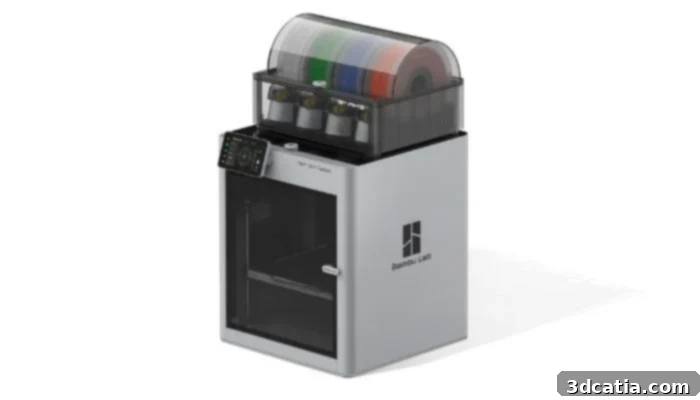
Bambu Lab’s X1 series printer, a benchmark for high-performance desktop FDM (photo credits: Bambu Lab)
Bambu Lab’s Meteoric Rise: Redefining Desktop 3D Printing
The journey of Bambu Lab since its 2022 debut has been nothing short of extraordinary. They didn’t just enter the 3D printing market; they fundamentally reshaped it. Traditional desktop FDM printers often demanded significant user expertise, intricate calibration, and extensive troubleshooting, creating a barrier to entry for many. Bambu Lab shattered these perceptions with printers like the X1 and P1 series, which were designed with an emphasis on out-of-the-box functionality and remarkable speed. Features such as automatic bed leveling, flow calibration, and active vibration compensation, combined with their innovative Automatic Material System (AMS) enabling multi-color and multi-material printing, set a new standard.
Their printers quickly became synonymous with reliability and high-fidelity output, catering to both hobbyists seeking effortless operation and professionals needing consistent results. The inclusion of AI-powered features, such as Lidar resolution for micron-level accuracy and spaghetti detection for print failure prevention, highlighted their commitment to smart, user-friendly technology. This blend of cutting-edge technology, robust build quality, and an accessible user experience created a fervent community of users and positioned Bambu Lab as a formidable innovator in the global 3D printing landscape.
Navigating Recent Challenges: Safety Recalls and Patent Disputes
While Bambu Lab’s rapid growth has been impressive, it has also brought increased scrutiny and new challenges. The proactive recall of their popular A1 3D printer in February 2024 exemplifies the complexities of scaling a global hardware company. The issue centered around a potential safety concern with the AC cable, which could be damaged if bent sharply at the heatbed connection point. Bambu Lab’s response was swift and decisive: they offered free replacements, significant discounts on newer models, and clear instructions for customers, prioritizing user safety above all else. This incident, while a logistical challenge, also showcased the company’s commitment to its customer base and its willingness to take responsibility.
Adding to these operational challenges, Bambu Lab is now facing a patent infringement lawsuit initiated by Stratasys. Stratasys, a pioneer and leader in the additive manufacturing space with a vast portfolio of patents, has accused Bambu Lab of infringing on its intellectual property. Such legal battles are not uncommon in rapidly evolving technological fields, especially when new players disrupt established markets. While the details of the lawsuit are still unfolding, it underscores the competitive nature of the 3D printing industry and the lengths to which companies will go to protect their innovations. Despite this legal entanglement, Bambu Lab’s continued focus on developing new products, like the recently announced printer series, signals their unwavering dedication to innovation and growth.
The Dawn of a New Era: Bambu Lab’s 2025 Printer Series
The anticipation for Bambu Lab’s next-generation printer series has been building steadily, with earlier rumors suggesting a September 2024 release. However, in a strategic move reflecting their commitment to uncompromising quality, Bambu Lab confirmed a revised launch window for early 2025. This delay is a conscious decision to ensure the product meets the highest standards of performance, reliability, and user satisfaction before it reaches the market. The company’s philosophy, as highlighted in their press statement, is clear: they are “not cutting any corners.” This commitment extends beyond hardware to include a robust ecosystem of support, spare parts, and global logistics.
This new series is poised to be a significant leap forward, reportedly surpassing even the capabilities of their acclaimed X1 printer line. The X1 series, already known for its sophisticated features like 16 multi-color options, advanced AI-powered functionalities, and high-quality printing with an impressive 7 μm Lidar Resolution, has set a high bar. With the upcoming series, Bambu Lab aims to deliver truly top-tier performance, specifically targeting the evolving needs of 3D printing prosumers – a demographic that demands professional-grade results without sacrificing user experience. The product will integrate several innovative features meticulously designed to meet the rigorous requirements for high quality, speed, and versatility expected by this discerning audience.
Unpacking Potential Innovations and Features of the New Series
While explicit details about the new printer series remain under wraps, Bambu Lab has dropped intriguing hints that allow for informed speculation. One key piece of information is that the new models will be “larger” than their previous offerings. This revelation came during an “Ask Me Anything” session on Reddit, where Bambu Lab responded to a question about the new series being bigger than their X1C printer with a simple yet promising, “We’re working on it.” This implies not just an increase in physical dimensions but, more importantly, a substantial expansion in build volume, opening doors to printing larger single objects or batch production of multiple smaller parts, which is crucial for professional applications.
A Glimpse at Enhanced Scale and Build Volume
A larger printer series goes beyond mere size; it directly impacts the scope of projects that can be undertaken. For prosumers and small businesses, an increased build volume could mean the ability to print functional prototypes or end-use parts without segmentation, enhancing structural integrity and reducing post-processing. It could also facilitate the integration of more sophisticated multi-material systems or larger heated chambers, further expanding the range of compatible materials and application possibilities. This strategic decision to scale up suggests Bambu Lab is catering to advanced users who require more substantial output capabilities for industrial design, engineering, or custom manufacturing.
Drawing Inspiration from the X1E: Professional-Grade Features
It is highly probable that some of the advanced features from Bambu Lab’s X1E printer, which is specifically engineered for professional and engineering applications, will find their way into the new series. The X1E introduced a suite of capabilities that address the demands of more rigorous environments, and their inclusion in the upcoming prosumer series would significantly elevate its utility:
- Ethernet Connectivity and Off-Cloud Operation: For businesses and educational institutions, network security and data privacy are paramount. Ethernet connectivity offers a stable and secure connection, while the option for off-cloud operation ensures that sensitive design files remain within the organization’s network, alleviating concerns about data transmission over public internet. This feature is critical for professional environments with strict IT policies.
- Heated Chamber: A temperature-controlled heated chamber is indispensable for printing engineering-grade filaments such as ABS, ASA, Nylon, and Polycarbonate. It significantly reduces warping, improves layer adhesion, and enhances the mechanical properties of prints, allowing for the creation of more robust and functional parts. This capability pushes the new series beyond basic PLA/PETG printing into serious prototyping and end-use part production.
- Vibration Compensation: Advanced vibration compensation systems are vital for maintaining print quality at high speeds. By actively mitigating resonances caused by rapid movements, these systems ensure smoother surfaces and greater dimensional accuracy, enabling users to leverage the printer’s full speed potential without compromising on the fidelity of their models.
- Enhanced Filtration Systems: Considering the use of more specialized filaments, an improved air filtration system (like HEPA and activated carbon filters) would be a crucial addition, ensuring a safer working environment by capturing ultrafine particles and volatile organic compounds (VOCs).
- Advanced Material Handling: The ability to reliably print with abrasive or flexible filaments often requires specialized hotends, extruders, and filament paths. The new series could feature more robust components to handle a wider range of technical materials.
- Integrated Fleet Management and Monitoring: For users operating multiple machines, features that allow for centralized control, remote monitoring, and print job management would be invaluable, streamlining workflows and increasing productivity.
Bambu Lab’s Holistic Vision: Beyond the Hardware
Beyond the tangible features, what truly defines Bambu Lab’s approach to this new product launch is its overarching vision. Dr. Tao, CEO and Co-Founder at Bambu Lab, articulated this commitment: “We’re building something that’s going to push the boundaries of what’s possible in consumer 3D printing. This extra time ensures we deliver on that promise, with a product that’s fully ready and supported worldwide.” This statement transcends mere hardware specifications; it speaks to a broader philosophy of innovation and user empowerment. “Pushing the boundaries” suggests not just incremental improvements but potentially groundbreaking advancements in print quality, speed, material versatility, or user interaction that could once again redefine expectations for desktop FDM technology.
Crucially, Bambu Lab has made it clear that their meticulous preparation extends well beyond the printer itself. They are not only dedicated to perfecting the new printer series by its early 2025 release date but are also ensuring that a comprehensive ecosystem is in place. This includes guaranteeing sufficient stock to meet anticipated demand, a robust supply of spare parts for long-term maintenance, and efficient, reliable logistics to support customers worldwide. This holistic approach, encompassing both product excellence and a seamless user experience, reflects a mature understanding of the 3D printing market and a long-term commitment to their global customer base, especially in light of past supply chain and support considerations.
The Competitive Landscape and Future Outlook
The introduction of this new series will undoubtedly intensify competition within the prosumer and professional 3D printing segments. By targeting users who demand higher performance and advanced features, Bambu Lab is directly challenging established players and carving out a distinct niche for itself. Their ability to deliver industrial-grade capabilities at a relatively accessible price point has always been a key differentiator, and the 2025 series is expected to further solidify this position. The company’s resilience in navigating recent challenges while continuing to innovate speaks volumes about its strategic vision and operational strength. As the 3D printing industry continues its rapid evolution, Bambu Lab’s next-generation printer series has the potential to once again set new benchmarks for what is achievable with desktop FDM technology.
In the meantime, for those eager to experience Bambu Lab’s current capabilities, we invite you to watch our comprehensive review of their popular P1S printer to get a feel for the quality and user experience their products offer. You can also learn more about Bambu Lab’s journey and product portfolio directly on their official website here.
What are your predictions for Bambu Lab’s upcoming 2025 printer series? Do you envision new functionalities, revolutionary designs, or perhaps enhanced material compatibility? Let us know your thoughts and expectations in a comment below! Engage with our vibrant community and share your insights on our LinkedIn, Facebook, and Twitter pages! Don’t miss out on the latest advancements and breaking news in the additive manufacturing world – remember to sign up for our free weekly newsletter here, delivered straight to your inbox! You can also find all our in-depth video reviews and interviews on our YouTube channel.