
3D Printed Soft Skin: Revolutionizing Robotics with Human-Like Touch and Cost-Effective Tactile Sensing
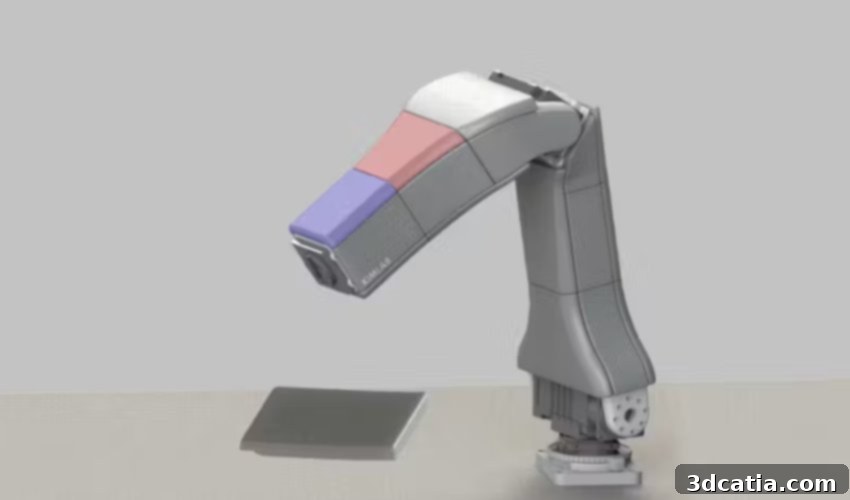
The future of robotics is evolving rapidly, driven by innovations that enable machines to interact with their environment and with humans in increasingly sophisticated ways. A groundbreaking development from researchers at the University of Illinois Urbana-Champaign (UIUC) is set to redefine this landscape. Their team has unveiled a highly cost-effective and remarkably versatile solution to equip robots with a human-like sense of touch. By ingeniously leveraging the power of 3D printing technology, these innovative soft skin pads provide not only a gentle physical interface but also function as robust mechanical pressure sensors. This advancement ushers in an extensive range of new possibilities, promising safer, more intuitive, and more adaptable robotic systems across numerous sectors.
Overcoming Traditional Barriers in Tactile Sensing
For years, the widespread adoption of advanced robotic tactile sensors has been hindered by two primary factors: complexity and cost. Traditional tactile sensing systems often involve intricate manufacturing processes, expensive specialized materials, and sophisticated electronic integration, making them prohibitive for many applications and limiting their scalability. This has created a significant bottleneck for robots that require delicate manipulation, safe human interaction, or precise environmental perception.
However, the pioneering team at UIUC, spearheaded by Professor Joohyung Kim, has fundamentally challenged these conventional limitations. They have demonstrated that functional, highly durable, and remarkably inexpensive alternatives can be produced using readily available, off-the-shelf 3D printers. This shift from complex, proprietary manufacturing to accessible additive manufacturing techniques represents a paradigm change, democratizing advanced robotic capabilities and paving the way for wider integration of touch-sensitive robots in everyday environments.
The Power of Customization and Enhanced Robotic Safety
One of the most compelling aspects of this 3D printing approach to soft skin pads is its inherent flexibility and ease of customization. Professor Kim highlighted this crucial benefit, stating, “Since it’s just a question of reprogramming a 3D printer, the same technique [of applying 3D printed soft skin pads] can be easily customized to different robotic systems.” This means that roboticists and engineers no longer need to rely on generic, one-size-fits-all solutions. Instead, they can rapidly design and print tactile sensors tailored precisely to the unique geometry, size, and operational requirements of specific robotic platforms, from industrial manipulators to intricate surgical robots.
Beyond mere customization, these soft skin pads play a pivotal role in enhancing robotic safety, a paramount concern in modern robotics, particularly as robots increasingly share spaces with humans. Professor Kim further emphasized, “Robotic hardware can involve large forces and torques, so it needs to be made quite safe if it’s going to either directly interact with humans or be used in human environments. It’s expected that soft skin will play an important role in this regard since it can be used for both mechanical safety compliance and tactile sensing.” The inherent softness and compliant nature of these pads act as a protective buffer, absorbing impacts and reducing the risk of injury during accidental contact. This mechanical compliance, combined with immediate tactile feedback, allows robots to perceive and react to unexpected interactions, moving away from potentially harmful scenarios and significantly improving the overall safety profile of human-robot collaboration. This is critical for applications ranging from manufacturing assembly lines where humans and robots work side-by-side, to domestic environments where assistive robots might interact with vulnerable individuals.
Unpacking the Ingenious Technology: Materials and Sensing Mechanism
The remarkable capabilities of these soft skin pads are a testament to an ingenious combination of advanced materials science and cutting-edge design principles. At their core, the pads are developed from thermoplastic urethane (TPU), a flexible and highly durable polymer known for its elasticity, abrasion resistance, and excellent printability. The team utilized readily available Raise3D E2 3D printers, demonstrating that sophisticated robotic components don’t require prohibitively expensive industrial equipment. This choice of material and printer significantly contributes to the solution’s affordability and accessibility.
The structural design of the pads is equally innovative. Each pad features a soft, compliant outer layer that encases a carefully designed hollow infill section. This internal void is critical to the sensing mechanism. When the soft outer layer of the pad is subjected to compression – whether from a gentle touch, a strong press, or even a vibration – the internal volume of the hollow section momentarily changes. This change in volume directly alters the air pressure within the pads. By connecting these pads to off-the-shelf pressure sensors, the minute variations in air pressure can be precisely detected and translated into signals that indicate vibration, touch intensity, and applied pressure. This pneumatic sensing approach offers several advantages, including robustness against electromagnetic interference, inherent mechanical compliance, and a relatively simple readout mechanism compared to complex strain gauges or capacitive arrays. The ability to detect subtle vibrations further enhances the robot’s perceptual capabilities, allowing it to “feel” textures or detect slight slippage of an object it is holding.
Broadening Horizons: Diverse Applications and Economic Advantages
The straightforward manufacturing process and inherent affordability of these 3D printed soft skin pads make them an exceptionally attractive option for integration into a wide array of emerging robotic systems. Beyond their technical prowess, their economic viability unlocks new possibilities for robotics deployment that were previously constrained by cost. The use of 3D printing is particularly beneficial in scenarios where the maintenance, cleaning, or rapid replacement of components pose significant financial or logistical challenges.
Professor Kim eloquently outlined how 3D printing can deftly navigate these hurdles, using a pertinent example from the healthcare sector: “Imagine you want to use soft-skinned robots to assist in a hospital setting. They would need to be regularly sanitized, or the skin would need to be regularly replaced. Either way, there’s a huge cost. However, 3D printing is a very scalable process, so interchangeable parts can be inexpensively made and easily snapped on and off the robot body.” This scenario highlights a critical advantage: in sterile environments like hospitals, the ability to quickly and cheaply replace contaminated or worn-out soft skin ensures continuous operation and maintains strict hygiene standards without incurring exorbitant costs. This has profound implications for assistive robots, patient interaction robots, and even surgical tools, where sterility and reliability are non-negotiable.
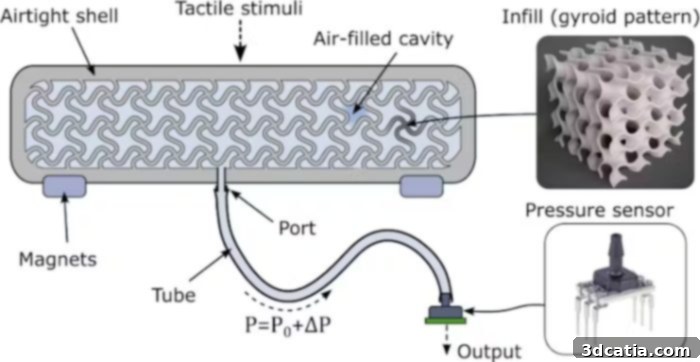
The soft touch pad design incorporates air within its hollow structure, causing pressurized areas of the pad on touch, which are then detected by sensors.
Beyond healthcare, the applications are extensive:
- Industrial Automation: Robots handling delicate components, performing quality control checks that require tactile feedback, or collaborating safely with human workers on assembly lines.
- Logistics and Warehousing: Robots capable of grasping irregularly shaped or fragile packages without damage, improving efficiency and reducing waste.
- Prosthetics and Assistive Devices: Enabling more natural and intuitive control for amputees, providing a sense of touch to prosthetic limbs, and enhancing user interaction with assistive technologies.
- Exploration Robotics: Robots deployed in hazardous or unknown environments (e.g., deep-sea, space, disaster zones) could use tactile sensing to navigate obstacles, identify materials, and perform delicate tasks where visual cues are insufficient.
- Consumer Robotics: Enhancing the safety and interactivity of home robots, toys, and educational platforms, making them more engaging and less intimidating.
Paving the Way for a New Era of Human-Robot Interaction
As the demand for safer, more intuitive, and adaptable robots continues to grow across industries and in daily life, these 3D printed soft skin pads offer a truly compelling solution. They facilitate a more comfortable, sensitive, and natural interaction between machines and the people they assist or work alongside. By mimicking the human sense of touch, these pads bridge a critical gap in robotic perception, enabling robots to perform tasks with greater dexterity and empathy.
Moreover, their dual advantages of affordability and versatility make them accessible to a much broader range of users and researchers than ever before. This widespread accessibility is poised to accelerate innovation in robotics, fostering new designs, applications, and theoretical advancements. The ability to rapidly prototype, test, and deploy customized tactile sensors at a low cost will undoubtedly pave the way for their extensive adoption in diverse fields, ultimately leading to a future where robots are not just tools, but highly capable, sensitive, and seamlessly integrated partners in human endeavors.
What do you think of the benefits and applications of these 3D printed soft skin pads? Let us know in a comment below or on our LinkedIn, Facebook, and Twitter pages! Don’t forget to sign up for our free weekly newsletter here for the latest 3D printing news straight to your inbox! You can also find all our videos on our YouTube channel.
*All Photo Credits: University of Illinois Urbana-Champaign