
Pioneering Bone Regeneration: The Promise of 3D Printed Antibacterial Bioactive Glass Scaffolds
Bone surgeries, while life-changing for many, represent a significant medical challenge. They are inherently complex, often painful, and carry a substantial risk of infection. Surgeons implement rigorous protocols and take extensive precautions to mitigate these risks, but despite their best efforts, bone infections remain a serious concern. These infections, such as osteomyelitis, are notoriously difficult to treat. They frequently necessitate prolonged courses of potent antibiotics, which can have their own side effects, and in severe cases, may require multiple, lengthy hospital stays and additional invasive surgeries. The potential consequences range from chronic pain and disability to, in extreme instances, limb amputation or even mortality. Therefore, any innovative product or technology that can effectively prevent these debilitating infections could dramatically improve patient outcomes, reduce healthcare costs, and play a pivotal role in public health by decreasing morbidity and mortality rates associated with orthopedic procedures.
In a groundbreaking endeavor to address this critical need, researchers from the Complutense University of Madrid have turned their attention to the cutting-edge field of 3D printing. Led by a distinguished team including Sandra Sánchez-Salcedo, Ana García, Adela González-Jiméneza, and María Vallet-Reghi, this research group proposed that additive manufacturing could be instrumental in revolutionizing bone tissue regeneration. Their focus was on the production of innovative antibacterial scaffolding, designed to serve as a robust and infection-resistant matrix upon which new bone can effectively grow. This approach combines advanced materials science with precision manufacturing to tackle one of the most persistent problems in orthopedic medicine.
One of the primary challenges in bone regeneration, particularly when using synthetic aids, is the body’s reaction to foreign materials. Any scaffolding or implant introduced into the body is immediately recognized as a non-native substance, which inherently increases the risk of bacterial colonization. This risk is particularly elevated in areas where blood supply is limited, as the body’s natural immune response struggles to reach and combat pathogens effectively. To overcome this hurdle, the research team developed a sophisticated solution: they synthesized novel nanocomposites based on mesoporous bioactive glasses (MBGs). These are advanced materials characterized by their nanoporous structure, featuring pores with diameters meticulously controlled to be between 2 and 50 nanometers. This unique porosity grants them an exceptionally high surface area, crucial for cellular interaction and controlled ion release.
Further enhancing their antimicrobial capabilities, these mesoporous bioactive glass matrices were then homogeneously doped with metallic silver nanoparticles (AgNPs). Chemical doping, in this context, refers to the deliberate and precise incorporation of these silver nanoparticles into the glass structure to imbue it with new, desirable properties – specifically, potent antibacterial activity. Silver has been recognized for centuries for its antimicrobial properties, and its nanonized form significantly boosts its efficacy. The integration of AgNPs into the MBG structure creates a synergistic material that not only promotes bone growth but also actively defends against bacterial invasion, offering a dual-action approach to bone regeneration and infection prevention. This innovative material design holds immense promise for improving the safety and success rates of bone repair strategies.
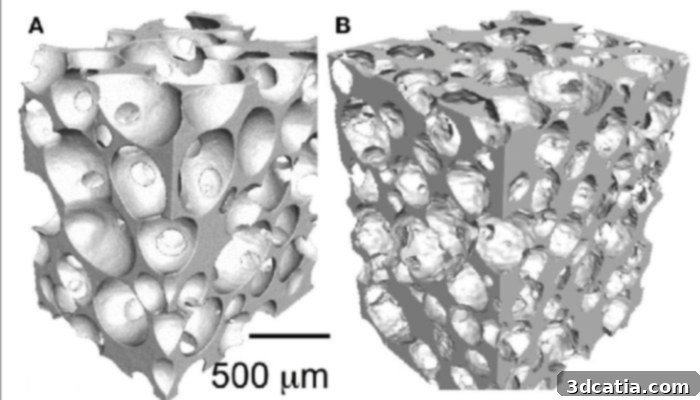
Bioactive glass scaffolds (A) sol-gel foam and (B) melt-derived gel-cast foam. (Photo credit: Jones and Hench, 2013)
The methodology employed in this study leveraged the precision and versatility of 3D printing technology. Specifically, an EnvisionTEC GmbH 3D Bioplotter™ bioprinter was utilized for the preparation of these advanced 3D scaffolds. The choice of bioprinting via rapid prototyping (RP) is critical, as it allows for the fabrication of complex, patient-specific geometries with high resolution and controllable internal architecture, which is paramount for effective bone regeneration. This level of control over pore size, interconnectivity, and overall scaffold shape mimics the natural bone structure, facilitating optimal cell infiltration and nutrient exchange.
Once fabricated through this intricate bioprinting process, the innovative scaffolds underwent rigorous testing. Each scaffold was carefully placed into 12-well Transwell plates, a standard laboratory apparatus designed for cell culture experiments. The primary objective was to observe how these advanced constructs would interact with cells and how their unique properties would influence tissue regeneration. The researchers posited that the scaffolds would serve as ‘temporary templates,’ providing a supportive and conducive environment for complete cell colonization. This templating function is crucial for guiding the growth and differentiation of osteogenic cells, ultimately leading to the formation of new bone tissue that gradually replaces the resorbable scaffold. The careful design ensures that as the new bone forms, the scaffold degrades safely, leaving behind functional, regenerated tissue.
The results of the study were highly encouraging, confirming the dual-action potential of the engineered scaffolds. A key finding was the pronounced antibacterial properties exhibited by the 3D scaffolds, directly attributable to the controlled release of silver ions into the surrounding medium. Silver ions are well-known broad-spectrum antimicrobial agents that effectively disrupt bacterial cell membranes, inhibit enzyme function, and interfere with DNA replication, thereby preventing bacterial growth and colonization. The ability of the scaffolds to locally release these silver ions means that the antimicrobial effect is concentrated precisely where it’s needed – at the site of potential infection – without the need for systemic antibiotic administration, which can lead to widespread side effects and contribute to antibiotic resistance.
This localized, sustained release of antimicrobial silver from the bioactive glass matrix offers a significant advantage over traditional methods of infection prevention in orthopedic surgery. The researchers are confident that this potent antibacterial property, derived from the silver content, holds immense potential for real-world applications in healthcare and bone tissue regeneration. By significantly reducing the risk of post-surgical infection and inhibiting bacterial proliferation at critical sites, these 3D printed antibacterial scaffolds could transform the landscape of orthopedic and craniofacial surgery, leading to faster recovery times, fewer complications, and vastly improved quality of life for patients undergoing bone repair procedures. This breakthrough represents a major step towards safer and more effective regenerative medicine.
The field of 3D bioprinting is rapidly advancing, with numerous innovative experiments showcasing its diverse applications beyond terrestrial settings. For instance, similar groundbreaking experiments in 3D bioprinting have included the ambitious project by the Ugandan government, which made headlines with its rocket launch in November 2022. This mission carried a bioprinter onboard, with the specific aim of performing experiments on human tissues in a zero-gravity environment. Such endeavors explore how microgravity influences cell growth and tissue formation, potentially yielding insights crucial for long-duration space missions and for advancing tissue engineering here on Earth. These examples underscore the immense global interest and investment in 3D bioprinting as a transformative technology in medicine and beyond.
The scientific paper detailing the precise methods, comprehensive results, and profound implications of this particular bone regeneration experiment using 3D printed antibacterial bioactive glass scaffolds is available for those seeking deeper insights into the research. For more in-depth details on the sophisticated synthesis techniques, the bioprinting parameters, the cell culture experiments, and the full analysis of the antibacterial properties and biocompatibility, you can find the scientific publication HERE. We encourage interested readers, researchers, and professionals to explore the original source for a complete understanding of this pioneering work.
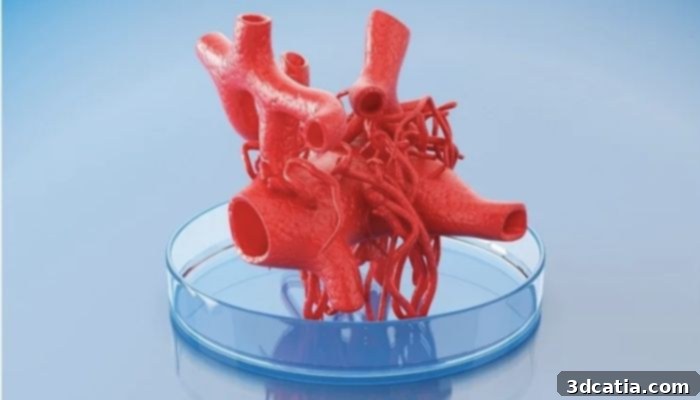
3D printing technology is often applied to medical uses. (Photo credit: Iaremenko Sergii / Shutterstock)
We’re eager to hear your thoughts on this exciting project for advanced bone regeneration using 3D printed antibacterial scaffolds. Do you envision this technology becoming a standard in orthopedic surgeries? What other applications do you see for such innovative materials? Let us know your insights, questions, and comments below! You can also join the conversation and share your perspectives on our Facebook and Twitter pages. Your feedback is invaluable in understanding the broader impact and potential of these scientific advancements. Don’t miss out on the latest developments in additive manufacturing and regenerative medicine. Be sure to sign up for our free weekly Newsletter, delivering all the breaking news, in-depth analyses, and exciting innovations in 3D printing straight to your inbox!
*Cover photo credit: Shutterstock/Alex Mit