
Annie Foo: Revolutionizing Footwear Design with 3D Printing for Sustainable and Personalized Fashion
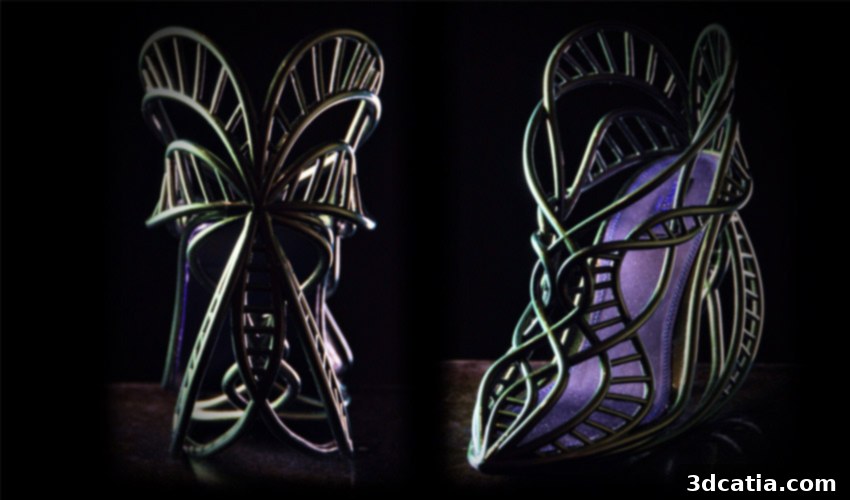
The world of fashion, particularly footwear, is currently undergoing a significant transformation driven by 3D printing technologies. While major players like the Chinese brand PEAK have recently made headlines with the announcement of fully 3D printed shoes for the general public, visionary designers like Annie Foo are pushing the boundaries even further, crafting high-end, bespoke footwear that exemplifies the true potential of additive manufacturing. We had the distinct pleasure of speaking with Annie Foo, a talented designer who seamlessly integrates advanced 3D scanning and additive manufacturing to produce custom, intricate, and uniquely geometric shoe designs. For Annie, 3D printing isn’t merely a manufacturing method; it’s a powerful avenue for creative expression, allowing her to offer end consumers products that are not only personalized and aesthetically striking but also environmentally conscious and inherently sustainable. Her approach represents a fresh perspective on footwear creation, moving beyond conventional methods to embrace a future where innovation, design freedom, and ecological responsibility converge. We delved into her groundbreaking work and her forward-thinking vision for the future of the fashion market.
3DN: Can you introduce yourself and elaborate on your connection to new technologies?

Annie Foo
“The world doesn’t need more shoes, but it deserves innovation.” This powerful statement encapsulates my philosophy. My professional journey began in the industrial fashion sector, which provided me with a deep understanding of conventional manufacturing processes and their inherent challenges. This background fueled my determination to explore groundbreaking methods of production. My primary drive is to merge innovative style with a profound desire to mitigate the significant environmental impact that the fashion industry often generates. I am particularly captivated by the synergy created when existing footwear manufacturing techniques are combined with cutting-edge modern technology and advanced materials. This combination allows me to conceptualize and create something genuinely ‘new’ and forward-thinking for the future of fashion. My focus is on leveraging digital tools and additive manufacturing to redefine how shoes are designed, produced, and consumed, aiming for a more responsible and creative industry.
3DN: Could you explain your unique manufacturing process in more detail?
My manufacturing process is a blend of digital precision and artistic freedom, beginning with a foundational scan. I start by meticulously 3D scanning either existing shoes or, ideally, human feet. This initial step provides a precise digital blueprint that serves as the base for my design work. Following the scanning, I transition into virtual reality (VR) environments to sculpt and refine my designs. I primarily use sophisticated 3D modeling software like Gravity Sketch, which is exceptional at capturing the nuanced, organic flow of freehand brush strokes. This allows me to create intricate and expressive three-dimensional forms for modern footwear, pushing beyond the limitations of traditional design tools. Once the initial forms are established in Gravity Sketch, the model is exported to Oculus Medium, where I delve into refining finer details, adding textures, and ensuring every curve and angle is perfected. The design then undergoes further meticulous adjustments in Rhino 3D, a powerful CAD software known for its precision and versatility, before the file is finalized and prepared for printing. For the spectacular final pieces I’ve produced for catwalk presentations, I utilize the advanced HP Jet Fusion 4200 3D printer. This machine employs Selective Laser Sintering (SLS) technology, working with PA12 Nylon, a material celebrated for its strength, durability, and fine finish. While PA12 Nylon is excellent for structural components, I am actively exploring and testing new, more flexible materials, such as printed TPU (Thermoplastic Polyurethane), which I believe holds immense potential for creating the softer, more pliable upper parts of shoes, offering enhanced comfort and dynamic aesthetics.
3DN: What led you to embrace 3D printing as a core technology for your designs?
My background as a sculptor has profoundly influenced my choice to integrate 3D printing into my design practice. Throughout my artistic career, I have worked extensively with a diverse range of raw materials, including ceramic, wood, metal, and various plastics. This hands-on experience has provided me with an intimate understanding of each material’s unique characteristics, inherent benefits, and specific limitations. When it came to translating my intricate and often complex visions for footwear structures into tangible products, traditional manufacturing methods often proved restrictive or simply incapable of achieving the desired level of detail and integration. The multi-faceted geometry and elaborate, integrated details that are central to my footwear concepts demand a manufacturing process that offers unparalleled freedom and precision. In this regard, 3D printing emerged as the most suitable and indeed, the ideal option for my projects. It empowers me to bypass the constraints of conventional molds and assembly, allowing me to create singular, unified structures with an extraordinary degree of complexity and customization that would be virtually impossible through other means. This technology truly unlocks a new dimension of design possibilities.
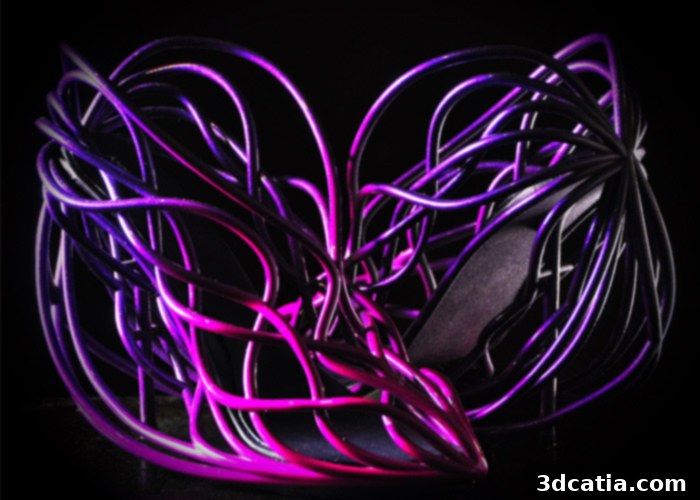
Annie Foo’s designs are deeply inspired by nature’s organic forms and complex geometries.
3DN: What are your primary sources of inspiration for your distinctive shoe designs?
My creative process is fueled by a rich tapestry of influences, drawing inspiration from various realms to form my distinctive aesthetic. My work is profoundly shaped by linear construction, where lines and planes intersect to create dynamic and structured forms, echoing principles found in architecture and minimalist art. London pop culture, with its vibrant energy, eclectic styles, and innovative spirit, also plays a significant role, injecting a sense of urban edge and contemporary flair into my designs. Architectural structures, from their monumental scale to their intricate detailing, provide a constant source of fascination, informing how I approach the engineering and aesthetics of footwear. Furthermore, I am deeply inspired by organic forms found in nature – the intricate patterns of leaves, the fluid curves of a river, or the skeletal structures of various organisms. These natural geometries offer an endless wellspring of ideas for innovative shapes and textures. Finally, contemporary abstract art and sculpture in general are fundamental to my artistic vision. The freedom of expression, the exploration of form and space, and the interplay of materials in these disciplines directly translate into the conceptual and visual language of my 3D printed footwear, allowing me to push boundaries and create truly unique pieces.
3DN: Do you believe 3D printing can significantly contribute to addressing the issue of sustainability in fashion?
Absolutely. I firmly believe that 3D printing offers immense potential to foster greater sustainability within the fashion industry. We are witnessing a fundamental shift in consumer behavior; today’s buyers are far more discerning than those of past decades. There’s a heightened awareness and concern about the materials used in products, the quality of craftsmanship, and crucially, the origins of what they purchase. This evolving consumer mindset is pushing the industry towards more responsible practices. I am optimistic that we are moving in a positive direction, actively making improvements for our future environment and generations. As I’ve stated before, achieving ‘zero-waste fashion’ is a complex ideal, perhaps truly attainable only by not consuming at all. However, 3D printing provides a tangible and powerful tool to drastically reduce fashion waste specifically during the manufacturing process. Unlike traditional methods that often involve cutting and discarding material scraps, additive manufacturing builds objects layer by layer, utilizing only the necessary amount of material. This minimizes off-cuts and allows for more efficient material usage. Furthermore, the ability to produce items on-demand reduces the need for large inventories, thereby curbing overproduction, which is a significant source of waste. However, it’s crucial to acknowledge that any powerful invention, including 3D printing, can have adverse effects if misused or not applied responsibly. As contemporary designers and producers, we bear a significant responsibility to carefully consider the implications of our creations before bringing them into existence. My stance is not inherently against plastic, especially when it can be utilized responsibly and for beneficial causes, such as creating durable, long-lasting products that reduce the need for frequent replacements. The key lies in thoughtful design, material selection, and end-of-life considerations to ensure that the environmental benefits of 3D printing are fully realized.
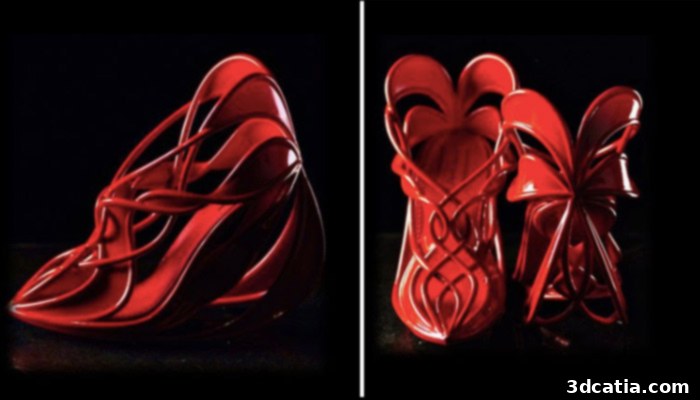
Photo Credits: Annie Foo
3DN: From your perspective, what does the future hold for 3D printing within the fashion industry?
I foresee an incredibly dynamic, rapidly growing, and profoundly revolutionary market for 3D printing, particularly within the fashion industry. The demand for unique, custom-fitted pieces is on an exponential rise. Consumers are increasingly seeking products that truly reflect their individuality and offer unparalleled comfort and fit. In the very near future, I envision a scenario where every household will possess its own 3D printer. This pervasive adoption will fundamentally transform the way we interact with fashion. Imagine the convenience and personalization: consumers will simply be able to place an order online for a garment or accessory by sending their own 3D scanned figure – a digital twin that captures their precise measurements and contours. This capability will empower designers to create truly custom pieces tailored to an individual’s exact body shape, which can then be instantly printed at home. This model is particularly well-suited for fashion footwear, various accessories like jewelry and handbags, and eyewear products, offering immediate benefits in terms of fit, style, and on-demand production. Of course, the full potential of this vision, extending to entire wardrobes, will truly materialize once we overcome current material limitations and can print flexible materials that convincingly replicate the luxurious feel and drape of natural leather and fabrics. The continuous advancements in material science are crucial to realizing this comprehensive, personalized, and localized fashion future, making truly bespoke fashion accessible to everyone. This shift will redefine retail, manufacturing, and consumer engagement, moving towards an era of hyper-personalization and distributed production.
3DN: Do you have any final thoughts or words of advice for our readers?
My ultimate message is one of responsibility and mindfulness. In an age of abundant consumption and rapid technological advancement, it is more critical than ever to ‘be responsible.’ I urge everyone, whether you are a consumer or a creator, to ‘think twice before you buy or create something.’ Consider the origins, the environmental impact, the longevity, and the true necessity of every item. This conscious approach can lead to more meaningful choices and contribute significantly to a more sustainable and ethical future for all.
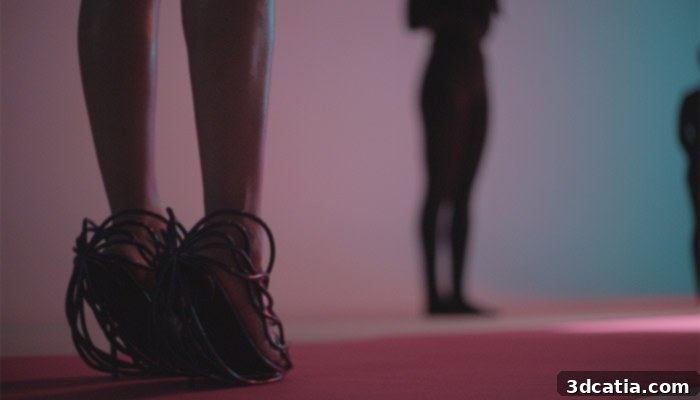
Photo Credits: Annie Foo
To discover more of Annie Foo’s visionary work and unique designs, you can explore her Instagram account HERE. We hope this insightful interview has illuminated the exciting intersection of fashion, technology, and sustainability. What are your thoughts on Annie Foo’s pioneering approach to custom 3D printed shoes and the future of fashion? We invite you to share your perspectives in a comment below or join the conversation on our Facebook and Twitter pages! Don’t forget to sign up for our free weekly Newsletter to receive all the latest news, trends, and interviews in the fascinating world of 3D printing directly in your inbox!