

Revolutionizing Industrial Manufacturing: Anisoprint Unveils the ProM IS 500 for Continuous Fiber Composite 3D Printing
The landscape of additive manufacturing is undergoing a profound transformation, driven by innovations that push the boundaries of material science and engineering. At the forefront of this revolution is Anisoprint, a pioneering company dedicated to developing cutting-edge additive manufacturing systems compatible with advanced composite materials. Specifically, Anisoprint specializes in solutions for continuous fiber-reinforced composites, a category of materials that promises unparalleled performance and opens new avenues for industrial applications. These advanced composites are not merely incremental improvements; they represent a paradigm shift, offering up to 30 times the strength of pure thermoplastics while maintaining properties comparable to traditional metals. Crucially, their advantage extends beyond sheer strength; they are several times lighter and significantly more cost-effective than metal 3D printed parts, addressing critical needs in demanding industries. As the market for composite 3D printing experiences rapid growth, Anisoprint has solidified its position as a prominent leader. The company’s commitment to innovation was brilliantly showcased at Formnext, where it officially launched its groundbreaking new machine: the ProM IS 500. This industrial-grade solution is meticulously engineered to print high-temperature thermoplastics, fortified with continuous fiber reinforcement, marking a significant leap forward in industrial additive manufacturing capabilities.
The introduction of the ProM IS 500 directly responds to a clear and pressing demand from the industrial sector. As Fedor Antonov, CEO of Anisoprint, eloquently explained, “Through the interaction with our customers we’ve learned that everyone is looking for bigger parts. Today, most of the 3D machines on the market have small build areas.” This observation highlights a critical limitation in the current additive manufacturing landscape, where the ability to produce large, high-strength components efficiently has remained a significant hurdle. Antonov further elaborated on the inherent challenges: “Bigger parts need higher strength, however the main challenge for printing big parts is productivity.” This dual requirement – for both enhanced mechanical properties and accelerated production rates – has historically constrained the wider adoption of additive manufacturing for industrial-scale applications. With the ProM IS 500, Anisoprint has engineered a sophisticated solution to overcome these challenges, fundamentally rethinking the approach to continuous fiber composite 3D printing. The innovation lies in its capacity to dramatically increase productivity through a novel combination of reinforced fibers of different sizes and a unique microlayering approach. This ingenious strategy allows for strategic material placement: “You can reinforce perimeters with thin, more tolerant fibers, while switching to much more productive thick fibers in infills and regular zones.” This tailored approach optimizes both part integrity and manufacturing speed. When combined with advanced industrial motion control systems and robust guideways, the ProM IS 500 can achieve a productivity rate that is an astonishing “5 to 10 times higher than in the current systems.” Moreover, Anisoprint’s technology offers a distinct advantage over traditional manufacturing techniques like milling. Antonov highlighted, “And, contrary to traditional machining techniques like milling, we save weight by saving machine time — this is the beauty of additive.” This efficiency translates into tangible benefits for industries, enabling the on-demand creation of “large scale jigs for welding, assembly, bending and milling that are robust, lightweight and precise – made on demand, on your machine shop, in a matter of hours. No compromise.” The ProM IS 500 thus represents not just a new machine, but a new era of agile, high-performance manufacturing.

The ProM IS 500 was unveiled for the first time at Formnext 2019, showcasing Anisoprint’s industrial continuous fiber composite 3D printing capabilities.
At the core of the ProM IS 500’s advanced capabilities is Anisoprint’s proprietary and patented Composite Fiber Co-extrusion (CFC) technology. This innovative process is not merely an evolution; it signifies a revolutionary step towards a new paradigm in manufacturing. The CFC technology empowers users with unprecedented design freedom and an expansive choice of materials, transcending the conventional limitations of plastics and metals. It fundamentally redefines what can be achieved through additive manufacturing, pushing the boundaries of material performance and geometric complexity. The ProM IS 500 represents Anisoprint’s second major offering based on this groundbreaking technology, following the success of its desktop continuous fiber 3D printer, the Composer. While the Composer introduced the power of CFC technology to a wider audience, the ProM IS 500 scales this innovation to an industrial level, addressing the rigorous demands of high-performance applications. With this machine, industrial users can now create intricate, complex-shaped continuous fiber composite tools, robust spare parts, and highly functional prototypes. These components are designed to meet, and often exceed, the stringent industrial standards prevalent across critical sectors such as aerospace, automotive, robotics, and various other advanced manufacturing industries. The ability to produce such high-caliber parts on demand, with exceptional strength-to-weight ratios and design versatility, positions the ProM IS 500 as a pivotal tool for engineers and manufacturers looking to innovate and optimize their production processes.
The engineering of the ProM IS 500 reflects a meticulous attention to detail and a deep understanding of industrial operational requirements. Its robust design integrates a comprehensive suite of industrial-grade components, including advanced CNC systems, sophisticated quality control mechanisms, and stringent safety protocols. This holistic approach ensures the precise, repeatable, and reliable manufacturing of mid-sized composite parts, crucial for mission-critical applications where consistency and performance are paramount. A key feature distinguishing the ProM IS 500 is its generous build volume of 600 x 420 x 300 mm. This substantial space allows for the production of larger components and batches, enabling greater efficiency and flexibility in manufacturing workflows. Furthermore, the machine is equipped with a state-of-the-art heated chamber, a vital component for successfully processing high-performance, high-temperature polymers such as PEEK or PEI. These materials are highly valued in industries like aerospace and medical for their exceptional mechanical strength, chemical resistance, and thermal stability. The heated chamber maintains precise thermal conditions throughout the printing process, preventing warping and ensuring optimal layer adhesion and part quality. Beyond these core specifications, the ProM IS 500 boasts an array of additional intelligent features designed to streamline operation and maximize output. These include automated calibration systems that minimize setup time and human error, comprehensive material and print quality controls for consistent results, and high-precision motion control systems that ensure unparalleled accuracy in fiber placement. The machine also supports a wide range of industrial interfaces, facilitating seamless integration into existing factory environments and automated production lines. Coupled with robust safety requirements, the ProM IS 500 is engineered for continuous, uninterrupted operation, designed to run 24/7 in demanding factory settings, thereby maximizing throughput and return on investment for industrial users.
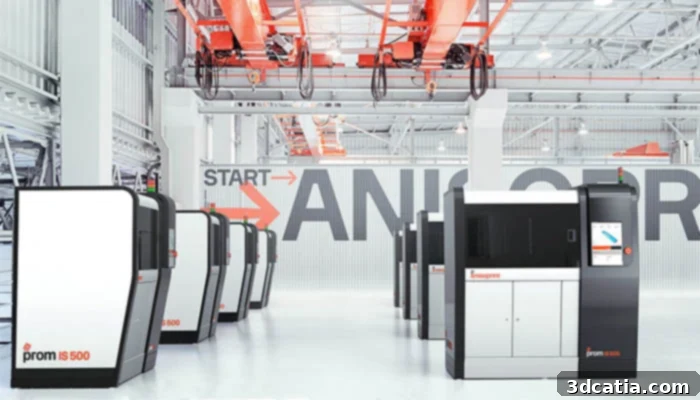
The ProM IS 500, designed for continuous operation in demanding industrial environments.
The journey to develop an additive manufacturing product that not only meets but exceeds industrial standards is a complex endeavor, as acknowledged by Evgeny Babarykin, Design Engineer at Anisoprint. He remarked, “Developing an additive manufacturing product which would meet industrial standards is a challenge for us as well as for the whole 3D printing industry.” This challenge stems from the inherently demanding nature of industrial enterprises, which require equipment to deliver exceptional reliability, precision, and longevity. Anisoprint’s strategy to address these rigorous expectations involves a deep commitment to quality, productivity, and an unparalleled focus on understanding and responding to customer needs and goals. Babarykin expressed strong confidence in the company’s direction: “I believe that with a machine such as the ProM IS 500 and our knowledge in composites we can show that additive manufacturing is at least comparable or even more effective than traditional manufacturing technologies for many applications.” This bold statement underscores Anisoprint’s vision for the ProM IS 500: to position continuous fiber composite 3D printing not just as an alternative, but as a superior method for a vast array of industrial applications. The ability to produce parts with customized mechanical properties, optimal weight, and complex geometries in a single process offers significant advantages over multi-stage traditional manufacturing, leading to faster design iterations, reduced material waste, and lower overall production costs. This approach not only enhances product performance but also streamlines the entire manufacturing value chain.
Anisoprint’s proprietary Composite Fiber Co-extrusion technology is a game-changer in the realm of advanced manufacturing. This innovative method enables the production of optimally engineered composite parts that are inherently stronger and significantly lighter than their metal or non-optimized counterparts. The manufacturer proudly highlights the impressive material properties achieved through this technology: plastic reinforced with Anisoprint materials boasts an extraordinary tensile strength of 860MPa. This figure alone is remarkable, but when combined with a density of just 1.4 g/cm³, the true advantage becomes clear. This density is approximately two times lighter than aluminum, a widely used lightweight metal, yet offers superior specific strength. This incredible strength-to-weight ratio is particularly critical for industries like aerospace and automotive, where every gram saved translates into increased fuel efficiency and performance. What truly sets Anisoprint’s technology apart is its capability for special fiber laying, specifically in the form of intricate lattices. This advanced technique allows engineers to strategically orient continuous fibers along the precise load paths within a part. By doing so, the maximum possible properties are achieved with the absolute minimum material usage required for the design loads. This results in components that are not only incredibly robust but also extraordinarily efficient in their material consumption. The economic implications are substantial: this approach significantly reduces material waste, drastically cuts down on production time, and ultimately lowers the overall price of the final part. This optimization of both performance and cost solidifies the ProM IS 500’s position as a transformative solution for industries seeking to innovate and gain a competitive edge.
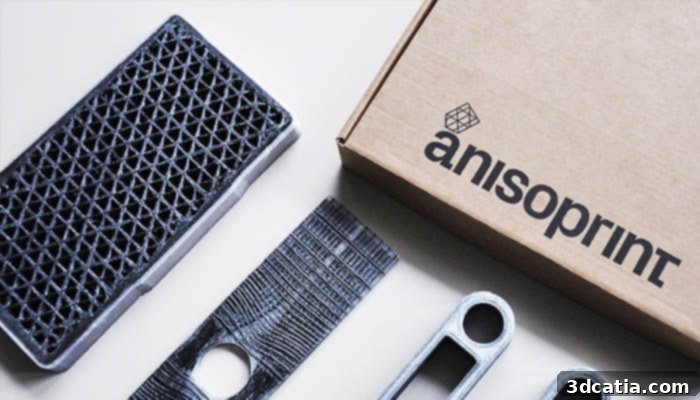
Curvilinear trajectories of fiber laying are possible thanks to Composite Fiber Co-extrusion technology. This enables parts with latticed inner structures made from composites, which significantly reduce material usage, production time, and eventually the total cost of the part | Credits: Anisoprint
The ProM IS 500 is engineered for unparalleled material versatility, a critical factor for addressing the diverse requirements of industrial applications. The machine is equipped with up to four changeable print heads, allowing for seamless integration of both advanced composites and pure plastics within a single print job. This multi-head configuration offers significant strategic advantages. It enables users to selectively reinforce different zones of a part with varying composite materials, such as carbon or basalt fibers, precisely tailoring the mechanical properties to the specific load conditions and functional goals of each component. For instance, areas subjected to high tensile stress might benefit from carbon fiber reinforcement, while zones requiring impact resistance could utilize basalt. This level of material customization was previously unattainable in additive manufacturing, providing engineers with unprecedented control over part performance and cost optimization. Furthermore, the ProM IS 500’s compatibility with high-temperature matrix materials like PEEK and PEI is a game-changer. When anisoprinted with these high-performance polymers, the resulting composite parts exhibit exceptional thermal stability, chemical resistance, and mechanical strength, even in extreme environments. This capability significantly expands the range of applications for 3D printed parts, moving beyond prototyping into demanding end-use components for industries such as aerospace, oil & gas, and medical. By offering a comprehensive material ecosystem and the flexibility to combine different materials strategically, Anisoprint’s ProM IS 500 truly unlocks the full potential of continuous fiber composite 3D printing. For more detailed technical specifications and to explore the full range of possibilities, additional information is available on Anisoprint’s official website HERE.
In conclusion, Anisoprint’s ProM IS 500 stands as a testament to the transformative power of continuous fiber composite 3D printing. By addressing critical industrial demands for larger, stronger, and more cost-effective parts, and by delivering unprecedented productivity through its patented CFC technology, Anisoprint is not just keeping pace with the additive manufacturing market – it is actively shaping its future. The ability to integrate high-performance materials like PEEK and PEI with strategic fiber reinforcement, all within a robust, industrial-grade system, positions the ProM IS 500 as an indispensable tool for forward-thinking manufacturers. It promises to revolutionize how tools, spare parts, and functional prototypes are designed and produced across aerospace, automotive, robotics, and beyond, driving innovation and efficiency across diverse industrial sectors. This advancement signifies a clear path toward sustainable, on-demand manufacturing that can compete with, and in many cases surpass, traditional production methods.
What are your thoughts on the groundbreaking ProM IS 500 and the future of continuous fiber composite 3D printing? We invite you to share your insights in a comment below or join the conversation on our Facebook and Twitter pages! Don’t forget to sign up for our free weekly Newsletter to ensure you receive all the latest news and developments in the dynamic world of 3D printing, delivered straight to your inbox!