

Revolutionizing Space Exploration: NASA’s 3D Printed Aluminum Rocket Nozzle with RAMFIRE Technology
In a dynamic era where innovation drives humanity’s reach further into the cosmos, advanced manufacturing technologies are proving indispensable. While the private aerospace sector has vigorously embraced 3D printing to achieve ambitious stellar objectives, the National Aeronautics and Space Administration (NASA) stands firmly at the forefront of this additive manufacturing revolution. Far from neglecting the transformative potential of this technology, NASA has been integrating it across numerous critical projects, making significant strides in recent years.
The year 2023 alone showcased NASA’s relentless commitment to additive manufacturing, with a myriad of groundbreaking applications. These included the creation of durable moon rover wheels designed to withstand the harsh lunar environment, essential components for the International Space Station to enhance its operational capabilities, and the ingenious utilization of 3D printed circuitry aboard rockets, elevating performance and reliability. These are but a few examples within NASA’s highly concerted effort to leverage advanced manufacturing for its rockets and a wide array of space-bound initiatives. The most recent and arguably one of the most impactful additions to this impressive portfolio is the successful testing of a novel 3D printed rocket engine nozzle, crafted entirely from aluminum. This breakthrough achievement promises to unlock unprecedented opportunities for space exploration, primarily because the inherent lightweight nature of aluminum allows for significantly larger payloads to be delivered into orbit and beyond.
The Genesis of Innovation: A Collaborative Aluminum Breakthrough
The development of this pioneering rocket engine nozzle was a testament to the power of collaborative innovation, stemming from a joint effort between brilliant NASA engineers at the Marshall Space Flight Center and Elementum 3D, a leading 3D printing company based in Erie, Colorado. This strategic partnership was forged with the specific goal of developing a new variant of aluminum, meticulously optimized for the rigorous demands of 3D printing high-performance rocket engine parts. Aluminum has long been recognized as a highly promising choice for additive manufacturing applications, primarily due to its exceptional combination of high strength and low weight. These properties make it an ideal candidate for applications where every gram saved can translate into substantial performance gains or cost reductions. Indeed, aluminum has already found widespread use in 3D printing various other complex mechanical components across diverse sectors, including high-stress parts like gearbox and engine components for prestigious automotive manufacturers such as BMW.
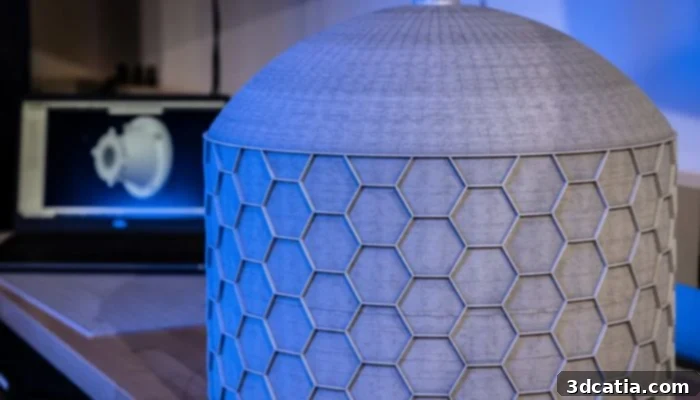
An image of the 3D printed nozzle on the laptop in the background and vacuum jacket manufacturing demonstrator tank used for cryogenic fluid application, made from the same aluminum material. (Photo credits: NASA)
However, despite its numerous advantages, the application of aluminum in rocketry has historically been limited. This stems from a critical drawback: aluminum’s relatively low heat tolerance. Under the extreme temperatures generated by a rocket engine’s blast – often reaching thousands of degrees Celsius – conventional aluminum alloys are highly susceptible to weakening, deformation, and even catastrophic cracking. This vulnerability has traditionally rendered it unsuitable for direct exposure to the combustion chamber environment, forcing engineers to rely on heavier, more heat-resistant materials. Yet, under the visionary NASA initiative known as Reactive Additive Manufacturing for the Fourth Industrial Revolution, or RAMFIRE, the collaborative team successfully engineered an innovative and sophisticated solution that fundamentally overcomes these long-standing material limitations. This breakthrough effectively mitigates aluminum’s heat vulnerability, leaving engineers free to harness only its highly desirable positive qualities for propulsion systems.
The RAMFIRE 3D Printed Rocket Nozzle: A True Game Changer for Space Travel
The technological leap achieved with the RAMFIRE nozzle lies ingeniously within the very design of the rocket nozzles themselves. Unlike traditional solid structures, these advanced nozzles incorporate intricate, small internal channels. These channels are not merely aesthetic; they are precisely engineered to actively redirect and manage the intense heat generated during engine operation, creating a sophisticated cooling system that prevents the aluminum metal from reaching critical melting or degradation points. This innovative thermal management solution is crucial for ensuring the structural integrity and operational longevity of the component in extreme environments.
Furthermore, the manufacturing methodology itself represents a significant advancement. By employing Laser Powder Directed Energy Deposition (LP-DED) 3D printing technology, the RAMFIRE nozzle can be constructed as a single, monolithic piece. LP-DED is an additive manufacturing process that uses a focused laser beam to melt and fuse powdered metal material as it is deposited, building up complex geometries layer by layer. This method is particularly well-suited for creating large-scale, high-performance metal components with excellent material properties, often surpassing those achieved through conventional techniques. The ability to print the nozzle as a single, integrated unit is a monumental achievement when contrasted with traditional manufacturing methods. Such conventional processes would typically necessitate the fabrication and assembly of thousands of separate pieces, each requiring individual machining, inspection, and joining. This not only adds immense complexity and potential points of failure but also significantly increases manufacturing time and cost. The final, flight-ready parts for the RAMFIRE initiative were expertly printed by another key NASA partner, RPM Innovations, located in Rapid City, South Dakota, further underscoring the collaborative spirit of this pioneering project.
Paul Gradl, a principal investigator driving the RAMFIRE initiative at NASA’s Marshall Space Flight Center, expressed profound positivity regarding the project’s outcomes and the exemplary collaboration that underpinned the development and printing of this revolutionary rocket nozzle. He remarked, “Industry partnerships with specialty manufacturing vendors aid in advancing the supply base and help make additive manufacturing more accessible for NASA missions and the broader commercial and aerospace industry. We’ve reduced the steps involved in the manufacturing process, allowing us to make large-scale engine components as a single build in a matter of days.” This statement encapsulates the multifaceted benefits: strengthening the domestic manufacturing ecosystem, democratizing access to cutting-edge AM capabilities, and drastically accelerating the production timeline for critical space hardware.
In the unforgiving realm of rocketry, where the weight of every component is meticulously scrutinized, often down to the last gram, the substantial reduction in weight afforded by the 3D printed aluminum nozzle represents a monumental game changer for NASA. This lighter design doesn’t just offer marginal improvements; it fundamentally creates new and expansive opportunities for advanced space travel. Reduced weight directly translates to increased payload capacity, enabling missions to carry more scientific instruments, additional crew supplies, or larger satellites. Moreover, it leads to greater fuel efficiency, extending mission durations and making voyages to distant destinations like Earth’s orbit, the Moon, Mars, and even deeper into our solar system more feasible and cost-effective. The rigorous testing phases for these innovative parts have already been successfully concluded. During these evaluations, the 3D printed nozzles demonstrated an extraordinary ability to withstand the simulated extreme heat and pressure conditions characteristic of deep space environments, validating their readiness for real-world missions.
Future Horizons: Expanding Additive Manufacturing’s Reach
Building on the resounding success of the RAMFIRE rocket nozzle, NASA is poised to significantly expand its integration of additive manufacturing technologies across a broader spectrum of projects. This includes exploring the potential of aluminum material for other critical components, such as satellite parts, where lightweighting and complex geometries are equally advantageous. The agency’s strategic vision extends beyond internal applications; NASA is also committed to disseminating its cutting-edge research findings and fostering increased collaboration with other additive manufacturing companies, industry stakeholders, and academic research bodies. This proactive approach aims to accelerate the maturation of AM technologies, stimulate innovation across the aerospace sector, and establish robust supply chains for future space exploration endeavors. By sharing knowledge and working in concert with a wider community, NASA not only pushes the boundaries of its own capabilities but also elevates the entire industry, paving the way for a more efficient, sustainable, and ambitious future in space. For more in-depth information about the transformative RAMFIRE 3D printed rocket nozzle project, readers are encouraged to view their comprehensive report directly HERE.
What are your thoughts on the groundbreaking RAMFIRE rocket nozzle and its implications for future space exploration? We invite you to share your perspectives and engage in the conversation by leaving a comment below or by connecting with us on our various social media platforms, including LinkedIn, Facebook, and Twitter! To stay updated with the very latest news and advancements in the world of 3D printing, don’t forget to sign up for our free weekly newsletter here, delivering cutting-edge insights straight to your inbox. Additionally, you can explore all our engaging video content and interviews on our dedicated YouTube channel.
*Cover Photo Credits: RPM Innovation