
Wohlers Report 2021: Navigating the COVID-19 Impact and Evolving Trends in Additive Manufacturing
As a highly anticipated annual benchmark for the additive manufacturing industry, Wohlers Associates has once again released its comprehensive report, providing an in-depth analysis of global trends, market outlook, and future forecasts. The Wohlers Report 2021, the 26th edition of this influential study, meticulously highlights the profound impact of the unprecedented global health crisis on the dynamic 3D printing market. Despite the widespread economic disruptions caused by COVID-19 throughout 2020, the additive manufacturing sector demonstrated remarkable resilience, achieving a commendable growth of 7.5% to reach an estimated market value of $12.8 billion. While this figure is a testament to the industry’s strength during challenging times, it’s crucial to contextualize it against the backdrop of the last decade, where the sector consistently recorded an impressive average annual growth rate of 27.4%. This comparison underscores the undeniable repercussions the crisis had on traditional production methods, global value chains, and the pace of new developments and innovations within additive manufacturing. However, it also brought unprecedented visibility to 3D printing, showcasing its inherent flexibility, adaptability, and capacity for rapid response, particularly in critical situations. The Wohlers Report 2021 is the culmination of extensive collaborative efforts, drawing insights from 124 service providers, 113 3D printer manufacturers, and 24 material producers worldwide, under the principal authorship of industry luminary Terry Wohlers and his dedicated team.
The previous year’s study, the Wohlers Report 2020, illuminated the burgeoning place of additive manufacturing in mass production, signaling a pivotal shift as the technology gradually transcended its foundational roles in rapid prototyping and tooling. This continued evolution reflects the increasing maturity and industrial adoption of 3D printing across diverse manufacturing landscapes. This latest edition, however, pivots its primary focus to a thorough examination of the multifaceted consequences of the health crisis on the entire market ecosystem. It delves into critical aspects such as overall market growth, the fluctuations in machine sales, the emergence of new and accelerated applications, and even the evolving cost structures of materials. Furthermore, the report provides an invaluable overview of the year’s significant mergers, acquisitions, strategic investments, and initial public offerings (IPOs), offering a clear snapshot of the industry’s consolidation and expansion dynamics during a period of global uncertainty.

The Wohlers Report 2021 is the 26th edition of the study (photo credits: Wohlers Associates)
Deciphering the Growth Dynamics: A Closer Look at Additive Manufacturing in 2020
Varied Performance Across the Additive Manufacturing Landscape in 2020
The year 2020 presented a dual narrative for the additive manufacturing sector. On one hand, 3D printing technologies proved indispensable in reimagining and shoring up disrupted supply chains, particularly during the early and critical phases of the pandemic. Their inherent ability to facilitate rapid, localized production became a cornerstone for addressing the urgent needs of the medical sector. Countless examples emerged globally, from the rapid manufacturing of protective visors and nasopharyngeal swabs to the complex production of components for critical medical respirators. This flexibility not only provided essential medical supplies but also highlighted the strategic importance of additive manufacturing for resilience and self-sufficiency in a crisis. On the other hand, the broader economic ramifications of the pandemic undeniably impacted the market’s overall financial performance. The Wohlers Report 2021 meticulously details that a significant majority of manufacturers specializing in 3D printing equipment experienced a notable decline in their sales figures. This downturn can be attributed to various factors, including cautious corporate spending, deferred capital investments, and disrupted global logistics. However, this trend stands in stark contrast to the performance of 3D print services. This segment, comprising companies offering on-demand printing, design, and post-processing services, posted a robust growth of 7.1%. This impressive expansion translates to approximately $5.3 billion in revenues for this vital segment, indicating a strong demand for outsourced additive manufacturing capabilities even as companies hesitated to invest heavily in their own in-house equipment.
Beyond the overarching market figures, the report also meticulously examines the performance and potential of specific application sectors. Unsurprisingly, the medical field takes center stage, given its critical reliance on 3D printing during the pandemic. However, the study also sheds light on two less traditionally highlighted but rapidly emerging markets: food and electronics. In the food industry, additive manufacturing is exploring personalized nutrition, intricate designs for culinary arts, and efficient production of specialized food items. In electronics, 3D printing offers innovative solutions for fabricating custom circuits, flexible electronics, and highly compact components, pushing the boundaries of device design and functionality. Another pivotal area of analysis within the study is the evolving landscape of material pricing, particularly for commonly used metals and polymers, and the often-overlooked “hidden costs” associated with additive manufacturing. The report emphasizes that a holistic understanding of the entire value chain is imperative for accurate cost assessment and strategic planning. This includes pre-production phases, which encompass print preparation, software licensing, design optimization, and simulation, as well as crucial post-production stages, involving sophisticated post-processing techniques, material recycling initiatives, and robust traceability systems. A dedicated chapter within the Wohlers Report 2021 is committed to exploring advanced inspection methods for 3D printed parts, highlighting the industry’s increasing focus on quality control, part validation, and ensuring the reliability and performance of additively manufactured components in demanding applications.
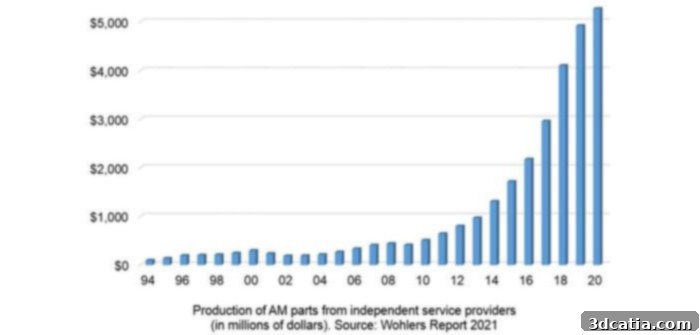
In general, 3D printing services experienced good growth in 2020 (photo credits: Wohlers Associates)
Investments, Acquisitions, and the Maturation of the Additive Manufacturing Market
Strategic Capital Inflows Propel Industry Forward Amidst Challenges
While 2020 presented economic headwinds for some segments, it paradoxically witnessed an invigorated landscape of investments, significant fundraising rounds, and notable stock market listings within the additive manufacturing sector. This surge in capital infusion underscores a profound confidence in the long-term potential and transformative capabilities of 3D printing technologies, despite the short-term market volatility. A prime example is Desktop Metal, which successfully announced its initial public offering (IPO) in the summer of 2020 through a special purpose acquisition company (SPAC) business combination. The report meticulously details that Desktop Metal’s market capitalization impressively exceeded $7.5 billion by February 2021, signifying strong investor belief in its innovative metal 3D printing solutions and aggressive market strategy. Another compelling instance is DyeMansion, a leading manufacturer of post-processing solutions critical for industrializing additive manufacturing. DyeMansion successfully raised $14 million in funding, a strategic move aimed at accelerating the development and deployment of solutions that enable the production of high-quality, finished parts. This investment is not just about financial growth; it represents a significant vote of confidence in the technology’s evolution from prototyping to reliable end-part production, addressing a crucial bottleneck in the additive manufacturing workflow.
The trend of market consolidation and strategic expansion continued into more recent times with several high-profile acquisitions that are reshaping the competitive landscape. These include the significant acquisition of 3D Hubs by Protolabs, a move that vastly expands Protolabs’ network and on-demand manufacturing capabilities, integrating a leading online platform for custom manufacturing. Simultaneously, Desktop Metal continued its aggressive growth strategy with the acquisition of EnvisionTec, a renowned pioneer in photopolymer 3D printing. These strategic maneuvers are far from trivial; they collectively bear witness to a robust and dynamic industry that is actively maturing, consolidating, and preparing for accelerated growth in a post-pandemic world. Such movements indicate a strategic positioning by major players to capture larger market shares, integrate complementary technologies, and enhance their overall value propositions, ultimately benefiting the entire additive manufacturing ecosystem. The comprehensive findings and detailed analysis of these trends are available for download in the full report HERE, offering invaluable insights for anyone involved in or impacted by the additive manufacturing industry.
The Wohlers Report 2021 serves as a critical compass for navigating the evolving landscape of additive manufacturing, providing a nuanced perspective on how the industry not only weathered a global crisis but also leveraged it to demonstrate its intrinsic value and resilience. The report underscores that while growth rates may have temporarily adjusted, the underlying fundamentals – innovation, investment, and increasing adoption for production – remain incredibly strong. The focus on overcoming challenges like hidden costs, streamlining post-processing, and improving inspection methods indicates a concerted industry effort towards greater industrialization and mainstream integration. As 3D printing continues to prove its versatility, from aiding medical emergencies to revolutionizing product development and supply chain management, the insights from the Wohlers Report are indispensable for stakeholders looking to understand, invest in, or contribute to this transformative technology.
What are your thoughts on the key findings of the Wohlers Report 2021? We encourage you to share your perspectives and engage with the broader community. Let us know your opinions in a comment below or connect with us on our Facebook, Twitter, and LinkedIn pages! For the latest breaking news and developments in the world of 3D printing, sign up for our free weekly Newsletter here and have the most important industry updates delivered straight to your inbox!