

Revolutionizing Power Transmission: The Unmatched Potential of 3D Printed iglidur® Plastic Gears with SLS Technology
For centuries, gears have stood as fundamental components in virtually every machine, from simple clocks to complex industrial machinery. Their primary role in transmitting power efficiently, altering speed, and changing rotational direction is indispensable. However, the traditional manufacturing of these critical elements often presents significant challenges. Achieving optimal performance necessitates meticulous design and precise material selection to minimize friction loss during power transmission. Conventional production methods, such as machining or casting, typically offer limited scope for true optimization, especially when it comes to custom gears. The process is inherently costly, requiring multiple individual manufacturing steps, and often demanding the creation or purchase of specialized tools for each unique design. This economic and logistical barrier has historically constrained innovation in gear design.
A groundbreaking alternative has emerged through the advancements in Selective Laser Sintering (SLS), a prominent Additive Manufacturing (AM) process. SLS technology offers a revolutionary solution by enabling the production of complex gear geometries in a single piece, entirely without the need for additional tooling. When combined with the innovative development of iglidur® high-performance polymers by igus, this technology truly shines. This powerful synergy facilitates the creation of highly customized plastic gears that are poised to transform numerous industries. These advanced gears boast significantly increased service life and remarkably low friction values, offering unparalleled performance benefits. Beyond their impressive longevity, 3D printed gears crafted from iglidur® materials exhibit exceptional efficiency, rivaling even lubricated metal gears with only a minimal difference. The accessibility of this innovation is further enhanced by igus, allowing engineers and designers to conceptualize and order these bespoke plastic gears directly from the igus website using their free CAD configurator, with the convenience of ordering quantities as small as a single part through the igus 3D printing service.
Unlocking Design Freedom with 3D Printed iglidur® Gears
As highlighted, the advent of SLS technology has dramatically simplified the production of customized plastic gears, opening doors to previously unattainable design possibilities. Fundamentally, any gear with a minimum wall thickness of 0.5 mm can be precisely manufactured using this method. The primary limiting factor remains the build volume of the SLS printer, which is continuously expanding with technological advancements. This freedom from traditional manufacturing constraints empowers engineers to explore complex geometries and intricate designs that would be impossible or prohibitively expensive to produce otherwise. For instance, designers can leverage this flexibility to achieve significant weight reduction without compromising strength or functionality, a crucial advantage in applications where mass is a critical performance parameter.
Beyond design versatility, SLS-based production of iglidur® gears offers substantial economic benefits compared to conventional mechanical manufacturing. These cost advantages stem from more efficient material utilization, as the additive process generates minimal waste, and significantly shorter production times. Unlike subtractive methods that carve parts from larger blocks of material, SLS only uses the powder necessary to build the component, making it incredibly resource-efficient. Furthermore, the design itself plays a far more influential role in extending the product’s service life. Traditional methods often require simplification of gear geometries due to manufacturing limitations. In stark contrast, 3D printing allows for optimal adaptation of gear tooth profiles and overall structures directly within the print model, leading to superior resistance, reduced stress concentrations, and a lower shaft calculation in the final product. This precision engineering results in components that are not only more durable but also operate with greater efficiency and reliability in demanding applications.
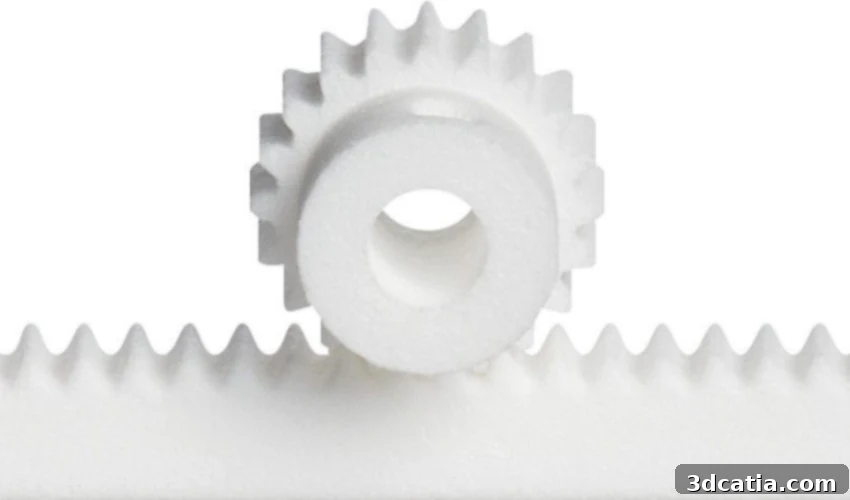
Any cog edge with a minimum wall thickness of 0.5 mm can be manufactured with SLS. (Picture credits: igus)
The choice of material represents another pivotal quality feature, especially given that not all plastics are created equal. igus has invested extensively in developing its unique iglidur® materials, renowned for their exceptional tribological properties. These specialized polymers are engineered to exhibit excellent friction values and minimal wear, making them perfectly suited for dynamic, moving applications like gear wheels. The integrated solid lubricants within iglidur® materials eliminate the need for external lubrication, reducing maintenance requirements and preventing contamination. While all iglidur® materials offer superior performance, some are specifically optimized for certain applications. For instance, iglidur I3 stands out for its high strength, making it an ideal choice for spur and bevel gears that encounter significant loads. For applications demanding optimized gliding capabilities, particularly worm gears, iglidur I6 offers superior performance. Moreover, for scenarios requiring electrostatic discharge (ESD) properties, iglidur I8-ESD provides a tailored solution. Recognizing that service life is inherently dependent on application parameters, igus provides a free online service life calculator on their website. This invaluable tool enables users to accurately estimate the expected service life of their custom plastic gears, taking into account specific operational conditions and chosen iglidur® material.
Strategic Manufacturing: 3D Printing vs. Injection Molding
The experts at igus emphasize that the decision between manufacturing gears using 3D printing and traditional injection molding should always be made on an application-specific basis, considering factors like volume, complexity, material properties, and lead time. As a general rule of thumb, for very high-volume production, such as an order for 10,000 gears, injection molding typically proves to be the more economical choice in the long run due to lower per-part costs once the initial mold investment is amortized. However, 3D printing plays a critical and complementary role even in these scenarios. Additive manufacturing excels at producing initial prototypes rapidly and cost-effectively, allowing for quick design iterations and functional testing before committing to expensive tooling. Furthermore, 3D printing can even be utilized to manufacture the injection molds themselves, especially for complex designs or when smaller batch molds are needed, which can then be used to produce a large quantity of gears with consistent material properties. This hybrid approach offers unparalleled flexibility and cost efficiency, especially for intricate components.
This strategic synergy also extends to gears requiring specialized plastic properties, such as fire-retardant characteristics, chemical resistance, or specific electrical insulation. While traditional injection molding can also produce parts from special plastics, 3D printing offers a more agile and cost-effective route for low-to-medium volume production of such specialized components, avoiding the significant upfront cost and lead time associated with custom injection molds for niche materials. With this comprehensive flexibility, igus effectively empowers customers with a cost-effective, customized, and highly adaptable solution for both individual prototypes and specialized series production of unique parts, bridging the gap between rapid development and scalable manufacturing. The ability to quickly adapt to changing market demands and technological advancements gives businesses a competitive edge in today’s fast-paced industrial landscape.
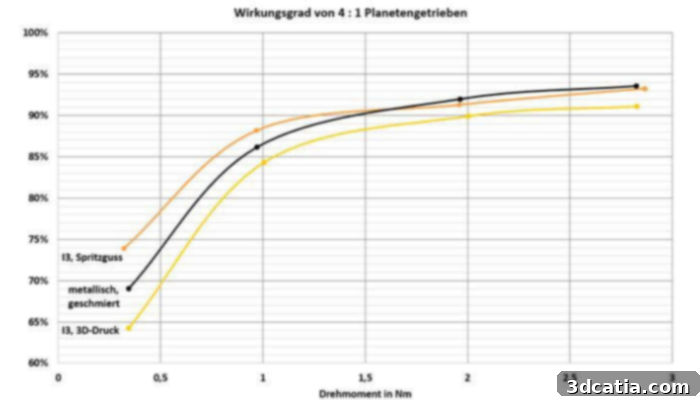
Comparison of the efficiency the different manufacturing processes (photo credits: igus)
Real-World Impact: 3D Printed Plastic Gears in Action
The transformative capabilities of 3D printed iglidur® plastic gears are best illustrated through their successful implementation across diverse and demanding applications. These real-world examples underscore the material’s robustness, the manufacturing process’s agility, and the significant advantages over conventional solutions.
Precision and Endurance for High-Performance Racing
One compelling example comes from the Formula Student team at Weingarten, a group dedicated to building high-performance racing cars. For a critical component within their chain drive – a customized plastic sprocket serving as a chain tensioner – the team faced the perennial challenge of long production and delivery times associated with industrially manufactured individual parts. Seeking a rapid and reliable solution, they turned to igus’s 3D printing service. The result was astonishing: the required pinion, crafted from iglidur I6 using SLS, was manufactured in less than 72 hours. This quick turnaround was invaluable, but the true benefit lay in the part’s performance. Richy Göser from the Formula Student Team Weingarten vividly articulated the improvement: “The ball bearings used so far in the chain drive have barely lasted more than 20 kilometers – which is unfavorable because our longest race is 22 kilometers long. From the 3D-printed sprockets from igus® we expect […] a significantly higher robustness.” This testimonial underscores how igus’s 3D printed gears not only accelerated their build process but also drastically improved the durability and reliability of a vital component, allowing the team to push the limits of their racing vehicle.
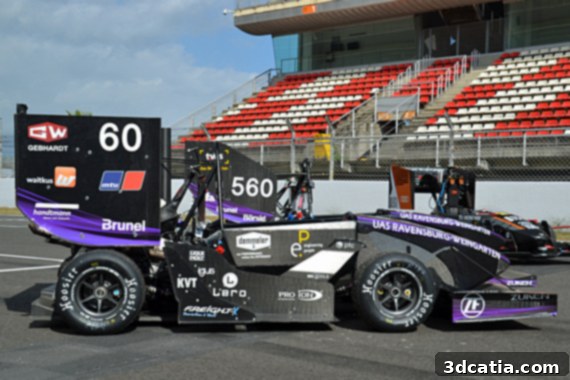
This race car contains the 3D-printed plastic pinion (photo credits: igus)
Reviving Classics: Custom Parts for Vintage Cars
The utility of plastic gears extends beyond the cutting edge of racing to the meticulous preservation of automotive history. Dr. Jörg Pühler, the proud owner of a Stanley 750B from 1924, faced a common dilemma for vintage car enthusiasts: the need to replace a defunct spare screw in his speedometer. Parts for such antique vehicles are notoriously difficult, if not impossible, to source, and the exact dimensions of the original component were unknown. Dr. Pühler required a manufacturing method that was both cost-effective and capable of producing high-quality, precise replacements. His solution was found in 3D printing. The inherent flexibility of adjusting a CAD model allowed for the rapid and comparatively inexpensive production of several prototypes, ensuring a perfect fit without costly trial-and-error in traditional machining. The chosen material, iglidur I6, provided not only the necessary stability but also a significant advantage: its integrated solid lubricants eliminated the need for external lubrication, a crucial benefit for a part nestled within a classic car’s delicate mechanisms. This case demonstrates 3D printing’s power to bridge the gap between historical preservation and modern manufacturing capabilities.
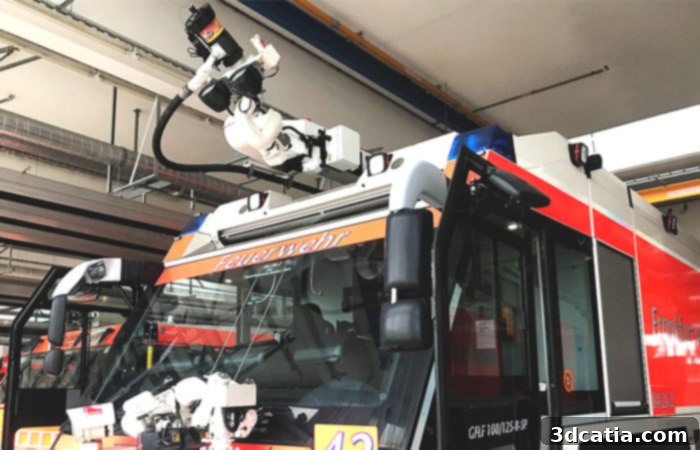
The 3D gear is strong enough to be used by the fire department (photo credits: igus)
Critical Reliability: Gears for Airport Fire Engines
The application scope of igus’s 3D printed plastic gears is not limited to land-based vehicles; it extends to the critical infrastructure of airports. The Frankfurt am Main airport fire department sought a cost-effective solution for the maintenance of the roof-mounted projector actuators on their large airport fire engines. Markus Brummer from the department explained the challenge: “The launcher can change the angle of the spray nozzle by means of a servomotor (in which the two gears are installed). Since this height change also takes place under water discharge, we have a high load on the gear wheels. After 10 years in use, the old gears are now slowly breaking down. The manufacturer recommends replacing the entire actuator, which is obviously very costly.” Facing the prospect of an extremely expensive full actuator replacement, the department decided to test 3D printed plastic gears from igus. The primary concern was whether these gears could withstand the intense loads and harsh conditions, including operation under water discharge. Following rigorous testing that confirmed their durability and reliability, the airport fire department confidently ordered more gears. Their satisfaction was so profound that Markus Brummer offered a strong recommendation: “We would recommend igus immediately, as we have now also had a second component, which controls the pneumatic doors of our large fire engines, manufactured by them.” This endorsement highlights the trust and performance capabilities of igus’s 3D printed solutions in mission-critical applications where failure is not an option.
The examples above vividly demonstrate the immense versatility, economic advantages, and performance reliability of 3D printed iglidur® plastic gears. From boosting the performance of race cars and preserving automotive heritage to ensuring the operational integrity of critical safety equipment, these advanced components are truly reshaping expectations for power transmission elements across industries.
What are your thoughts on these innovative 3D printed plastic gears? We invite you to share your perspectives in a comment below or join the conversation on our Facebook, Twitter, and LinkedIn pages! Stay informed about the latest advancements in additive manufacturing by signing up for our free weekly Newsletter here, delivering the freshest 3D printing news straight to your inbox!