
One morning in my elementary school music class, the teacher brought an assortment of instruments for us to explore and see which one might spark our interest. I tried a violin, a cello, a tuba and a flute, and when it came to wind instruments I could barely produce a sound. I didn’t know how to control my breath or position my lips, and the best I managed on a trumpet was a single, embarrassing squeak. I never joined the school band. Looking back, I wonder how different it might have been if a simple positioning guide like the one recently developed by the Institute of Science Tokyo had been available.
Researchers at the Institute of Science Tokyo have created a digitally fabricated guide that reproduces the exact spatial relationship between a player’s lips and an air-reed instrument. The device is a small, wearable guide that sits between the musician’s chin and the instrument to ensure consistent, correct positioning. The project grew from an effort to test whether digital workflows and design principles commonly used for prosthodontic surgical guides can be applied outside the mouth. For their proof of concept, the team focused on the shakuhachi, a traditional Japanese end-blown bamboo flute known for its subtle embouchure demands.
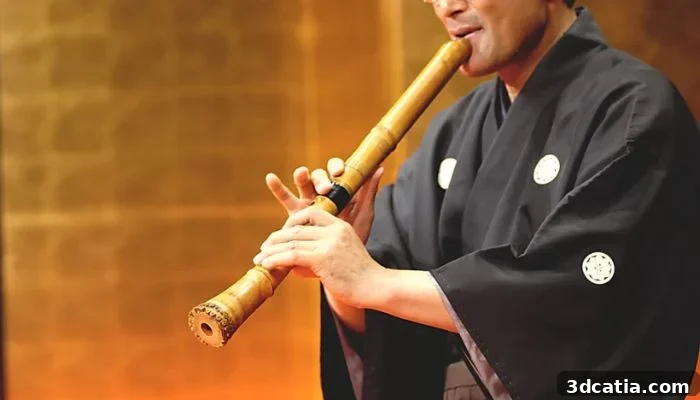
The shakuhachi is made from bamboo. (Photo Credit: Gen)
The shakuhachi presents a steep learning curve for beginners, who must coordinate lip shape, breath angle, and instrument placement to create the correct tone. Because this coordination involves subtle three-dimensional relationships, it is difficult to convey through observation or verbal instruction alone. The researchers noted that the lack of clear visual and tactile references often slows the development of a reliable embouchure, so they set out to design a device to provide those references directly.
How Was The 3D Printed Flute Guide Created?
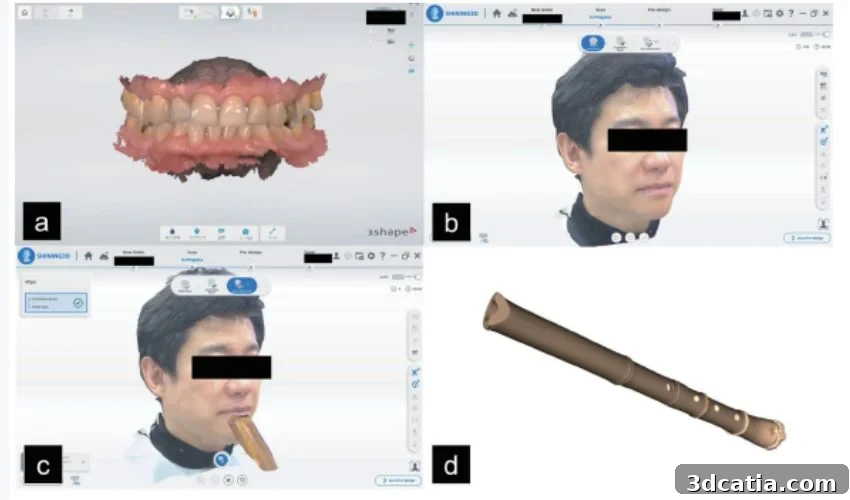
The team began by scanning the shakuhachi and taking facial and intraoral scans of an experienced male player while he assumed his optimal playing position. Capturing the musician in mid-performance allowed the researchers to record the precise spatial relationship among the face, lips, and instrument that produces the desired sound.
These scans were imported into CAD software, where dental landmarks, the occlusal plane, and facial reference points were used to reconstruct the embouchure geometry. From that digital model, the researchers designed a roughly spherical insert about 70 mm in diameter to occupy the space between the musician’s chin and the shakuhachi. That solid form was then hollowed to produce a lightweight guide tailored to the player’s dentofacial anatomy. Because the guide was intended for stereolithography production, a drain window was included in the design to allow uncured resin to escape during post-processing. The chosen material was a biocompatible photopolymer commonly used for dental surgical guides so the guide could be disinfected and sterilized safely.
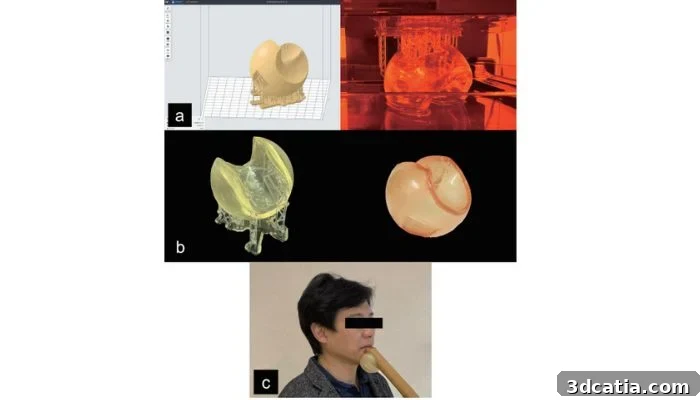
The fabrication of the air-reed instrument guide. (Image credit: Hada et al.)
The finished guide is custom fitted to the player’s facial structure, with a hollow core and thin walls to keep it light and comfortable during use. A bracing arm can be added or adjusted to fine-tune the instrument’s position relative to the lips. When an expert player tested the prototype, the guide scored highly for stability, fit and overall usability, suggesting the concept can effectively support consistent embouchure formation.
“Beyond music education, we expect this concept could potentially be extended to maxillofacial prosthetics, orofacial rehabilitation, and other extraoral devices requiring precise perioral spatial control,” said Assistant Professor Tamaki Hada, who led the project with Professor Manabu Kanazawa. The work demonstrates that digital design and additive manufacturing techniques developed for dental and surgical applications can be adapted to support entirely different skill sets, such as musical instrument performance.
This approach may be particularly valuable for beginners, music educators and therapists: a simple, hygienic guide can provide immediate tactile feedback and a repeatable reference for embouchure placement, reducing frustration and accelerating early progress. In clinical contexts, similar devices could be repurposed to help patients relearn or stabilize oral and facial motor patterns after surgery or injury, offering a noninvasive adjunct to traditional therapy.
What do you think of this research and its potential uses? Are there other instruments or clinical applications where a custom spatial guide might help learners or patients? Share your thoughts and experiences with embouchure training, rehabilitation, or digital prosthetic design.
Cover image: 3D scans of the face and shakuhachi. Image Credit: Hada et al.