
Bambu Lab faced a difficult week in court. On September 17, a federal jury in the Eastern District of Texas ordered the company to pay Stratasys $27.6 million after finding that four entities associated with Bambu Lab had willfully infringed four Stratasys patents related to 3D printing. This verdict is the first outcome in a larger legal dispute between the two companies that began in August 2024; another trial in the case remains pending. Bambu Lab has pursued its own challenges at the patent office, but this particular trial favored Stratasys.
In a statement released on September 18, Bambu Lab said it respects the judicial process but disagrees with the jury’s verdict. The company noted it intends to pursue post-trial review and appeals, exercising the legal options available to it.
A few days after the verdict, Bambu Lab announced a new product: its first laser engraver. Whether by timing or strategy, the launch marked a notable expansion beyond the company’s established portfolio of FDM 3D printers.

Bambu Lab Enters a New Category with a Laser Engraver
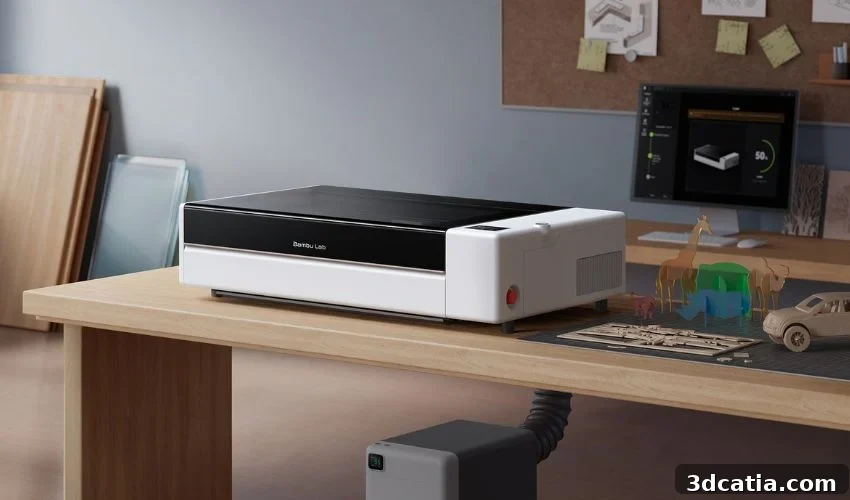
On September 22, Bambu Lab unveiled the R1, a 55W CO2 laser cutter and engraver, its first product not directly tied to additive manufacturing. The R1 is designed to cut and engrave a wide range of materials, including wood, acrylic, leather, paper, and fabric. It can also engrave glass, stone, and coated metal. The machine is capable of cutting up to 18 mm plywood and 20 mm acrylic on a workbed measuring 600 x 300 mm, and with an optional Conveyor accessory it can accommodate stock up to three meters long.
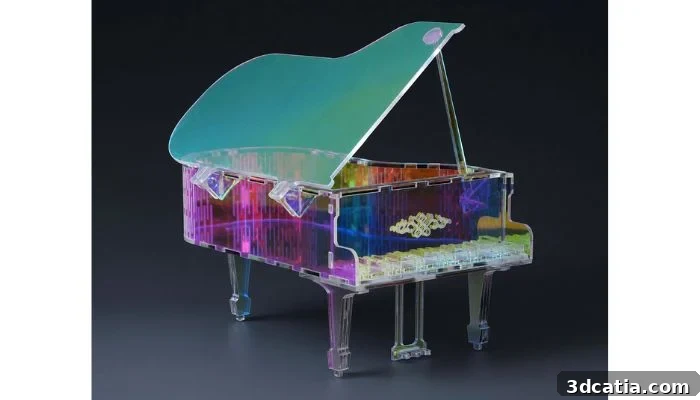
An example of engraved acrylic material.
What Makes the R1 Different From Other CO2 Lasers
The R1’s headline feature is Auto Laser Alignment. Traditional CO2 lasers typically require manual mirror alignment using test burns and iterative adjustments; Bambu Lab’s system senses the beam and automatically corrects the optical path with motorized actuators in about a minute, eliminating the need for manual test burns. If it works consistently, this feature could noticeably reduce setup time and improve day-to-day usability.
The R1 also incorporates a TriSense System, which combines three sensing elements to prepare the machine before cutting. A BirdsEye camera captures the entire work area, a second toolhead-mounted camera focuses on a precise region of the material, and a pinpoint laser marks the exact cut target. A distance-measuring laser reads surface height and dynamically adjusts focus to maintain sharp results on uneven or curved surfaces. Real-time XY encoders track the toolhead position so the system always knows its exact location during a job. Bambu Lab claims this combination enables outline tracing and cutting with accuracy under 0.2 mm.
Several technologies are adapted from Bambu’s 3D printers. Vibration compensation reduces mechanical resonance to prevent jagged edges when the head changes direction sharply, a technique the company previously used to minimize ringing in printed parts. The R1 also dynamically modulates laser power to compensate for speed variations, preventing darker burns in slow areas and lighter marks in fast sections. That synchronization allows consistent engraving tones even at high speeds, reportedly up to 1000 mm/s.
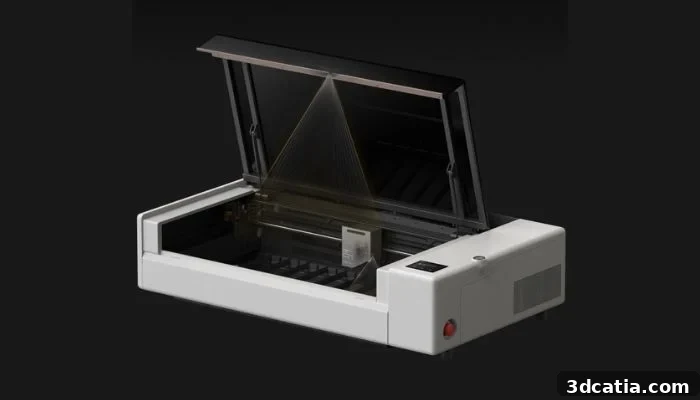
The R1 Laser Engraver aligns its own optical path in about a minute.
The R1 integrates with Bambu’s existing software ecosystem, connecting to MakerWorld accounts and the Bambu Suite application that owners of the company’s printers already use. This should minimize the learning curve for current customers. Pre-orders for the R1 opened the day of the announcement, with pricing set at $2,499 in the US and €2,499 in the EU, and shipments scheduled to begin in October.
The product launch signals Bambu Lab’s intent to broaden its hardware offerings beyond 3D printing and shows how the company is applying its motion control and automation expertise in new domains. The R1 aims to make laser cutting and engraving more approachable through automation and integrated sensing, while preserving capabilities expected by makers and small businesses.
What are your thoughts on Bambu Lab entering the laser engraving market? Share perspectives in the comments or with other users in the community. Photo credits for the product images belong to Bambu Lab.
*All photo credits: Bambu Lab
