
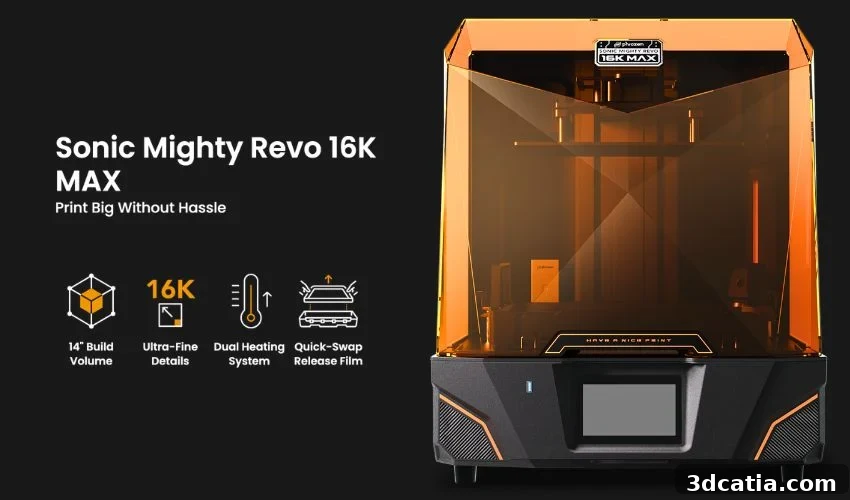
Phrozen has addressed a longstanding gap in its lineup. Until now, anyone seeking the company’s finest resolution had to choose the Sonic Mighty Revo 16K, a machine with outstanding detail but a limited 211.68 × 118.37 × 235 mm build volume. Those needing larger prints turned to the Sonic Mega 8K S, which provided scale but at a coarser 43 µm pixel size. To produce a large display model with crisp detail meant accepting compromises or slicing models apart and assembling them afterward.
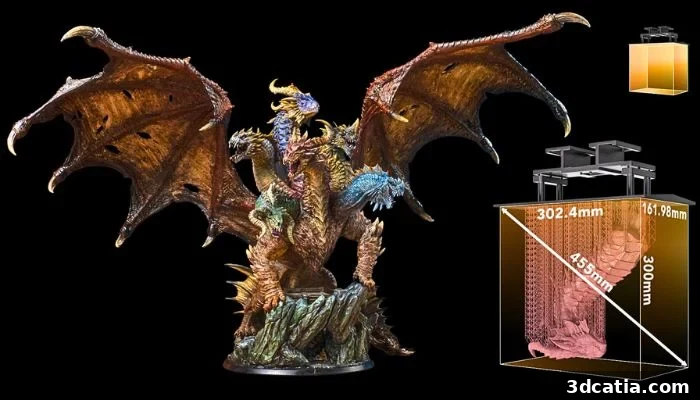
The Sonic Mighty Revo 16K MAX—branded by Phrozen as the Revo MAX—bridges this divide by combining greater build volume with high pixel density. It pairs a 14.7 L build envelope (302.4 × 161.98 × 300 mm) with a 14-inch 16K monochrome LCD, giving creators both scale and precision in a single machine.
Beyond screen size and pixel counts, practical studio features matter just as much. Long multi-day prints are vulnerable to common problems: cold environments that thicken resin, vats that run dry overnight, or downtime from fiddly maintenance like replacing release films. Phrozen designed the Revo MAX around these real-world concerns. At a $1,600 list price the machine includes a standard chamber heater, a 2 L vat to reduce refill interruptions, and a quick-release film system that swaps without tools. An optional heated vat is available separately to complete the dual-heating setup. Early pre-orders opened in Taiwan with first shipments scheduled soon after.
Resolution spread across a larger plate
Phrozen labels the machine 16K because the panel has roughly 15,000 pixels along its long axis. On a 14-inch screen that translates to an effective pixel footprint of approximately 20 × 26 µm, compared with about 14 × 19 µm on the smaller Mighty Revo. This difference reflects geometry rather than a flaw: both screens house nearly the same total pixel count, but the MAX’s panel is about 40% wider, so each pixel occupies more area. To compensate, the Revo MAX includes anti-aliasing to smooth details that exceed single-pixel resolution.
File ceiling and real-world workflow
A higher file-size limit makes daily work much easier. The Revo MAX accepts sliced files up to 10 GB, a meaningful increase over the 2 GB cap on the smaller Mighty Revo. Packing a 14-inch plate with dense, high-detail models creates very large slice files; on a machine limited to 2 GB you’d be forced to split a single plate into multiple jobs. The larger file ceiling simplifies single-run jobs and reduces slicing overhead for high-density builds.
Speed and peel physics
Larger format printing affects speed because each layer must separate from the vat’s transparent film before the next layer forms. Wider layers cling more strongly, so the printer must lift more slowly to avoid tearing parts free. Phrozen reports an average of about 245 layers per hour on the Revo MAX, compared with a 676 layers-per-hour maximum on the smaller machine. Users moving up from mid-size printers should expect longer run times for large-format, high-detail prints.
Dual heating: chamber and vat
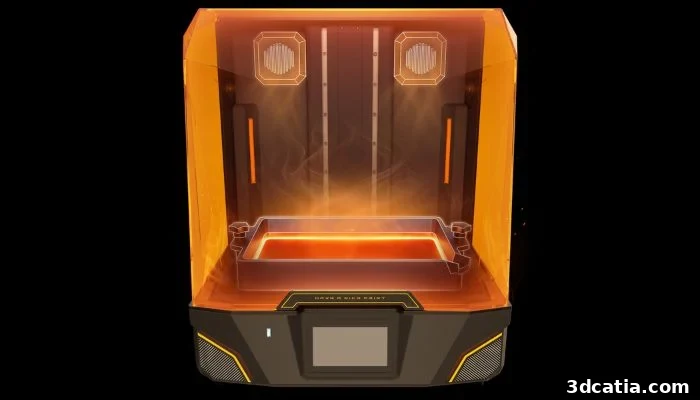
Resin that becomes cold and viscous shows poor first-layer adhesion and can cause layer separation mid-print. While many large-format models only heat the vat, Phrozen offers a dual approach. The Revo MAX includes a dual-fan chamber heater that warms the enclosure air to around 30 °C; this heater operates in an on/off mode. For high-viscosity resins, an optional heated vat is available to directly warm materials up to 4,000 cps. Together, the chamber heater and optional heated vat help maintain consistent resin flow and adhesion across long prints.
Fewer interruptions on long jobs
The Revo MAX’s 2 L vat holds roughly two and a half standard resin bottles, enabling extended runs without an automated feeder. Phrozen argues a larger vat avoids the leaks, clogs, and mechanical failures that pump-based systems can introduce. Other vendors choose smaller vats paired with automated refill systems; each approach has trade-offs between continuous operation and added mechanical complexity.
Phrozen also addressed several common maintenance pain points to reduce downtime:
- Tool-free film swaps: The quick-release release film can be replaced in about three minutes without tools.
- Quick-release LCD and build plate: The LCD is removable after loosening a single screw. The build plate has dual side handles for secure handling and a sloped top to let excess resin drain back into the vat instead of requiring scraping.
- Enclosed drip rack: An internal hanger holds the build plate above the vat to drain after printing while the lid remains closed to limit mess and contamination.
Monitoring built for unattended runs
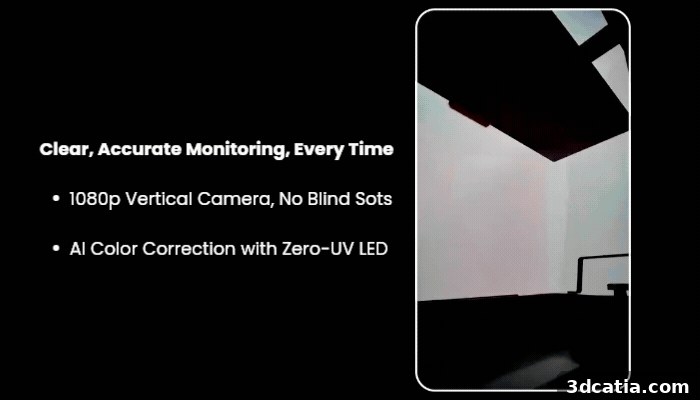
The Revo MAX includes a downward-facing 1080p camera that views the build plate directly, preventing the growing build from obscuring the lens during long prints. Dual UV-free amber light bars illuminate the chamber without curing resin, and built-in AI color correction adjusts images to counteract the amber tint that typically skews remote snapshots. These features improve remote monitoring for unattended or overnight jobs.
Fail-safes and reminders
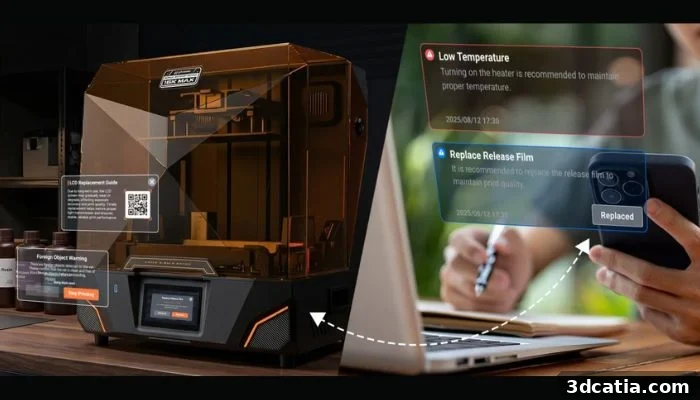
The printer watches for print failures and foreign objects in the vat. It can resume a job after a power loss, continuing from the exact layer where it stopped; Phrozen cautions a faint restart line may be visible. The system also issues maintenance reminders for the Z-axis, the LCD, and release film replacement. A four-color status light on the front displays success, running, preparing, and error states so multiple machines can be monitored from across a room.
Smart leveling and exposure calibration
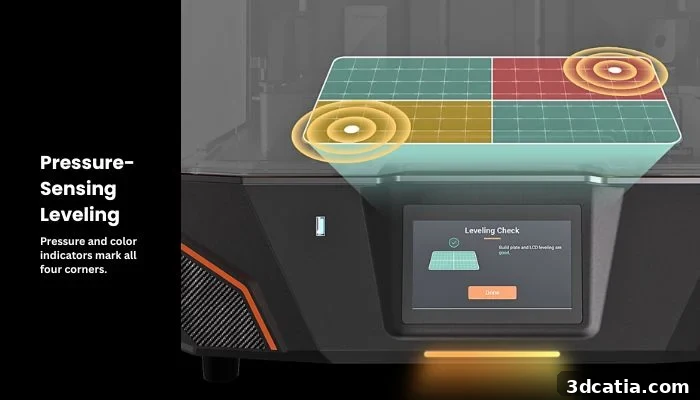
Calibration is simplified with two built-in software tools. A pressure-sensing assist displays real-time force readings for all four corners during manual leveling, removing guesswork when balancing the build platform. A zonal exposure test prints multiple exposure settings on a single test model—two, four, six, or eight zones—making it faster to identify the best exposure after changing resin types or compensating for seasonal temperature shifts.
Market position and comparisons
The 14-inch segment is competitive. Several rivals offer similar build volumes and resolution at different price points. Phrozen positions the Revo MAX above many competitors by emphasizing its supporting features rather than just raw pixel density. Notable differentiators include the standard chamber heater combined with an optional heated vat, a large 2 L vat that reduces the need for feeds, a downward-facing 1080p camera with AI color correction, and quick-release systems for the film, LCD, and build plate—all aimed at professional workflows and reduced downtime.
Who it’s for and what it prints
Phrozen targets professional model makers, independent studios, and small-batch manufacturers. Typical use cases include full-size 28 mm wargaming figures printed at high detail, 20–30 jewelry wax patterns per plate using high-wax castable resins, and single-piece engineering enclosures for prototyping. Pre-production units were tested by creators and reviewers, with broader independent reviews expected after full launch.
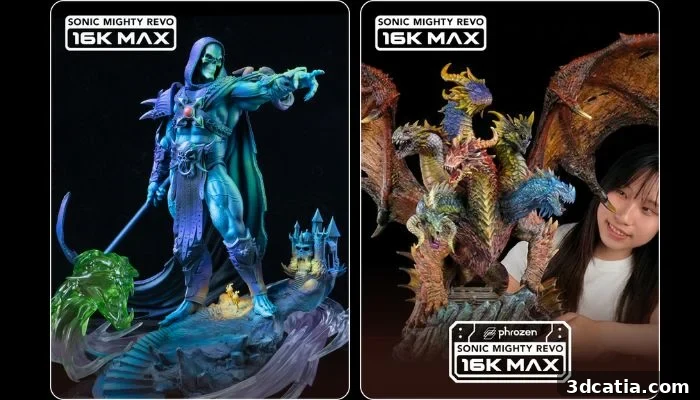
Sample prints from the Phrozen Sonic Mighty Revo 16K MAX. Left: Model designed by @zez.studios, painted by @wormxp. Right: Model designed by @loot.studios, painted by @yong_cheng99 and @dream_worker66.
All photo credits: Phrozen