Professional ballet dancers often go through hundreds of pairs of pointe shoes each year. That constant turnover makes pointe shoes both costly and environmentally unfriendly. German startup act’ble aims to change this by rethinking the classic pointe shoe with contemporary manufacturing methods and a modular design.
Ballet began in Europe in the 15th and 16th centuries, and the specialized construction of the pointe shoe was refined by Italian shoemakers in the 19th century. Since then, the basic concept has remained largely unchanged. Traditional pointe shoes are still predominantly handmade: skilled makers layer fabric, paper, glue and satin around a shaped last to form the rigid toe box and supportive structure.
That long-standing design persists largely because of tradition rather than optimal performance. Dancers routinely have to break in, pad and modify every pair to fit their feet and technique. Professional dancers often find a pair of pointe shoes only lasts a single performance day before the shank softens and support is lost. The result is one of ballet’s most expensive and least sustainable pieces of equipment, and recurring foot pain and injury are common consequences.
A modular pointe shoe
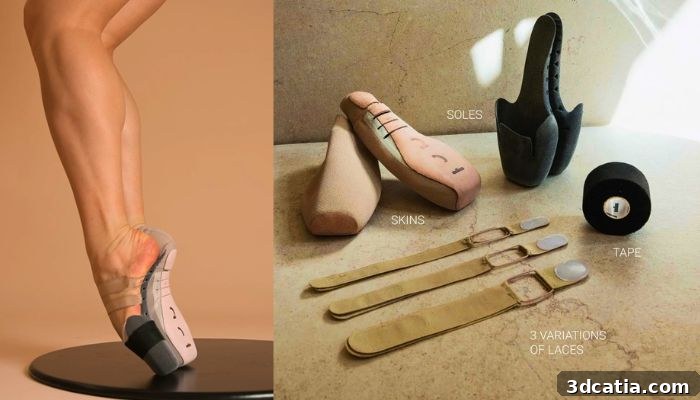
act’ble approaches the problem with an additive-manufacturing mindset. The company’s shoe is modular, composed of three main parts: a 3D-printed sole, a knitted skin, and a system of supporting laces. The intent is to allow dancers to repair or replace the worn component instead of discarding the entire shoe.
The core is a 3D-printed inner sole made from a high-performance TPU engineered specifically for the unique demands of dancing en pointe. The sole incorporates strategically placed incisions that segment it so the shoe can flex naturally when the foot is flat and then lock into a rigid configuration as the dancer rises onto the toes. This dynamic behavior supports the foot at the exact moment weight transfers to the pointe, addressing limitations of traditional constructions that can restrict natural foot mechanics.
Encasing that sole is a knitted skin that fits like a sock. Beyond simply holding the sole to the foot, the knitted layer provides compression that redistributes pressure away from the toes and across a larger surface of the foot. This even load distribution reduces localized stress and can improve comfort during demanding rehearsals and performances.
Hidden beneath the knitted skin, a set of laces does more than fasten: they bear load. These laces click into the sole and wrap around the foot to lift and stabilize the arch so that weight does not rest solely on the toes. The laces are offered in several widths, which allows dancers to tune the shoe to their strength and foot shape. Narrower options preserve flexibility for less experienced dancers, while wider laces give stronger, higher-arched feet a firmer platform.
Durability on pointe
Major ballet companies consume thousands of pointe shoes each year. For example, a large professional company can use several thousand pairs annually, representing a significant financial and environmental cost. Recycling traditional pointe shoes is still not common practice, so most worn pairs end up discarded.
act’ble’s modular approach directly targets longevity and sustainability alongside comfort. Because the shoe’s elements are replaceable, dancers can swap out the worn component—whether that is the sole, the knitted skin, or the laces—without discarding the entire shoe. The company reports that its modular shoes can last significantly longer than conventional handmade pointe shoes, reducing waste and the need for frequent replacements.
From prototype to production
Founder Sophia Lindner developed the initial concept while training as a ballet dancer and later studying design. Her first prototype, created as a bachelor’s thesis in 2018, was intended as an experiment rather than a commercial product. Feedback from dancers, choreographers and dance medicine specialists, however, prompted continued development. Over many design iterations, Lindner refined the form and function, producing new 3D-printed prototypes at a rapid pace to test and improve the concept.
Manufacturing has evolved alongside the design. Early versions used different fabrication technologies, while later production shifted to industrial additive-manufacturing processes suited to footwear. These production techniques enable consistent parts, repeatable performance, and scalable manufacturing—key factors in bringing a novel footwear concept to the wider dance community.
The potential advantages of a modular, 3D-printed pointe shoe include better fit and comfort, reduced waste, and longer usable life for each shoe. Whether a dancer or a company adopts this approach will depend on testing, personal preference and cost, but the innovation demonstrates how modern materials and manufacturing can revisit century-old traditions with practical, sustainable improvements.
*All photo credits: act’ble