
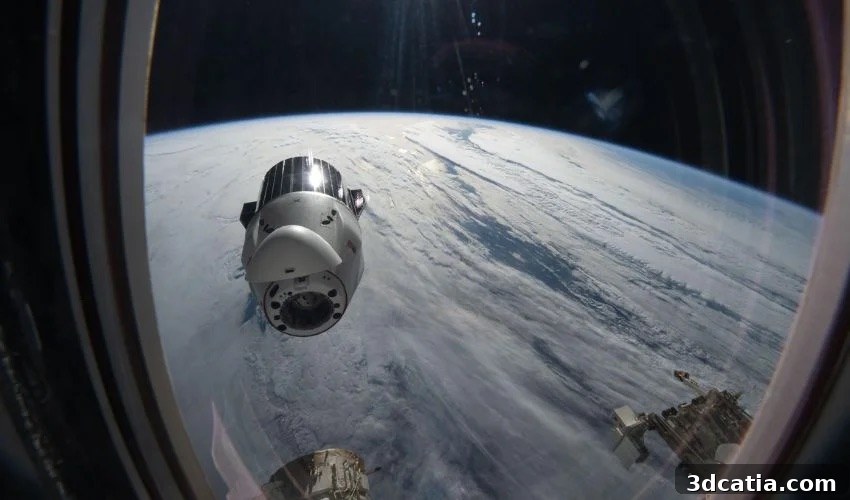
The American company Auxilium Biotechnologies has for the first time successfully 3D-printed kidney and liver tissue in space. The experiment took place aboard the International Space Station (ISS) using the station’s AMP-1 orbital bioprinter. The printed samples returned to Earth on June 17, splashing down off the coast of California as part of NASA’s SpaceX CRS-34 mission. The objective of the work was to advance the manufacturing of biomedical products beyond Earth and demonstrate that complex biological structures can be produced in microgravity.
Bioprinting depends on bio-inks—mixtures of living cells and supportive biomaterials that are deposited layer by layer to form tissue-like structures. Bringing bioprinting into orbit opens new possibilities for producing tissues and biological models directly in microgravity. Manufacturing organ models in space could reduce reliance on Earth-based supply chains and launch schedules, enabling researchers to obtain samples on demand for experiments and therapeutic development.
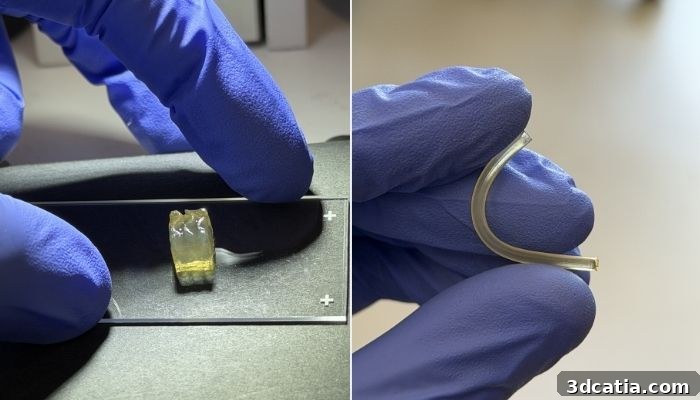
Tissue sample (left) and a nerve repair implant, both bioprinted aboard the International Space Station (ISS). (Credit: Auxilium Biotechnologies)
Auxilium focused the mission on producing organoids—miniature, three-dimensional models that mimic the structure and function of human organs. Organoids are valuable for studying disease, screening drugs and predicting clinical responses, and they provide an alternative to animal testing. To date, most organoids are fabricated on Earth and then launched into orbit for research. Successfully bioprinting organoids in situ would allow teams to generate models as needed during orbital experiments, increasing flexibility and speeding scientific workflows.
During the mission, the AMP-1 platform printed samples of kidney and liver tissue, cartilage, and 28 implants designed for nerve repair. The operation demonstrated that a single autonomous manufacturing system can produce both living tissue constructs and implantable medical devices in the same flight. The tissues were printed in collaboration with the Wake Forest Institute for Regenerative Medicine (WFIRM), which provided the cellular materials and tissue models. “The successful bioprinting of living liver and kidney tissue aboard the International Space Station marks a major advance for regenerative medicine,” said Anthony Atala, professor of medicine and director of WFIRM.
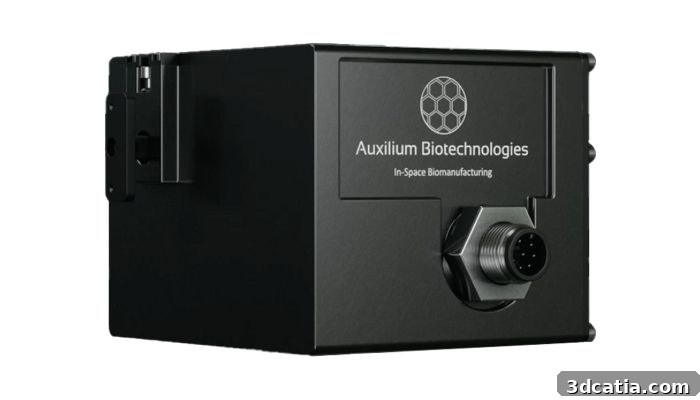
Auxilium’s In-Space Biomanufacturing platform. (Credit: Auxilium Biotechnologies)
This achievement arrives as low Earth orbit undergoes a transition from the International Space Station toward a future that includes commercial platforms. Auxilium has been engaging with companies developing next-generation commercial stations and has discussed opportunities to extend its technology beyond Earth, potentially to lunar habitats and long-duration missions. Jacob Koffler, CEO of Auxilium, described the milestone as a step toward establishing practical production capabilities for biomedical products in space, building on prior demonstrations of manufacturing medical devices in orbit.
Printing biological tissues in microgravity can offer scientific advantages. The absence of gravity-driven sedimentation and different fluid dynamics in space may enable new tissue architectures and improve cell organization in ways that are difficult to achieve on Earth. These conditions could yield more physiologically relevant organoid models or enable novel device geometries, both of which can accelerate research into treatments and regenerative therapies.
While challenges remain—such as ensuring long-term cell viability, scaling production, quality control and validating function compared with Earth-grown tissues—the successful return of bioprinted samples from this mission provides important data. Continued collaboration between commercial biomanufacturers, academic research centers and space agencies will be essential to translate in-orbit manufacturing into reliable workflows for science and medicine.
As the field evolves, in-space bioprinting could reduce the time between experiment design and sample availability, expand experimental possibilities in microgravity, and support medical capabilities for future crewed missions. The recent results show that autonomous biomanufacturing platforms can operate in the demanding environment of space and produce both living tissues and implantable devices, marking a promising advance for regenerative medicine and space-based biotechnology.
*Cover photo: SpaceX’s Dragon capsule separates from the ISS on June 16, 2026, carrying mission experiments, including Auxilium’s bioprinted tissues, back to Earth. (Credit: NASA/Jessica Meir)