
Revolutionary DISH 3D Printing Achieves Unprecedented Speed and Precision
A groundbreaking advancement in 3D printing technology has emerged from a team of innovative Chinese scientists. Their novel DISH 3D printing process reportedly achieves the creation of intricate, millimeter-scale objects in an astonishingly rapid 0.6 seconds, all while maintaining exceptional resolution. This breakthrough signifies a potential paradigm shift, eliminating the conventional trade-off between speed and precision that has long plagued the additive manufacturing industry. While still in its early stages of development, the initial results are remarkably promising, suggesting that this innovative method could revolutionize diverse fields such as biomedicine, microtechnology, and beyond. The implications of this technology are far-reaching, offering the potential to reshape manufacturing processes and unlock new possibilities for creating complex and highly detailed objects with unprecedented efficiency.
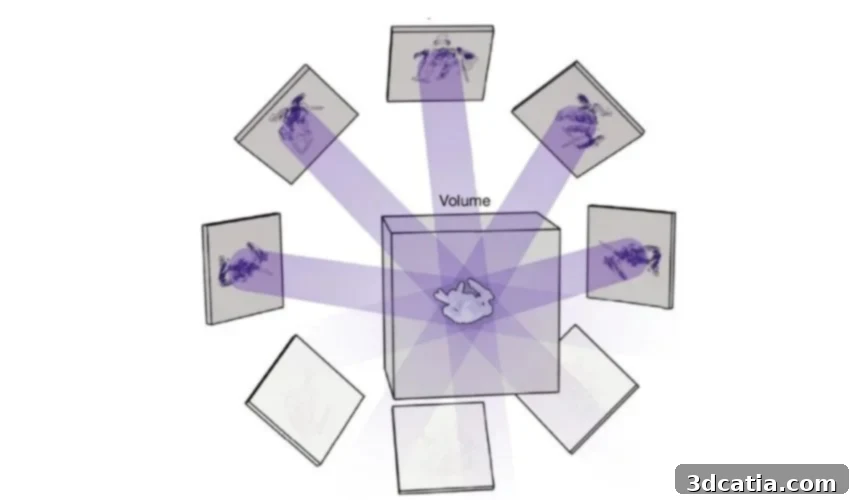
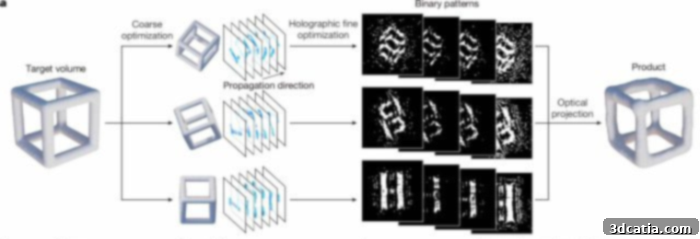
The research team, operating from the esteemed Imaging and Intelligent Technology Laboratory at Tsinghua University, harnessed the power of computational optics to engineer this transformative process. Specifically, they skillfully manipulated high-dimensional holographic light fields to meticulously sculpt three-dimensional structures. This approach represents a departure from traditional layer-by-layer or point-by-point methods, instead employing a holistic, light-based technique to achieve rapid and precise object formation.
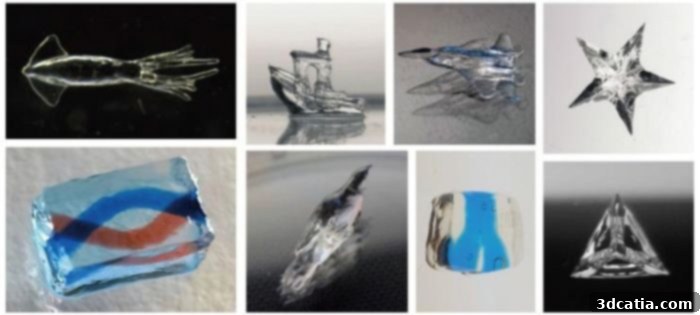
Examples of parts printed with DISH 3D printing
The outcome of this ingenious approach is truly remarkable. The scientists successfully produced objects exhibiting feature sizes as small as an impressive 12 micrometers in a mere 0.6 seconds. Furthermore, the volumetric printing rate achieved an astounding 333 cubic millimeters per second. According to Wu Jiamin, an associate professor and a key member of the research team, this feat represents the fastest 3D printing speed ever documented, surpassing all existing records in the field. This unprecedented speed opens up new avenues for rapid prototyping, customized manufacturing, and the creation of intricate micro-devices that were previously unattainable with conventional 3D printing techniques.
But what exactly does DISH stand for? The acronym represents “Digital Incoherent Synthesis of Holographic Light Fields.” In simpler terms, the process hinges on meticulously modulating light fields to generate a three-dimensional structure with incredible precision. While the concept may initially seem complex and abstract, the underlying principle is relatively straightforward. The key distinguishing factor lies in the method’s ability to form the entire structure simultaneously, rather than constructing it point by point or layer by layer. This simultaneous formation is the driving force behind the technology’s record-breaking speeds and its ability to overcome the limitations of traditional 3D printing approaches. The inherent efficiency of the DISH method opens up possibilities for mass production of intricate components and accelerates the design and development cycles in various industries.
Moreover, the DISH process eliminates the need for cumbersome resin vats or bulky machinery, which are often associated with other 3D printing techniques. The researchers emphasize that the DISH method only requires a flat optical surface, which remains stationary throughout the entire printing process. This simplified setup significantly reduces the complexity and cost of the equipment, making the technology more accessible and potentially paving the way for wider adoption in various research and industrial settings. The compact nature of the system also makes it suitable for integration into existing workflows and opens up possibilities for mobile or on-demand 3D printing applications.
While the DISH 3D printing process holds immense potential, further refinements and optimizations are still necessary before it can be widely implemented in commercial applications. However, the researchers believe that the technology is particularly well-suited for the serial production of microcomponents, such as advanced camera modules and cutting-edge photonic computing devices. These microcomponents often require high precision and intricate designs, making them ideal candidates for the DISH 3D printing method. Furthermore, the technology could potentially be applied in the development of microrobotics and flexible electronics, opening up new avenues for innovation in these rapidly evolving fields. The potential use cases for DISH 3D printing are incredibly diverse, ranging from medical devices and sensors to advanced materials and custom-designed electronics. The technology’s ability to create complex and highly detailed structures with speed and precision makes it a promising tool for a wide range of applications.
The future of DISH 3D printing looks bright. Its unique ability to create complex objects with high speed and precision opens the doors to various industries. Imagine customized medical implants manufactured on demand, or intricate micro-robots designed for targeted drug delivery. The possibilities are endless. Further research and development will undoubtedly unlock even more applications, solidifying DISH 3D printing’s place as a revolutionary force in manufacturing. The simplified setup compared to other methods will also allow small businesses and individual researchers to access and use this innovative technology and further accelerate its development. As the technology matures and becomes more accessible, we can anticipate a surge of innovation across various sectors, driving advancements in healthcare, electronics, and beyond.
The development of DISH 3D printing also highlights the importance of interdisciplinary collaboration. The research team’s success stems from the combination of expertise in computational optics, materials science, and engineering. This collaborative approach underscores the value of bringing together diverse perspectives and skill sets to tackle complex technological challenges. By fostering collaboration between researchers from different fields, we can accelerate the pace of innovation and unlock new breakthroughs that would not be possible through isolated efforts. The future of 3D printing, and technology in general, relies on this spirit of collaboration and the willingness to share knowledge and resources across disciplinary boundaries.
The impact of DISH 3D printing extends beyond its technical capabilities. The technology also has the potential to address some of the challenges associated with traditional manufacturing processes, such as material waste and energy consumption. By enabling the creation of objects with greater precision and efficiency, DISH 3D printing can help to minimize waste and reduce the environmental impact of manufacturing. Furthermore, the technology’s ability to create customized products on demand can reduce the need for mass production and transportation, further contributing to a more sustainable manufacturing ecosystem. As we move towards a more circular economy, technologies like DISH 3D printing will play an increasingly important role in creating closed-loop systems and minimizing our environmental footprint.
What are your thoughts on the DISH 3D printing method? Share your opinions in the comments below or connect with us on our LinkedIn and Facebook pages. Stay updated with the latest 3D printing news by subscribing to our free weekly Newsletter. Don’t forget to explore our video content on our YouTube channel.
*All Photo Credits: Tsinghua University