
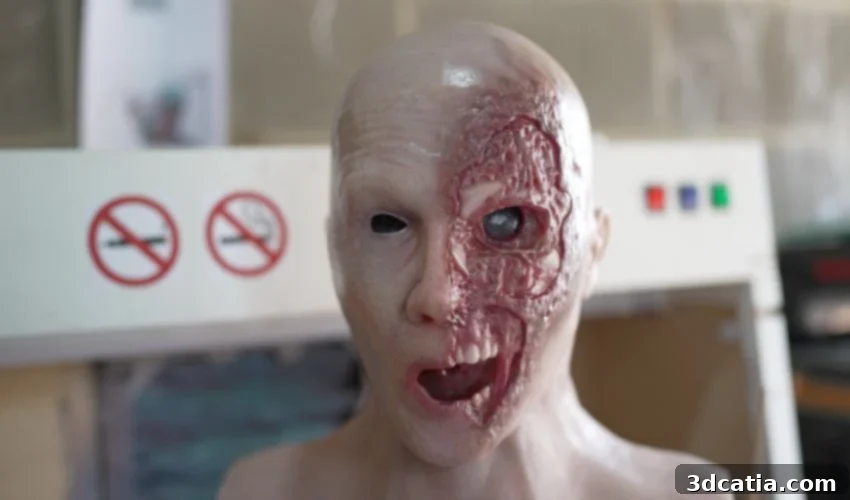
AnthroTek: Revolutionizing Medical Simulation and Film with 3D Printing and Advanced Materials
Imagine the possibility of recreating intricate human body parts, realistic skin models, and functional organs with incredible precision. This seemingly impossible feat is now a reality thanks to advancements in additive manufacturing. AnthroTek, a pioneering company specializing in materials science, is at the forefront of this revolution, creating realistic parts for medical simulation, soft robotics, and the film industry. From detailed anatomical models and lifelike film masks to organs that accurately replicate blood flow, AnthroTek offers a diverse range of 3D-printed applications. Their success is driven by the use of both resin 3D printing and fused deposition modeling, coupled with a deep understanding of materials like silicone, enabling them to achieve unparalleled realism. We had the privilege of speaking with Dr. Raoul Peltier, co-founder of AnthroTek, to delve deeper into the company’s mission and innovative projects.
3DN: Dr. Peltier, could you please introduce yourself and share how you first encountered the world of 3D printing?
My name is Raoul Peltier, and I’ve dedicated much of my life to the pursuit of scientific knowledge. I hold a PhD in materials science and spent seven enriching years in academia before transitioning to a biotechnology company where I focused on developing groundbreaking DNA-printing technology. Beyond my scientific pursuits, I’ve always nurtured a passion for creative endeavors, including clay sculpting and crafting monster masks in my garage. This blend of science and art has been a driving force in my journey.
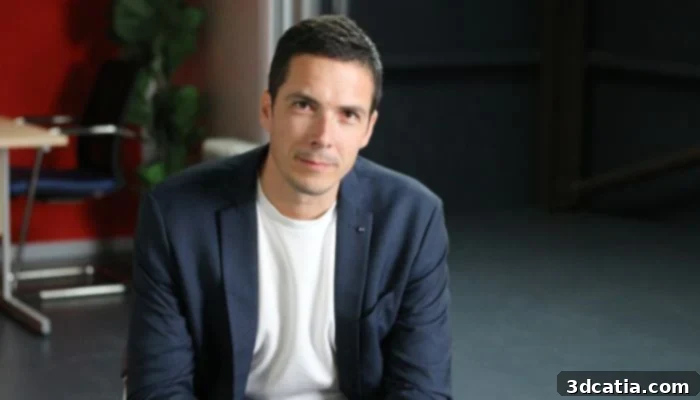
Raoul Peltier (Photo credits: AnthroTek)
In an effort to refine my mask-making hobby, I began exploring the possibilities of 3D modeling and 3D printing. I immersed myself in learning Blender and acquired my first 3D printer, an Anycubic Mono X, in late 2020. This marked a turning point, completely transforming my mask-making workflow and unlocking a realm of creative possibilities I hadn’t imagined. At the time, 3D printing was not widely adopted among mask-makers, and I recognized an opportunity to leverage this technology to create something truly unique and impactful.
I registered as a sole trader and launched The Face Forge, a brand dedicated to crafting high-end masks using cutting-edge 3D technology. The response was overwhelmingly positive, and I soon found myself collaborating with musical artists, wrestlers, and independent film productions to bring bespoke designs to life. This culminated in 2023 when I was presented with the incredible opportunity to create masks for Danny Boyle’s production, 28 Years Later.
3DN: Can you tell us about the genesis of AnthroTek? What inspired the creation of the company?
In 2023, I made a bold decision to temporarily step away from my scientific career and dedicate myself full-time to The Face Forge. It was around this time that I had a serendipitous encounter with my future co-founder, Nazmus Tareque, while punting on the River Cam in Cambridge – a quintessential Cambridge experience! Nazmus, with his expertise in business and law, immediately recognized the potential in my unique blend of materials science and artistic talent.
He invited me to lunch and said, “This has incredible potential. I know people in medical simulation, robotics, even individuals experimenting with humanoids.” That single conversation sparked a series of discussions, ultimately leading to the birth of AnthroTek.
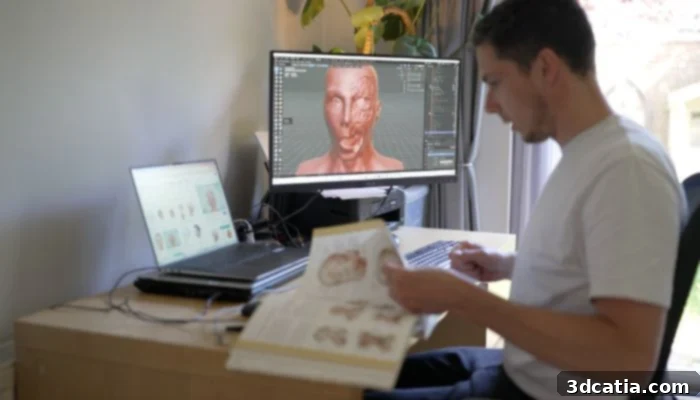
Photo Credits: AnthroTek
AnthroTek, a name derived from the Greek words “anthropos” (human) and “technology,” was officially established in 2024. The company’s core mission is to leverage advanced materials science to address complex challenges in the fields of medical simulation, soft robotics, and the film industry. We specialize in working with soft materials such as silicone, rubber, and polymers, materials that possess the remarkable ability to mimic human tissue with exceptional accuracy. This focus on realistic material properties sets us apart and allows us to create truly immersive and effective solutions.
3DN: What 3D printing technologies and solutions are you currently utilizing? Are there any other technologies that are particularly noteworthy?
3D printing forms the very foundation of our production process. We employ 3D printing to create intricate molds for artificial organ casting, manufacture custom mechanical components and bone simulations, and, in certain cases, directly 3D print silicone organs through our collaboration with Lynxter. On a daily basis, we rely on large-format resin 3D printing solutions. Our LC Magna (Photocentric) operates around the clock, producing large molds, while our suite of smaller Anycubic resin printers handle more intricate and technical parts. For our largest components, we utilize a large BIG-120Z (Modix) printer. We are also constantly experimenting with innovative 3D printable materials, including flexible filaments (FlexPLA), soft resins, soluble filaments (PVA), and other advanced resins designed for our most complex projects. Our dedication to exploring the boundaries of materials science allows us to push the limits of what’s possible with 3D printing.
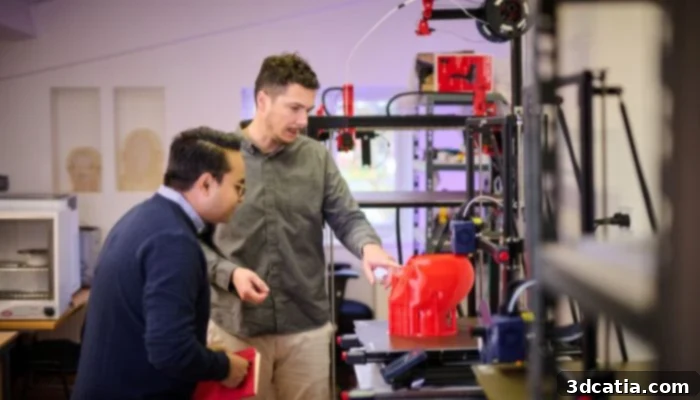
AnthroTek uses many 3D printing solutions (Photo Credits: AnthroTek/Julian Claxton)
3DN: What are the primary challenges encountered when 3D printing surgical models?
Direct 3D printing of silicone organs presents significant challenges due to the inherent softness of the materials, the delicate thinness of the walls, and the overall complexity of the shapes involved. In this regard, our partnership with Lynxter, providing us access to their powerful modular platform for soft materials, has proven invaluable. Each organ is unique and necessitates a tailored manufacturing process. Whether it’s direct 3D printing, casting from multi-part printed molds, utilizing soluble or flexible supports and fillers, or designing custom internal structures, a combination of innovative manufacturing techniques and unconventional thinking has been critical to our success. We are constantly pushing the boundaries of what’s possible to create the most realistic and functional surgical models.
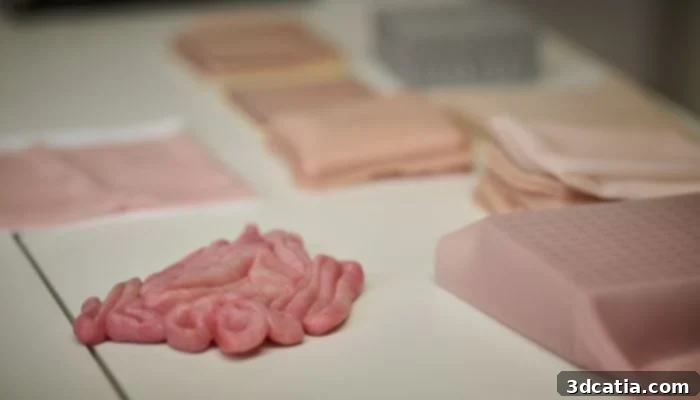
Photo Credits: AnthroTek/Julian Claxton
3DN: With the increasing prevalence of 3D-printed surgical models and solutions for surgeons, what distinguishes AnthroTek from the other options available?
Our core strength lies in our deep understanding of materials science. This expertise enables us to develop innovative materials and seamlessly integrate them into our prototyping pipeline, unlocking functionalities that were previously unattainable in simulation models. For instance, we have engineered one of the most mechanically accurate skin models currently available, comprised of three distinct layers that mimic the epidermis, dermis, and hypodermis. We can precisely adjust the thickness and hardness of each layer to replicate various skin phenotypes, taking into account factors such as age, body part, and ethnicity. Furthermore, we create fluidically accurate organs that replicate blood flow and realistic blood pressure by meticulously controlling the thickness and hardness of blood vessels and microfluidic channels. We also have ongoing research and development initiatives focused on incorporating smart sensors into artificial skin for robotics applications, as well as developing antibacterial silicone-based coatings for medical devices. This commitment to innovation and material science is what truly sets AnthroTek apart.
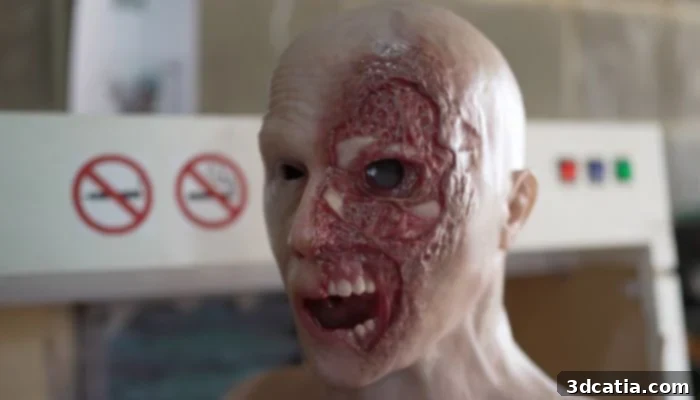
The company’s expertise in materials science enables it to carry out ultra-realistic projects. (Photo Credits: AnthroTek)
3DN: Do you have any final thoughts or words of advice for our readers?
I encourage everyone to continue exploring their passions and hobbies, as you never know where they might lead. Sharing my work online proved invaluable in the beginning, allowing me to gain visibility, gather feedback, assess market demand, and cultivate the network necessary to transform my garage hobby into a small business and, ultimately, a company with six employees. Also, I urge you to remain curious and stay informed about emerging technologies that can streamline your work processes and enhance efficiency. These advancements can make a significant difference. If you’re interested in learning more about AnthroTek, please visit our website HERE.
What are your thoughts on AnthroTek’s innovative approach to 3D printing? Share your comments below or connect with us on our LinkedIn and Facebook pages. Don’t forget to subscribe to our free weekly Newsletter to stay up-to-date on the latest 3D printing news. You can also find all our videos on our YouTube channel.
*Cover Photo: AnthroTek