
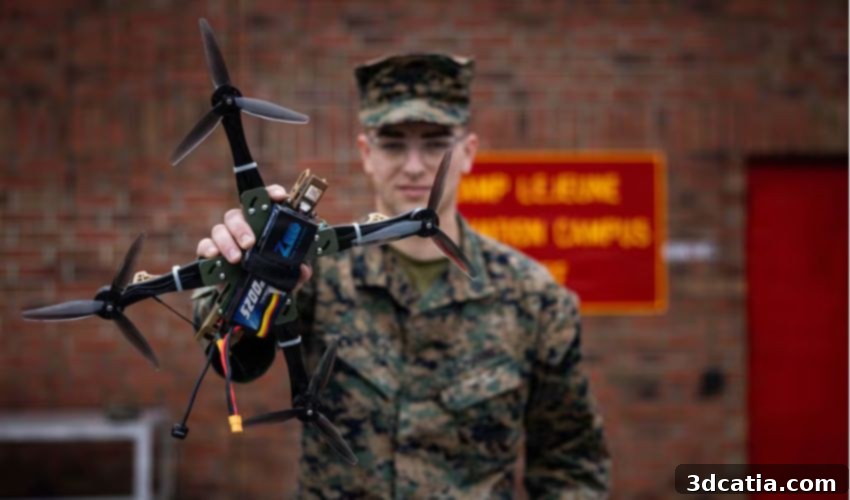
3D-Printed Drone Revolution: US Marine Corps Achieves NDAA Compliance with HANX
The United States Department of Defense is currently engaged in an ambitious race to achieve “drone dominance,” a plan that includes the acquisition of up to 300,000 single-use attack drones by 2028. As part of this initiative, the Marine Corps has taken a significant first step by developing its first 3D-printed drone that fully complies with the National Defense Authorization Act (NDAA).
The National Defense Authorization Act (NDAA) is a crucial piece of legislation that governs the technologies and components used in US military systems, particularly in sensitive areas like communications, electronics, and software. The NDAA aims to prevent the use of components that could potentially contain backdoors or create technological dependencies on countries considered adversaries. This ensures the security and integrity of US military technology.
The drone, aptly named HANX, is the brainchild of a dedicated team of Marines stationed in North Carolina. Leading this innovative project is Sergeant Henry David Volpe, a motor transport mechanic who has passionately pursued 3D printing and robotics since his teenage years. His self-taught expertise has been instrumental in bringing HANX to fruition.
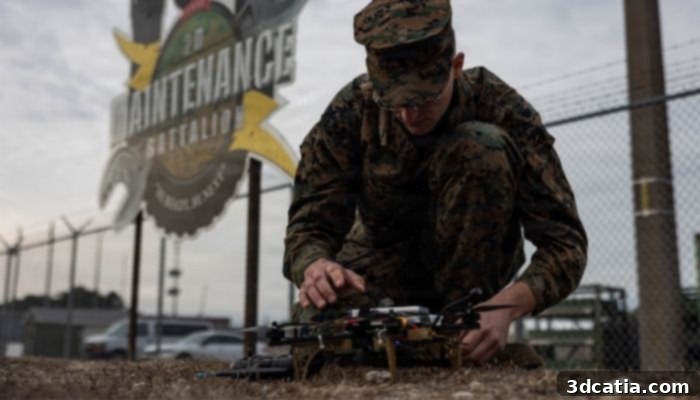
While the Marine Corps has previously explored the use of 3D-printed drones, HANX represents a monumental breakthrough. Unlike its predecessors, HANX adheres strictly to NDAA requirements. This means that all its components are free from potentially compromised hardware and software, guaranteeing the drone’s operational security and reliability. This is a critical advancement in ensuring the integrity of military technology and protecting against potential vulnerabilities.
HANX is designed as a modular platform, empowering Marines to print, modify, and repair the drone themselves. This adaptability allows for rapid design adjustments to suit various mission requirements. The drone’s intended applications are diverse, including tactical reconnaissance, light logistics, training, and even serving as a low-cost attack drone. This versatility makes HANX a valuable asset for the Marine Corps in a variety of operational scenarios.
Sergeant Volpe’s dedication and expertise were evident in the rapid development of HANX. In just 90 days, he created five major versions of the drone and countless minor iterations. This iterative process allowed for continuous refinement and optimization of the design, ensuring that the final product met the rigorous demands of the Marine Corps.
To ensure that all motors, controllers, sensors, and communication systems met NDAA standards, Sergeant Volpe invested several months in thorough research. He directly contacted manufacturers, seeking detailed information and validation. He also collaborated with government agencies, including NAVAIR, which is responsible for flight certification, to obtain the necessary approvals. This meticulous approach ensured that HANX complied with all applicable regulations and standards.
Ultimately, HANX received interim flight approval, marking a significant milestone as the Marine Corps’ first 3D-printed drone with official authorization to operate. This achievement demonstrates the potential of additive manufacturing to revolutionize military technology and provide innovative solutions to complex challenges.
Following the approval, the Innovation Campus initiated a project to transform HANX into a comprehensive training program. This program includes the development of training plans and course frameworks, enabling other units to manufacture and maintain their own drones. This initiative will empower Marines across the Corps to leverage the capabilities of 3D printing and create customized drone solutions for their specific needs.
According to a Marine Corps statement, several units, including special forces and explosive ordnance disposal teams, have already expressed strong interest in producing more HANX units for specific missions. The versatility and adaptability of HANX make it an ideal platform for a wide range of operational requirements, from reconnaissance and surveillance to logistical support and even direct action.
The rapid evolution of drone technology and the current international landscape have sparked considerable debate and uncertainty. It’s undeniable that drones are reshaping modern warfare and creating new challenges for military strategists. Understanding how these technologies are integrated into military structures is crucial for analyzing the future role of additive manufacturing in defense.
The HANX project exemplifies the potential of 3D printing to accelerate innovation, reduce costs, and enhance the capabilities of the armed forces. By embracing additive manufacturing, the Marine Corps is positioning itself at the forefront of technological advancement and preparing for the challenges of the future battlefield. This forward-thinking approach will enable the Corps to maintain its competitive edge and effectively address evolving threats.
The success of HANX also highlights the importance of empowering individual Marines and fostering a culture of innovation within the ranks. Sergeant Volpe’s initiative demonstrates that motivated individuals with the right skills and resources can make significant contributions to the development of cutting-edge military technology. By encouraging and supporting such initiatives, the Marine Corps can unlock a wealth of untapped potential and drive further innovation in the years to come.
The NDAA compliance of HANX is particularly significant, as it demonstrates that 3D-printed drones can be designed and manufactured in accordance with stringent security standards. This is essential for ensuring the integrity of military technology and preventing adversaries from exploiting potential vulnerabilities. The HANX project sets a precedent for future 3D-printed military systems, paving the way for the widespread adoption of additive manufacturing in the defense sector.
The modular design of HANX is another key advantage, as it allows Marines to easily adapt the drone to different mission requirements. This flexibility is crucial in a rapidly changing operational environment, where the ability to quickly reconfigure equipment can make the difference between success and failure. The modularity of HANX also simplifies maintenance and repair, as individual components can be easily replaced or upgraded as needed.
In conclusion, the development of HANX represents a significant step forward for the US Marine Corps and the broader defense community. This NDAA-compliant, 3D-printed drone demonstrates the potential of additive manufacturing to revolutionize military technology, enhance operational capabilities, and empower individual Marines. As drone technology continues to evolve, projects like HANX will play a crucial role in shaping the future of warfare and ensuring the security of the United States.
What are your thoughts on HANX and the potential of 3D printing in the military? Share your opinions in the comments below!