
3D Printing News: Food Streets, Dental Advancements, Disney Props & Gun Control
This week’s roundup of 3D printing news takes us on a global journey, highlighting innovative applications across diverse industries. From India to the United States, we explore how additive manufacturing is transforming food service, healthcare, entertainment, and even the ongoing debate surrounding firearm regulations. This article delves into a unique “Food Street” project at Ashoka University featuring 3D-printed kitchens, the expansion of dental 3D printing capabilities at an Alabama Air Force base, the introduction of Disney’s first permanent 3D-printed theme park prop, and proposed legislation in New York aimed at regulating 3D-printed firearms. Join us as we uncover the latest developments shaping the world of 3D printing.
The Hungry Caterpillar: A 3D-Printed Food Street
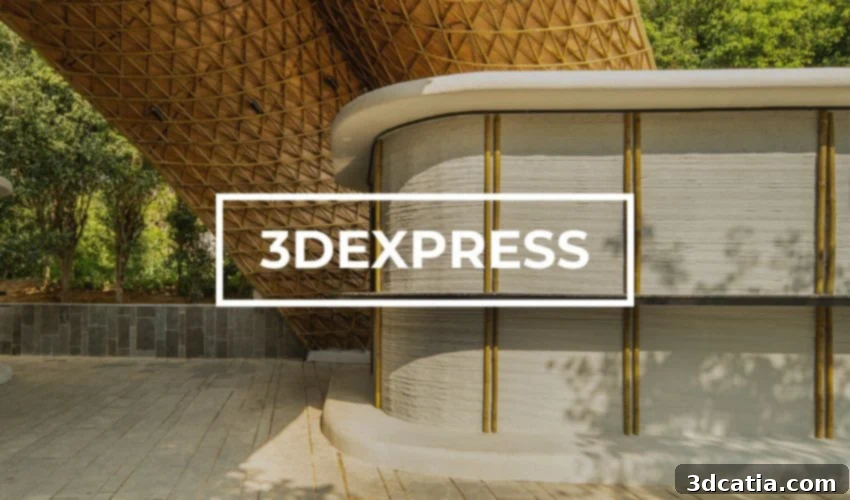
Lyth Design, a Mumbai-based studio, has recently completed an extraordinary project at Ashoka University: a “food street” called the Hungry Caterpillar. This unconventional canteen, envisioned by architect Apoorva Shroff, draws inspiration from the natural world, specifically the image of a cocoon nestled within the surrounding tree canopy. The resulting space seamlessly blends this organic vision with a strong commitment to sustainable and responsible design practices. The core of the project lies in its 3D-printed kitchens, brought to life through concrete 3D printing technology by Micob Pvt. Ltd. These modular kitchen units were carefully assembled on the university campus, showcasing the efficiency and low-waste potential of this construction method. A key advantage of using 3D printing was the ability to integrate practical features directly into the wall cavities, such as thermal insulation, improving the energy efficiency of the structures.
Complementing the 3D-printed kitchens is a striking bamboo gridshell that provides ample shade for the food street. This caterpillar-like structure gracefully curves in two directions, spanning up to an impressive 19 meters. It’s constructed using layered bamboo elements, finished with a textured crushed bamboo mat, adding a natural and visually appealing element to the overall design. The combination of these innovative elements – the 3D-printed kitchens and the bamboo canopy – creates a welcoming and comforting food street environment for Ashoka University’s students and faculty.
The project highlights the potential of 3D printing in architectural design, offering a faster, more sustainable, and customizable approach to construction. By embracing innovative technologies and sustainable materials, Lyth Design has created a unique and inspiring space that demonstrates the transformative power of 3D printing in the built environment. The Hungry Caterpillar is a testament to the possibilities of blending nature-inspired design with cutting-edge manufacturing techniques to create functional and aesthetically pleasing spaces.
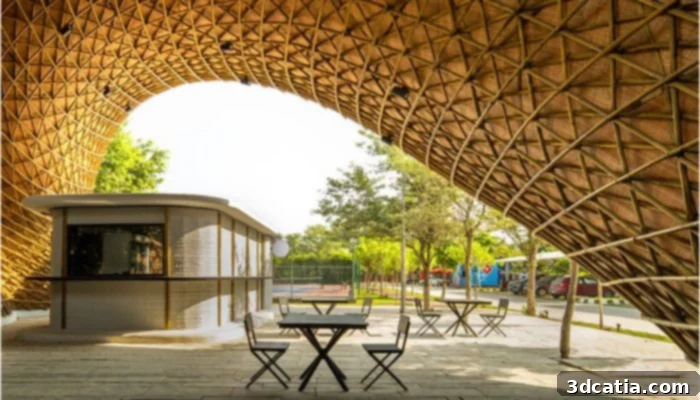
(Photo Credit: Lyth Design)
Maxwell Air Force Base Enhances Dental Care with 3D Printing
The Maxwell Air Force Base in Alabama is at the forefront of modernizing dental care for its Airmen, thanks to the integration of advanced digital dentistry and oral surgery techniques, particularly 3D printing. Previously, the dental flight faced limitations, requiring them to refer Airmen to external providers for essential procedures like root canals, implants, and wisdom teeth extractions. This reliance on external specialists caused delays and logistical challenges. Now, with the acquisition of new training and cutting-edge technology, the Maxwell Medical Group’s Dental Flight is equipped to perform these procedures in-house, significantly improving the efficiency and accessibility of dental care for the Airmen stationed at the base.
The advancements extend beyond basic procedures. The dental flight can now also perform more complex periodontal surgeries, including sinus lifts and ridge augmentation, further expanding the scope of services offered on-site. This comprehensive approach ensures that Airmen receive the necessary dental care without the burden of external referrals. U.S. Air Force Tech. Sgt. Ernessie Ladouceur, Maxwell Medical Group dental flight chief, emphasized the importance of this improved capability: “When patients are deploying, we ensure that they are ready to go. If they do have things that are limiting them from going, we will stop what we’re doing to get them out the door.” This highlights the crucial role of the dental flight in maintaining the operational readiness of Airmen.
At the heart of this transformation are two 3D printers, enabling a fully digital workflow within the dental flight. The process begins with digital scanning, capturing precise representations of patients’ teeth and oral structures. These scans are then used to 3D print models and mill restorations, such as crowns and bridges, with remarkable accuracy and efficiency. This digitization offers numerous benefits, including improved precision, reduced material waste, and faster turnaround times. Furthermore, the centralized storage of digital medical information ensures easy access and seamless collaboration among dental professionals.
The integration of 3D printing into the Maxwell Air Force Base’s dental flight is a significant step forward in providing comprehensive and efficient dental care to Airmen. By embracing digital technologies, the base is enhancing its operational readiness and improving the overall well-being of its personnel.
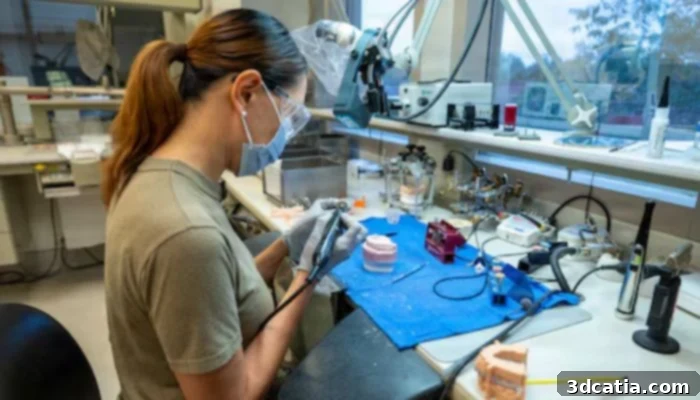
U.S. Air Force Tech. Sgt. Jin Wallace, dental lab technician at Maxwell Medical Group, prepares dental restorations at Maxwell Air Force Base. (Photo Credit: U.S. Air Force by Senior Airman Evan Porter)
Disney’s Jungle Cruise Gets a 3D-Printed Upgrade
Disneyland’s iconic Jungle Cruise ride has received a significant upgrade, marking a milestone in the integration of 3D printing into theme park attractions. The ride now features the first permanent 3D-printed prop in a Disney theme park: a meticulously crafted canoe. This addition demonstrates Disney’s commitment to embracing innovative technologies to enhance the guest experience and preserve the authenticity of its beloved attractions.
The 3D-printed canoe was the result of a collaborative effort between Disney’s “Imagineers” and Haddy, a Florida-based company specializing in large-scale 3D printing. The project aimed to create a prop that seamlessly blended with the ride’s existing aesthetic, specifically matching the style of the original boats from the Jungle Cruise’s opening in the 1960s. To achieve this level of accuracy, the Imagineers utilized a 3D scan of an existing canoe and a historical photograph of a 1960s model. These resources were used to create a detailed digital model of the new bow section, ensuring a perfect match with the ride’s established design.
Haddy utilized advanced robotic 3D printers and polymer pellets to fabricate the canoe. The printing process took approximately 70 hours, a fraction of the time required for traditional boat building methods. Creating a 20-foot boat using traditional techniques would typically require around 1,000 hours of human labor. This significant reduction in production time highlights the efficiency and cost-effectiveness of 3D printing for creating large-scale props.
The successful implementation of the 3D-printed canoe in the Jungle Cruise suggests a promising future for additive manufacturing in Disney theme parks. This innovative approach could pave the way for the creation of more intricate and customized props, enhancing the immersive experience for park visitors. The use of 3D printing also offers the potential for faster turnaround times for repairs and replacements, ensuring that rides and attractions remain in optimal condition.
New York Aims to Curb 3D-Printed Gun Production
In response to growing concerns surrounding the proliferation of 3D-printed firearms, New York Governor Kathy Hochul has proposed new legislation aimed at regulating their production and distribution. The proposed measures seek to address the challenges posed by “ghost guns,” which are often untraceable and can be assembled at home using 3D printers.
The legislation would make it a criminal offense to possess or sell digital blueprints necessary to 3D print firearms without proper licensing. This provision aims to restrict access to the designs required to create these weapons. Additionally, the legislation would mandate that manufacturers implement measures to block their machines from being used to produce firearms. This could involve software restrictions or hardware modifications that prevent the printing of gun components.
To further track and monitor the use of 3D-printed guns, the legislation would require that any such firearms be reported to the Criminal Gun Clearinghouse database maintained by the New York State Police. This would help law enforcement agencies identify and investigate cases involving 3D-printed weapons. The proposed legislation also includes provisions requiring gun manufacturers to design pistols in a way that prevents easy modification for automatic fire. This measure aims to address the potential for 3D-printed components to be used to convert legal firearms into illegal automatic weapons.
The urgency of this legislation stems from a rise in crimes involving “ghost guns” in New York State. A particularly high-profile case involved the assassination of United Healthcare chief executive Brian Thompson by Luigi Mangione, who allegedly used a 3D-printed gun and silencer. This incident underscored the potential dangers posed by unregulated 3D-printed firearms.
The proposed legislation represents a significant step towards addressing the challenges associated with 3D-printed guns. By restricting access to blueprints, mandating manufacturer controls, and requiring reporting of 3D-printed firearms, New York aims to curb their proliferation and reduce the risk of gun violence.
What are your thoughts on these latest developments in the world of 3D printing? Share your opinions in the comments below or connect with us on LinkedIn or Facebook! Stay informed about the latest trends by subscribing to our free weekly Newsletter, delivering 3D printing news directly to your inbox. Don’t forget to explore our YouTube channel for engaging video content.