

Top 5 3D Printers and Scanners to Watch in 2025: A Comprehensive Guide
Still searching for the perfect Christmas gift? Look no further! If you’re considering diving into the world of 3D printing or 3D scanning, this curated list of standout products from 2025 is exactly what you need. We’ve meticulously analyzed the latest releases, identifying the most innovative and impactful models in both desktop 3D printers and 3D scanning solutions. 2025 witnessed a surge of new machines, particularly in the FDM (Fused Deposition Modeling) and resin categories, offering increased affordability and user-friendliness. Navigating this influx of options can be challenging, distinguishing true innovation from mere incremental upgrades. Therefore, we’ve hand-picked five exceptional printers and scanners that warrant your attention, all while remaining conscious of budget considerations. This compilation is not exhaustive, and we encourage you to share your insights and experiences in the comments section below.
Bambu Lab H2 Series: Redefining Speed and Modularity
It’s impossible to discuss 3D printing advancements in 2025 without acknowledging Bambu Lab. This Chinese manufacturer significantly impacted the market with a consistent stream of innovative releases. Rather than focusing on a single flagship product, Bambu Lab introduced an entire ecosystem: the H2 series. Known for their emphasis on speed, exemplified by the H2S and P1S models, Bambu Lab truly distinguished itself in 2025 with the H2D and the introduction of genuine modularity within their ecosystem. This modular approach allows users to adapt their machines to various tasks, expanding their creative possibilities.
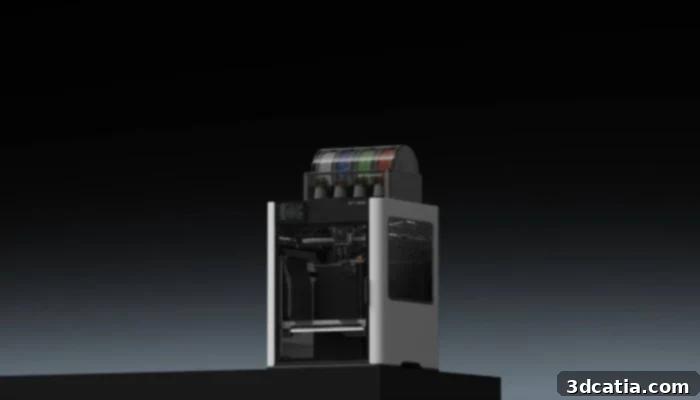
The H2D 3D printer (Photo Credit: Bambu Lab)
While Bambu Lab might not have invented modular 3D printing – companies like Snapmaker have offered versatile 3-in-1 machines with CNC and laser modules for years – they have revolutionized the integration process. Bambu Lab developed a seamless software workflow that allows users to effortlessly transition from 3D printing a template to laser-engraving a serial number. This integration is what sets them apart. Users can now quickly swap a print head for a laser cutter or vinyl cutter in a matter of seconds, transforming the 3D printer into a versatile fabrication hub suitable for office environments. This ease of use and streamlined workflow significantly enhances productivity and creative potential.
Rounding out the H2 series is the H2C, recently showcased at Formnext. This impressive printer supports up to six hotends and 24 filaments, enabling the creation of intricate multicolored parts with ease. If you’re seeking a reliable and fast solution for working with a diverse range of colors and materials, the H2C, priced under €2,250, is an excellent choice. Its multi-filament capabilities unlock new dimensions in 3D printing, allowing for the creation of visually stunning and functionally complex objects.
Prusa Core One Ecosystem: Modular Upgrades for Enhanced Performance
The Czech manufacturer, Prusa, is actively combating the increasing competition from China with its Core One ecosystem, a strong contender for a Christmas gift this year. Initially launched in 2024, the Core One underwent significant upgrades in 2025, further solidifying the platform’s capabilities. Prusa initially introduced the Core One L, which, as its name implies, features a significantly larger build volume of 300 x 300 x 330 mm – roughly double that of the original model. This increased build volume allows users to create larger and more complex objects, expanding the scope of their projects.
However, the most notable upgrade is the INDX system unveiled by Prusa at Formnext. This innovative architecture, specifically designed for the Core One, supports up to eight different filament spools through rapid and efficient tool changes. This allows users to work with a broader spectrum of colors and materials with greater ease, fostering creativity and enabling the production of visually diverse and functionally advanced prints. The INDX system significantly enhances the Core One’s versatility and makes it a compelling option for users who require multi-material capabilities.
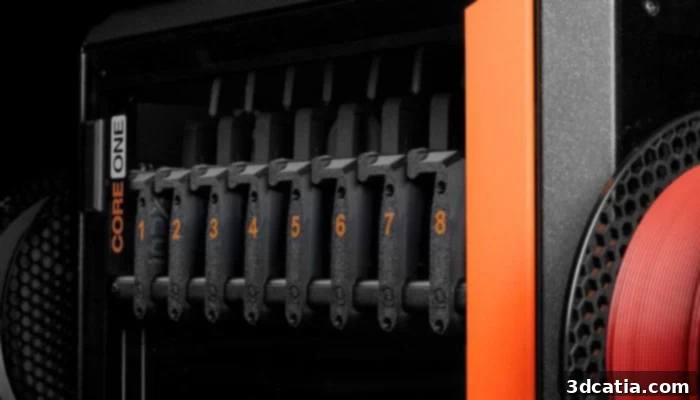
The INDX system (Photo Credit: Prusa)
Shining 3D Einstar Rigil: Streamlining 3D Scanning for Everyone
Tired of relying solely on pre-made STL files downloaded online? Consider taking the next step and creating your own custom models with the aid of a 3D scanner. 3D scanning has evolved significantly, transforming from a complex and time-consuming process to an accessible and efficient workflow, thanks to user-friendly solutions like the Einstar Rigil scanner from Shining 3D. This device is a game changer. Equipped with advanced sensors, the Einstar Rigil delivers dramatically faster scanning speeds and can effortlessly capture dark or shiny surfaces without requiring the use of a scanning spray. This eliminates the need for messy pre-processing and simplifies the scanning process. Battery life has also been improved, providing extended uninterrupted use, making it ideal for capturing larger objects or performing multiple scans in a single session. The Einstar Rigil makes 3D scanning more accessible and efficient than ever before.
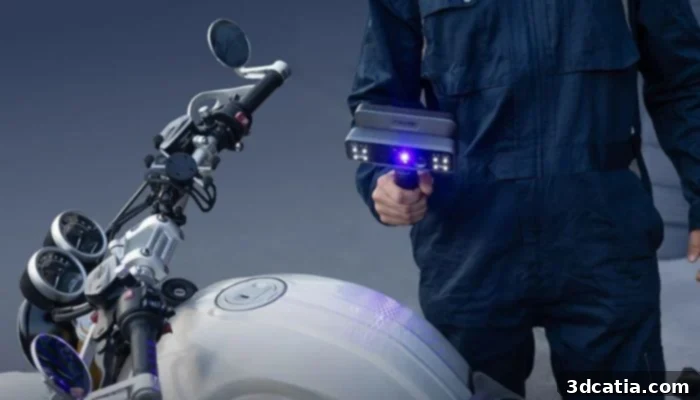
Photo Credit: Shining3D
Elegoo Centauri Carbon: High Performance at an Affordable Price
While 3D printers from Bambu Lab and Prusa offer impressive capabilities, they represent a significant financial commitment for some users. If you’re working with a more restricted budget, Elegoo provides a compelling and accessible alternative. While the new version of the Centauri Carbon (V2) is slated for release in the first quarter of 2026, it’s definitely worth considering. The original Centauri Carbon V1 garnered significant attention thanks to its remarkable print speeds of 500 mm per second, integrated Klipper firmware, and robust CoreXY frame – all at a price point under $400. This combination of performance and affordability made it a popular choice among budget-conscious users.
At Formnext 2025, Elegoo unveiled the V2 version of this popular FDM printer, featuring a reinforced chassis designed to minimize vibrations, expanded material compatibility, and a new camera equipped with onboard AI to automatically halt the machine in the event of a printing issue. This AI-powered monitoring system helps prevent failed prints and saves valuable time and materials. The printer also includes a brass hardened steel nozzle and a heated build plate capable of reaching 110°C, guaranteeing enhanced thermal stability and enabling the use of a wider range of filaments. If you can afford to wait, the V2 offers significant improvements over its predecessor. Otherwise, the original Centauri Carbon remains a solid option for those on a tighter budget, providing excellent performance at an unbeatable price.
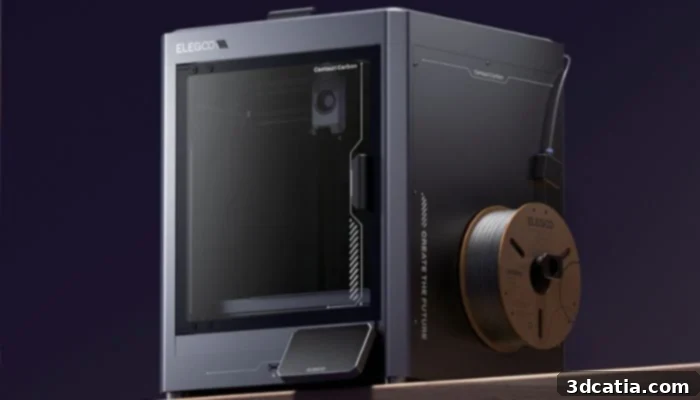
The Centauri Carbon V2 is not yet available. (Photo Credit: Elegoo)
HeyGears Reflex Series: Elevating Resin Printing to New Heights
While our focus has primarily been on Fused Deposition Modeling (FDM) printers, let’s not forget about resin-based solutions. If resin printing is more aligned with your needs, we highly recommend exploring HeyGears and their Reflex range. These resin 3D printers stood out in 2025, pushing the boundaries of precision and automation. In the previous year, we rigorously tested the Reflex RS and the Reflex, and were consistently impressed by the manufacturer’s innovative “Auto-Peel” technology, which significantly improves print quality and reduces the risk of print failures. This year, HeyGears took innovation a step further with the Reflex 2 Pro.
The new Reflex 2 Pro boasts a larger build volume of 230 x 144 x 350 mm compared to its predecessor, along with more precise light projection for optimized resin curing. This results in superior surface quality and reduced material waste, making it both more efficient and environmentally friendly. The Reflex 2 Pro also incorporates the “Resin Capsule” system, which automates resin tank filling and drainage. This eliminates the messy and time-consuming process of manually pouring resin and dealing with sticky gloves every time materials are changed. The Reflex 2 Pro streamlines the resin printing workflow and delivers exceptional print quality, making it an excellent choice for professionals and hobbyists alike.
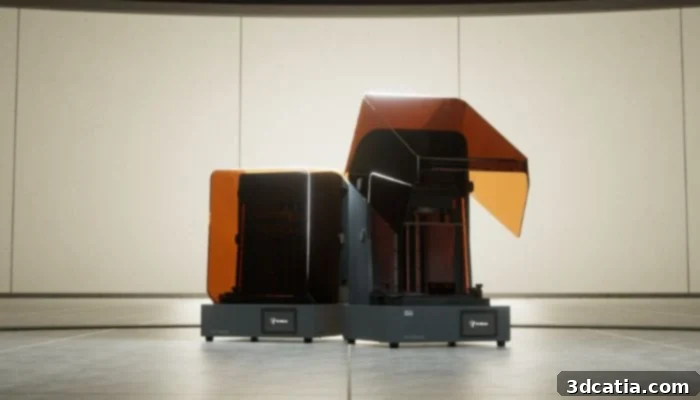
The Reflex 2 range (Photo Credit: HeyGears)
So, there you have it! Our selection of the top 3D printers and scanners from 2025. As we mentioned before, this list isn’t exhaustive, and the 3D printing market continues to evolve rapidly. However, these models stand out as some of the best options for anyone looking to invest in this transformative technology. We encourage you to share your thoughts and experiences in the comments section below, or on our LinkedIn or Facebook pages! Don’t forget to subscribe to our free weekly Newsletter to stay up-to-date with the latest 3D printing news. You can also find all our videos on our YouTube channel. Happy holidays and happy printing!