
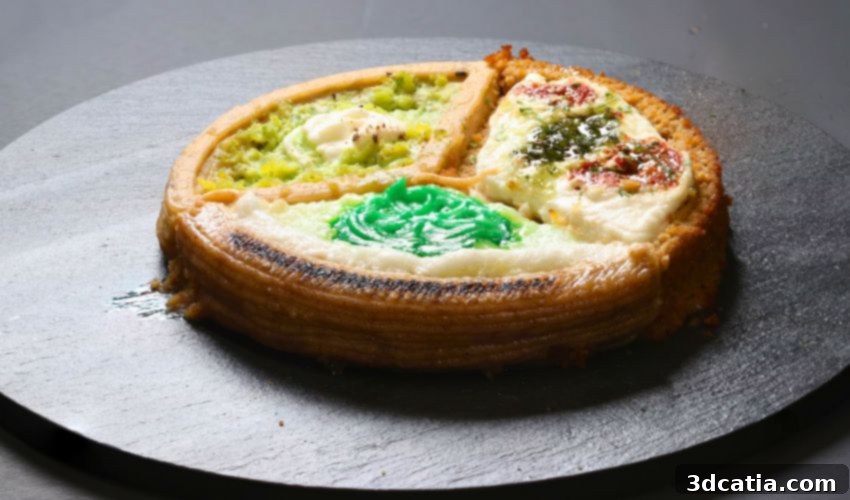
3D Printed Culinary Revolution: Laser Cooking Creates Authentic Textures
Imagine a dining experience where every course, from the appetizer to the dessert, is meticulously crafted by a 3D printer and cooked with lasers. This futuristic vision has become a reality at Columbia University, where researchers have successfully produced a complete meal featuring a quiche-inspired tart, cauliflower pizza, and key lime pie. What sets this culinary feat apart is the achievement of textures that rival those of conventionally cooked foods, a significant breakthrough in the field of 3D food printing.
While 3D food printing has made remarkable strides in recent years, achieving authentic texture has consistently been one of the technology’s most significant hurdles. Traditional cooking methods, despite their familiarity and widespread use, lack the spatial resolution necessary to match the precision offered by additive manufacturing. This limitation makes it difficult to control heat application with the same level of accuracy as material deposition, resulting in textures that often fall short of expectations.
Closing the Texture Gap: A Breakthrough in 3D Food Printing Technology
The groundbreaking project at Columbia University was spearheaded by Jonathan Blutinger during his doctoral studies in mechanical engineering, under the guidance of Professor Hod Lipson. According to reports in the Columbia Spectator, the research spanned approximately six years, as the team meticulously investigated whether the cooking process could be controlled with the same degree of precision as digital fabrication. This ambitious endeavor brought together students and engineers from a diverse range of disciplines within Columbia’s vibrant research ecosystem.
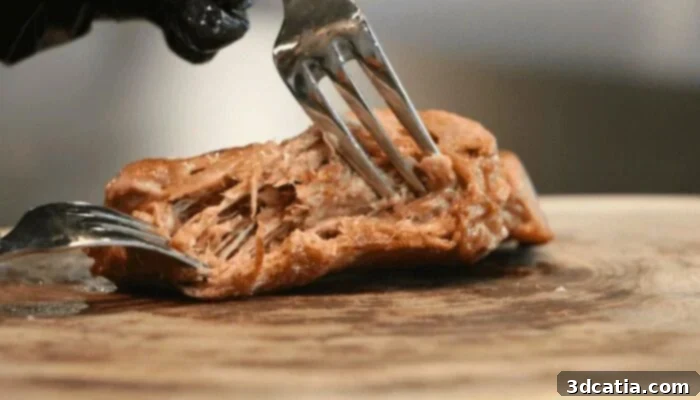
An example of a 3D-printed meat alternative (Photo Credit: Steakholder Foods)
The central innovation of the project lies in the seamless integration of laser-based cooking directly into the 3D printing process. Unlike conventional approaches where food is printed separately and then transferred to an oven for cooking, this system applies localized laser heating during the fabrication process itself. This ingenious method enables selective cooking of specific regions within a printed structure, while simultaneously preserving its overall geometry and intricate design.
From Raw Ingredients to a Fully Cooked, 3D Printed Meal
The demonstration meal, a testament to the project’s success, was meticulously crafted using 14 readily available ingredients sourced from standard grocery stores. These ingredients underwent standard food-processing techniques before being carefully loaded into the 3D printer. By precisely adjusting the laser exposure during the printing process, the researchers were able to achieve textures that closely mimic those of conventionally cooked foods, marking a significant step forward in the pursuit of culinary realism in 3D food printing.
This pioneering work builds upon earlier food-printing research conducted at Columbia’s Creative Machines Lab. In a previous project, the team showcased a seven-ingredient 3D-printed dessert, skillfully assembled using edible inks and a layered deposition technique. This earlier work primarily focused on multi-material food assembly, raising fundamental questions about the potential for future cooking appliances to integrate 3D printing with sophisticated, software-driven heating methods. The creation of the three-course meal represents a significant evolution, directly addressing the challenge of texture, which has long been a persistent obstacle in the advancement of 3D food printing.
The core research team, comprised of Blutinger, Evan Lloyd Omo, and Pol Bernat, benefited from the contributions of approximately 30 to 40 additional students and engineers. Their groundbreaking findings were published in September in the prestigious Journal of Food Engineering, as reported by the Columbia Spectator. This publication marks a significant milestone in the group’s ongoing exploration of digitally controlled cooking, paving the way for future advancements in the field.
Beyond the inherent novelty of 3D printed meals, Blutinger emphasizes the technology’s potential to enable more deliberate and transparent food preparation. “This kind of technology could help people be more deliberate about what they’re eating, and give you more transparency in the food that you’re eating and track it in a much better way,” he explains. According to the Columbia Spectator, future research will focus on rigorously evaluating the nutritional content of laser-cooked foods in comparison to those prepared using conventional cooking methods, providing valuable insights into the health implications of this innovative technology.
While the system remains a research prototype, its success underscores how digitally controlled cooking has the potential to overcome a significant limitation of 3D food printing. The approach opens up exciting possibilities for personalized nutrition, texture-modified foods tailored to individual needs, and software-driven food production that optimizes taste and nutritional value. It also shifts the focus from simply asking whether complete meals can be 3D printed to exploring how such systems can be meaningfully applied in real-world contexts, revolutionizing the way we approach food production and consumption.
The Future of Food: Personalized Nutrition and Sustainable Practices
The implications of this technology extend far beyond creating visually appealing and texturally accurate 3D printed meals. The ability to precisely control the ingredients and cooking process unlocks the potential for personalized nutrition. Imagine a future where individuals can receive meals tailored to their specific dietary needs and preferences, optimizing their health and well-being. This is particularly relevant for individuals with allergies, dietary restrictions, or specific health conditions, such as diabetes or heart disease.
Furthermore, 3D food printing can contribute to more sustainable food production practices. By using alternative protein sources, such as insects or plant-based proteins, and reducing food waste through precise portion control, this technology can help address some of the most pressing challenges facing the global food system. The ability to create complex structures from simple ingredients also opens up new possibilities for food design, allowing for the creation of novel and appealing food products that cater to a variety of tastes and preferences.
The development of laser-based cooking techniques further enhances the sustainability aspect of 3D food printing. Lasers offer a highly efficient and precise way to cook food, minimizing energy consumption and reducing the need for traditional ovens and cooking equipment. This can lead to significant cost savings and a smaller environmental footprint, making 3D food printing a more attractive option for both consumers and food manufacturers.
Challenges and Opportunities in the 3D Food Printing Landscape
Despite the significant advancements made in 3D food printing, several challenges remain before the technology can be widely adopted. One of the main challenges is the cost of the equipment and materials. 3D food printers are currently expensive, limiting their accessibility to research institutions and specialized food companies. As the technology matures and demand increases, the cost of 3D food printers is expected to decrease, making them more affordable for a wider range of users.
Another challenge is the limited range of ingredients that can be used in 3D food printing. While researchers have successfully printed with a variety of ingredients, including chocolate, cheese, and meat alternatives, there is still a need to expand the range of printable materials. This requires further research and development in food science and materials engineering to identify new ingredients and develop suitable printing techniques.
Despite these challenges, the opportunities for 3D food printing are vast. The technology has the potential to revolutionize the food industry, offering new possibilities for personalized nutrition, sustainable food production, and creative food design. As research and development continue, 3D food printing is expected to play an increasingly important role in shaping the future of food.
Bon appétit! The future of food is being printed, one layer at a time.
Would you try a laser-cooked 3D printed meal? Share your thoughts in the comments below or connect with us on LinkedIn or Facebook! Stay informed about the latest 3D printing advancements by subscribing to our free weekly Newsletter. Explore our video content on our YouTube channel.
*Cover Photo Credit: Jonathan Blutinger Courtesy of Columbia Engineering