
Soft Cells in Space: Unveiling Geometric Secrets in Microgravity
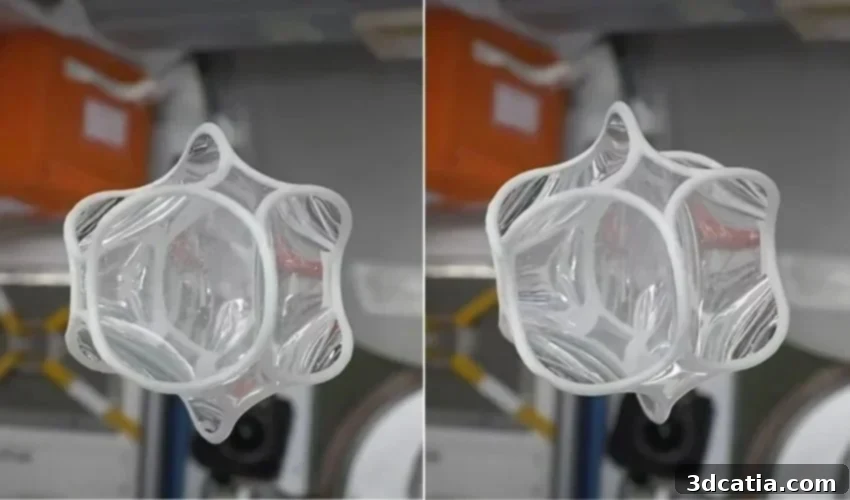
A revolutionary geometric model, the result of collaborative research between the University of Oxford and the Budapest University of Technology and Economics, has become the centerpiece of an extraordinary experiment conducted in space. These innovative “soft cells” represent geometric forms uniquely capable of filling space without relying on straight edges, a characteristic also observed in various biological structures. The f2 variant, a specific iteration of these soft cells, was launched into space to study its behavior under microgravity conditions. The results of this experiment have astounded even the most seasoned astronauts.
Introduced in 2024, soft cells redefine our understanding of geometric shapes. They represent a novel class of forms that can fill space without the necessity of sharp vertices. While their geometry shares similarities with polyhedra, a crucial distinction lies in the absence of flat faces and straight edges. Specifically, the f2 variant features surfaces described as “minimal,” akin to the surfaces formed when a soap film stretches across a wire frame, creating a captivating and naturally optimized structure.
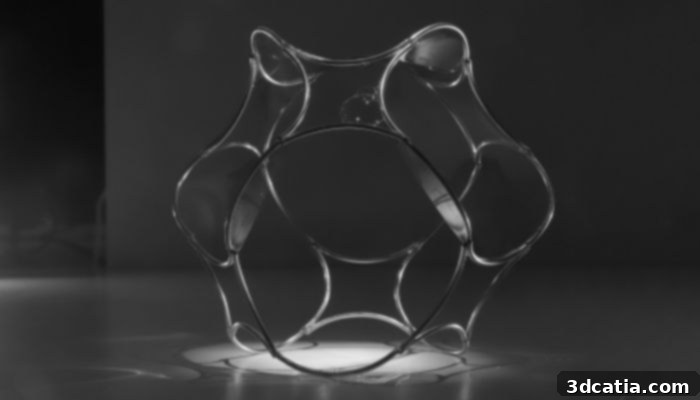
The Geometric Shape Discovered in 2024
The unique characteristics of the f2 soft cell attracted the attention of the Hungarian space program, HUNOR. As part of the Axiom-4 mission, HUNOR proposed sending a structure resembling the edge of the f2 cell to the International Space Station (ISS). The primary objective of this experiment was to fill the structure with water in the microgravity environment of the ISS and meticulously observe the formation of curved surfaces without the distorting influence of the liquid’s weight.
The meticulous planning and execution of this experiment spanned over six months, involving close collaboration between the Budapest team, Axiom Space, and NASA. Final adjustments were made in orbit, meticulously overseen by commander Takuya Onishi and the Axiom-4 crew. Hungarian astronaut Tibor Kapu played a pivotal role in ensuring the experiment’s success. The results far surpassed initial expectations. The absence of gravity enabled the water to adopt configurations that are simply unattainable on Earth, providing invaluable insights into how minimal surfaces distribute themselves within the unconventional volume of a soft cell. This opened a new window into the fundamental behaviors of fluids and geometries in extreme conditions.
This groundbreaking experiment naturally raises the question of how these intricate soft cells were manufactured. While official sources have not disclosed the precise methodology employed to create the 3D structure, it is highly probable that 3D printing played a crucial role. 3D printing, also known as additive manufacturing, is renowned for its ability to accurately and rapidly reproduce highly complex geometries. Given that the ISS has consistently utilized additive manufacturing for various experiments, both on the ground and in orbit, it is reasonable to assume that this project also leveraged this advanced technology to bring the soft cell structure to life.
Additive manufacturing in space provides unique advantages. It enables the creation of custom tools, spare parts, and even habitats directly on demand, reducing reliance on Earth-based resupply missions. Furthermore, experiments such as the soft cell project contribute to our understanding of material behavior and manufacturing processes in microgravity, paving the way for future in-space manufacturing capabilities that will be essential for long-duration space exploration and colonization efforts.
The implications of this experiment extend far beyond the realm of pure scientific curiosity. The Mathematical Institute of the University of Oxford emphasizes that these findings not only deepen our understanding of the geometry underlying many biological tissues but also unlock the potential for designing buildings and structures without traditional angles. This marks a significant shift towards a completely new paradigm in future design, where organic forms and optimized geometries dominate.
Imagine buildings that seamlessly blend with the natural environment, structures that are inherently stronger due to their curved forms, and designs that prioritize efficiency and sustainability. Soft cell geometry could revolutionize architecture, engineering, and even product design, leading to a more harmonious and resource-conscious future.
Moreover, the insights gained from studying soft cells in microgravity could have a profound impact on the development of new materials. By understanding how these geometric shapes behave under extreme conditions, scientists and engineers can potentially create novel materials with enhanced properties, such as increased strength, flexibility, and resistance to stress. These materials could find applications in a wide range of industries, from aerospace and automotive to medicine and construction.
The success of the soft cell experiment underscores the importance of international collaboration in pushing the boundaries of scientific knowledge. By bringing together expertise from universities, space agencies, and private companies, researchers were able to achieve breakthroughs that would have been impossible working in isolation. This spirit of collaboration will be essential for addressing the complex challenges facing humanity, from climate change to resource scarcity to space exploration.
What are your thoughts on these intriguing soft cells? Do you believe they have the potential to reshape the future of space exploration and architectural design? Share your opinions in the comments below. Connect with us on LinkedIn and Facebook to join the conversation! For comprehensive details, refer to the full press release here. Stay up-to-date with the latest 3D printing news by subscribing to our free weekly Newsletter. Don’t forget to explore our video content on our YouTube channel. For more insights into 3D printing advancements within the aerospace and defense sectors, visit our dedicated page HERE.