
Latest Advancements in 3D Printing: Fashion, Aerospace, and Beyond
This week’s developments in 3D printing demonstrate the technology’s expanding influence across diverse sectors. From revolutionizing medicine to transforming aerospace engineering, creating innovative consumer goods, and pushing the boundaries of materials science, 3D printing continues to redefine what’s possible. Let’s delve into some of the most exciting breakthroughs.
CurifyLabs recently unveiled a groundbreaking 3D printed compounding system designed to produce medications tailored for pets. This innovative system provides a significantly faster and more consistent alternative to traditional manual preparation methods, ensuring pets receive the precise dosages they require in a palatable form. In the aerospace industry, Saab has introduced a remarkable five-meter aircraft fuselage, entirely designed by artificial intelligence and predominantly 3D printed in metal. This achievement highlights the potential of software-driven iteration to revolutionize aircraft production, enabling more agile and efficient manufacturing processes. Researchers at the University of Science and Technology of China (USTC) have achieved a significant milestone with the high-precision 3D printing of high-entropy ceramic nanolattices. These ultralight and ultra-strong structures, boasting features as small as 150 nanometers, showcase the capabilities of advanced additive manufacturing techniques. Simultaneously, additive manufacturing continues to shape culture and design, permeating industries and applications ranging from sneaker design to toy manufacturing, further illustrating the technology’s pervasive impact.
Justin Bieber Enters the 3D Printing Scene with Unique Sneaker Design
3D printing reached a new level of mainstream recognition this week with the debut of Justin Bieber’s first 3D-printed sneaker, the “Earth Bender.” This innovative footwear was created in collaboration with Zellerfeld and launched at SKYLRK’s inaugural pop-up event in Tokyo. The Earth Bender boasts a sculptural, slip-on design inspired by soccer cleats, featuring a unique blend of textures, including mesh-like side panels, all seamlessly produced as a single, continuous 3D-printed piece.
Zellerfeld is renowned within the footwear industry as a pioneering 3D printing manufacturer and digital platform. They empower designers to transform experimental concepts into tangible footwear, working with independent studios and global brands like Nike and Havaianas. The Earth Bender represents the latest innovation to emerge from this dynamic ecosystem. Following Bieber’s launch of Skylrk with designer Neima Khaila earlier this year, this collaboration firmly places additive manufacturing at the forefront of contemporary sneaker culture.
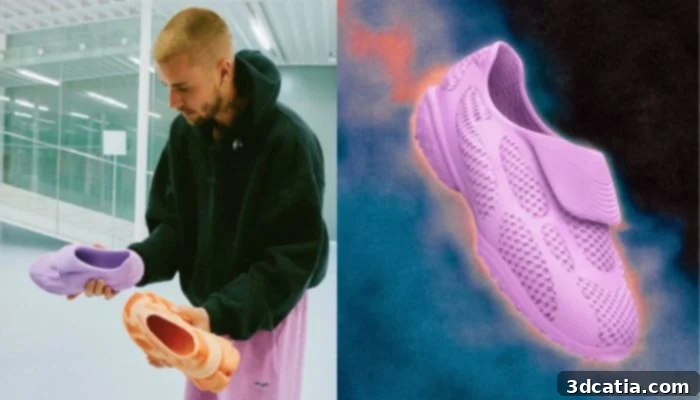
(Photo Credit: (Right) Instagram via @lilbieber and (Left) Skylrk)
LEGO Group to Deliver Keynote at AMUG 2026
Recent headlines have highlighted LEGO’s release of its first retail set incorporating a 3D-printed part: a festive Christmas train. This announcement is particularly timely, as the Additive Manufacturing Users Group (AMUG) has announced that Ronen Hadar, Senior Director and Head of Additive Design & Manufacturing at The LEGO Group, will be a keynote speaker at their 2026 conference.
The AMUG conference is scheduled to take place in Reno, Nevada, from March 15-19. Hadar’s keynote address, entitled “Additive Manufacturing at Scale in Consumer Goods: The Case of The LEGO Group,” will be delivered on Thursday, March 19th. He will explore how LEGO is integrating 3D printing into its operations within an industry characterized by high-volume, low-cost production requirements. With over 15 years of experience shaping LEGO’s approach to additive manufacturing, Hadar’s insights will offer attendees a comprehensive understanding of how the iconic toy brand leverages AM for innovation. For additional information regarding AMUG 2026, please visit AMUG’s official website.

(Photo Credit: AMUG / Lego)
Saab Unveils World-First AI-Designed, Fully 3D-Printed Aircraft Fuselage
Saab, in collaboration with Divergent Technologies, has reached a significant milestone in additive manufacturing with the unveiling of a five-meter aircraft fuselage. This fuselage is not only fully 3D-printed but also designed by artificial intelligence. The experimental structure, created using Divergent’s advanced additive production system, marks a historic moment as the first instance of an airframer attempting to construct a large, flight-ready fuselage without relying on traditional tooling methods. Saab anticipates conducting the first test flight in 2026.
This project draws upon Saab’s extensive digital engineering expertise gained from the Gripen E fighter program, where model-based design and rapid software updates revolutionized development cycles. This same philosophy is now being applied to physical hardware through what Saab refers to as Software-Defined Hardware Manufacturing. Optimization algorithms are utilized to generate organic, load-bearing forms that would be impossible for humans to design manually. The resulting structure is highly integrated, composed of only 26 printed metal parts, replacing hundreds of individual components and eliminating the need for thousands of fasteners. Saab views this demonstrator as an early indication of a future where aircraft can be redesigned, printed, and assembled with software-like speed. This could potentially transform upgrade cycles, enable the creation of mission-specific variants, and fundamentally reshape the way next-generation crewed and uncrewed aircraft are built.
CurifyLabs Launches First 3D Printed Compounded Drugs for Pets
CurifyLabs has pioneered a new 3D printing technology designed to provide personalized compounded medications for veterinary use. At the heart of this system is Curablend Vet, an excipient blend specifically formulated for printing pet-friendly dosages. This innovative blend works in conjunction with CurifyLabs’ automated Compounding System Solution, which produces soft, chewable gel pills in a matter of minutes.
Because many drugs are not commercially available in pet-specific strengths, pharmacists often resort to manual compounding processes that can be time-consuming and inconsistent. CurifyLabs’ automated workflow addresses this challenge by replacing much of the variability inherent in manual compounding. The system generates digitally documented, standardized 3D-printed formulations tailored to each individual animal’s needs. This results in medication that is easier for pets to ingest, potentially improving compliance among pet owners. CurifyLabs CEO Charlotta Topelius describes the launch as a groundbreaking advancement for veterinary care, expanding the reach of a platform that was previously limited to human hospitals and pharmacies across Europe and the United States. Founded in 2021, CurifyLabs views Curablend Vet as a significant step towards modernizing compounding practices and bringing reliable, customized 3D-printed medicine to the veterinary field.

(Photo Credit: Adobe Stock)
USTC Develops First High-Precision 3D Printed High-Entropy Ceramic Nanostructures
Researchers at the University of Science and Technology of China have achieved a breakthrough with a new micro and nanoscale 3D printing method. This method enables the creation of high-entropy ceramics in complex structures with unparalleled precision. The team developed a highly transparent, high-loading photosensitive resin and combined it with femtosecond laser two-photon printing and sintering to produce fully dense ceramic architectures with feature sizes as small as 150 nanometers.
High-entropy ceramics are known for their exceptional performance in extreme environments. However, their application has been limited primarily to powders and bulk materials due to the difficulty of shaping them at minuscule scales. The new approach addresses this limitation by providing a repeatable, high-fidelity printing process that yields ultralight, ultrastrong nanolattices with exceptional specific strength and energy absorption capabilities. The researchers emphasize that this work represents a pivotal step forward for microstructured ceramics, potentially expanding their use in emerging fields such as MEMS, microphotonics, and advanced aerospace components. The achievement also builds upon the group’s ongoing progress in micro 3D printing of glass, ceramics, and metals, further solidifying the technology as a next-generation platform for high-performance microdevices.
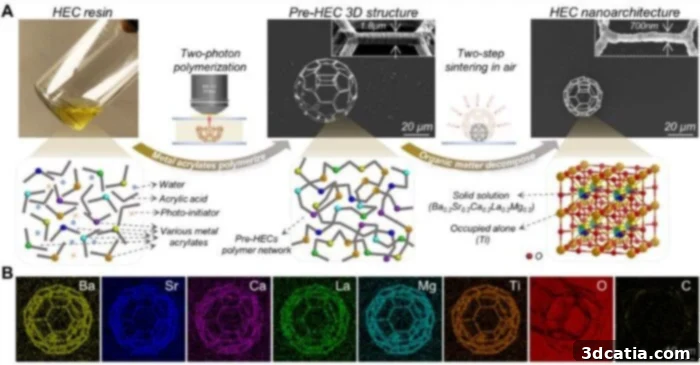
Their proposed method for fabricating high-entropy ceramic micro three-dimensional structures. (Credit: University of Science and Technology of China)
What are your thoughts on Justin Bieber’s new 3D printing collaboration with Skylrk? Share your opinions in the comments section below or on our LinkedIn or Facebook pages! Don’t forget to subscribe to our free weekly Newsletter to receive the latest 3D printing news directly to your inbox. You can also find all our videos on our YouTube channel.
*Cover Photo Credit: Skylrk