
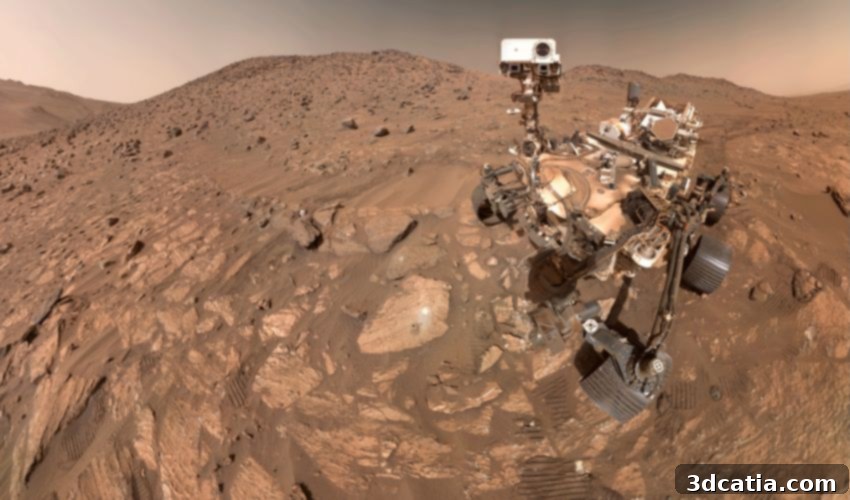
AMUG 2025: NASA JPL’s Dr. Ryan T. Watkins on Pioneering Aerospace Design with Additive Manufacturing
As the additive manufacturing world eagerly anticipates AMUG 2025, scheduled for March 30 – April 3 in the vibrant city of Chicago, Illinois, attention is already turning to the exceptional lineup of keynote speakers. Among the distinguished voices poised to share groundbreaking insights is Dr. Ryan T. Watkins, a prominent research engineer at NASA’s Jet Propulsion Laboratory (JPL). Dr. Watkins will be guiding attendees through a deep exploration of the critical role of design in additive manufacturing, with a particular emphasis on its transformative applications within the demanding aerospace sector. Ahead of this highly anticipated event, we had the privilege of sitting down with Dr. Watkins to gain a deeper understanding of his pioneering work and to learn what attendees can expect from his address at AMUG, a conference renowned for its forward-thinking discussions and collaborative spirit.
3DN: Could you introduce yourself and your connection to 3D printing, especially within the context of space exploration?

Ryan T. Watkins, PhD
My name is Ryan T. Watkins, and I hold a PhD in engineering. I currently serve as a research engineer at NASA’s Jet Propulsion Laboratory, located in Pasadena, California. For nearly a decade, my professional journey has been dedicated to uncovering and harnessing the immense potential of 3D printing and additive manufacturing technologies, specifically in how they can revolutionize space exploration. My work at JPL is at the forefront of combining advanced manufacturing techniques, such as selective laser melting and electron beam melting, with highly innovative design methodologies. These include cutting-edge approaches like topology optimization and the strategic implementation of lattice structures, all aimed at significantly enhancing spacecraft performance, reducing mass, and improving overall mission success rates. Beyond the theoretical and experimental research, a significant part of my role involves actively transitioning these nascent technologies into practical space applications. For 3D printing, this critical process encompasses a variety of tasks: rigorously qualifying novel materials for the extremely harsh and unpredictable environments of space, providing essential support to engineering teams in adopting design principles tailored for additive manufacturing, and systematically guiding the broader adoption of these advanced techniques across numerous NASA missions. This comprehensive approach ensures that the innovations developed in the lab are robust and reliable enough for the ultimate test of space.
3DN: What can attendees expect from your highly anticipated keynote speech at AMUG 2025?
In my keynote speech at AMUG 2025, I am thrilled to share the detailed insights from my ongoing work on 3D-printed titanium lattice structures, which have been meticulously developed at JPL for critical sample return missions. While the concept of lattice structures has long captivated the additive manufacturing community due to their exceptional strength-to-weight ratios and customizable energy absorption properties, their widespread real-world adoption has historically been constrained by significant design and fabrication challenges. At JPL, we are actively overcoming these hurdles by ingeniously leveraging these complex structures as highly effective energy attenuators. Our primary goal is to provide unparalleled protection for delicate and invaluable scientific samples during what are often hard, high-impact landings, such as those occurring on Earth’s surface after a journey through space. As the principal investigator who has been leading this cutting-edge research since 2020, I will delve into the fundamental reasons why crushable lattices are uniquely suited and ideally positioned for these extremely demanding applications. My presentation will cover the entire rigorous research and development journey required to conceptualize, develop, and ultimately qualify these structures for actual flight missions. I will also candidly share the myriad highs and lows, the triumphs and the formidable challenges, encountered when transforming a novel technological concept from an initial idea into a fully mission-ready and flight-certified component. This journey underscores the immense effort and innovation required to push the boundaries of space technology with additive manufacturing.
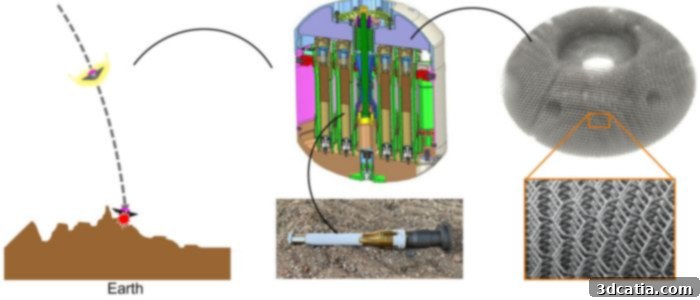
The crushable lattice concept that Dr. Watkins will be discussing at AMUG 2025
3DN: Why is it absolutely necessary to extensively discuss the intrinsic link between advanced design methodologies and additive manufacturing?
For a significant number of engineers today, our foundational education and crucial early career experiences were firmly rooted in traditional manufacturing methods – techniques that were prevalent long before additive manufacturing became widely accessible or even a feasible option. Even recent graduates entering the workforce often possess surprisingly limited exposure to the full capabilities of 3D printing, especially when it pertains to advanced applications involving metal additive manufacturing. As a direct consequence of this historical bias, we frequently, and often subconsciously, impose restrictive constraints on the design process. These limitations don’t just affect the geometric shaping of individual components; they profoundly influence how we fundamentally define and approach complex engineering requirements. This deeply ingrained manufacturing intuition, while valuable in its traditional context, can unintentionally stifle true innovation, even when we consciously strive to break free from conventional thinking and embrace novel approaches. The act of stepping into unfamiliar design spaces, where the rules of traditional manufacturing no longer apply, is inherently challenging. This is precisely why continuous advancements in sophisticated design tools are not just beneficial, but absolutely critical for the evolution of additive manufacturing. Tools such as topology optimization and generative design play a pivotal role in bridging this cognitive gap. They fundamentally shift the design paradigm from merely focusing on what a part should aesthetically look like, to instead defining with precision what a component needs to functionally achieve. By prioritizing performance over preconceived form, these tools unlock a new era of design freedom, allowing engineers to create structures that are lighter, stronger, and more efficient than ever imagined possible with conventional methods, thereby fully exploiting the unique advantages of additive manufacturing.
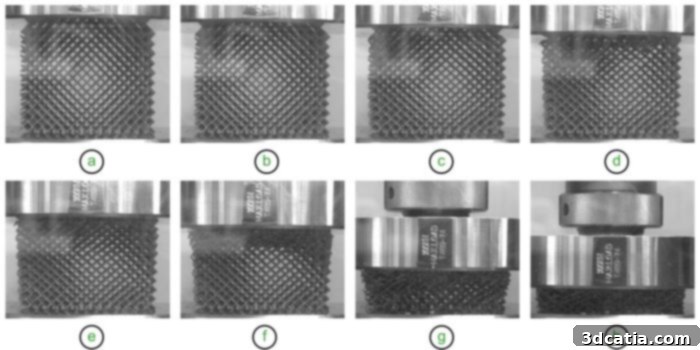
The lattices in the process of being crushed
3DN: What is the paramount importance of events like AMUG for effectively bringing together the various, often disparate, parts of the additive manufacturing value chain, including crucial aspects like design?
Engineering is frequently perceived as an exclusively technical field, meticulously driven by precise logic, rigorous calculations, and unwavering precision. However, the nuanced reality is that innovation, particularly within the rapidly evolving domain of additive manufacturing (AM), is equally and profoundly shaped by a multitude of human factors. These include our collective experiences, our individual and organizational perceptions of risk, and the intricate ways in which we navigate and adapt to extraordinarily rapid technological change. These less tangible, yet immensely powerful, elements play a truly significant and often underestimated role in determining the ultimate success and widespread adoption of new technologies. Events such as AMUG are absolutely invaluable because they serve as a unique crucible, bringing together the entire, diverse AM community under one roof. This facilitates an essential bridge between the purely technical advancements and the critical human-centric aspects of progress. Beyond merely showcasing the latest technological breakthroughs, these dynamic gatherings are expertly designed to foster deep collaboration, cultivate a shared understanding, and accelerate knowledge exchange. They provide an indispensable forum for professionals from all segments of the AM value chain—from material scientists and software developers to designers, manufacturers, and end-users—to connect, engage in robust discussions, exchange varied perspectives, and collectively navigate the complex social, economic, and practical aspects inherent in technology adoption. It is precisely this synergy of collective expertise, coupled with an embracing of diverse outlooks and cross-industry insights, that has historically propelled 3D printing technology forward at an astonishing pace, and it is this same collaborative spirit that will undoubtedly continue to shape its promising future trajectory.
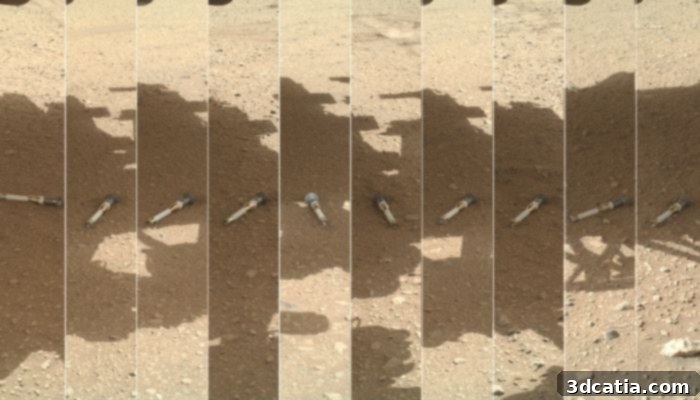
Examples of samples taken from Mars which would be protected by lattices such as those being investigated by Dr. Watkins
3DN: What aspects are you personally most looking forward to experiencing at AMUG 2025?
Much of my direct experience and specialized expertise with 3D printing technologies has been concentrated within the highly demanding aerospace sector, specifically tailored for the unique challenges and opportunities presented by space applications. In this focused environment, it’s remarkably easy to inadvertently lose sight of just how extensively and profoundly this revolutionary technology impacts a myriad of other diverse industries and scientific disciplines. Therefore, I am particularly eager and genuinely looking forward to exploring these broader applications and innovative use cases at AMUG 2025. My aim is to gain fresh, interdisciplinary perspectives that can not only inform but also significantly enhance and inspire the critical work we undertake at NASA’s Jet Propulsion Laboratory. As JPL continues its strategic expansion in the utilization of additive manufacturing across its various programs and missions, I am also incredibly excited to observe and understand the overarching direction in which the entire industry is heading. This includes both the near-term advancements that will soon become commercial realities and the longer-term, more speculative evolutionary paths of this transformative technology. I am especially interested in advancements related to large-scale printing capabilities, as this particular aspect is now increasingly becoming a limiting factor in the design and production for many of our increasingly ambitious aerospace applications. The ability to print larger, more complex components efficiently and reliably will unlock new possibilities for spacecraft design and mission profiles, pushing the boundaries of what we can achieve in space.
3DN: Do you have any final words of insight or advice for our esteemed readers in the additive manufacturing community?
I firmly believe that additive manufacturing is currently at an extraordinarily pivotal point in its ongoing development trajectory. We now possess a diverse array of sophisticated processes that are demonstrably capable of producing high-quality, production-ready parts for a wide range of industries. What is particularly encouraging and noteworthy is that I have observed a significant and positive shift in the general perception within the broader engineering community – moving decidedly from an initial stance of skepticism and cautious observation to one of genuine excitement, strategic investment, and active engagement. This change in sentiment is a powerful indicator of the technology’s maturing capabilities and proven value. The key question moving forward, which will profoundly shape the next era of AM, is whether the technology can continue to evolve rapidly enough to make its value proposition even clearer, more compelling, and universally accessible across various manufacturing contexts. For instance, it is still not uncommon for certain complex parts to be more cost-effective to produce using highly precise 5-axis machining techniques than with additive manufacturing, especially for higher volume productions or specific material requirements. If additive manufacturing can successfully close this remaining cost-efficiency gap, while simultaneously continuing its impressive trajectory of improving scale, resolution, material diversity, and overall production speed, then the landscape of global manufacturing could look dramatically different just 20 years from now. This transformation would be particularly impactful in low-production, high-value industries like aerospace and defense, where the benefits of customizability, weight reduction, and performance optimization often outweigh initial cost considerations. The intrinsic potential of additive manufacturing is, without exaggeration, absolutely enormous, and how we collectively navigate this crucial next stage of its development will undeniably shape the future of engineering design, manufacturing processes, and technological innovation for decades to come.
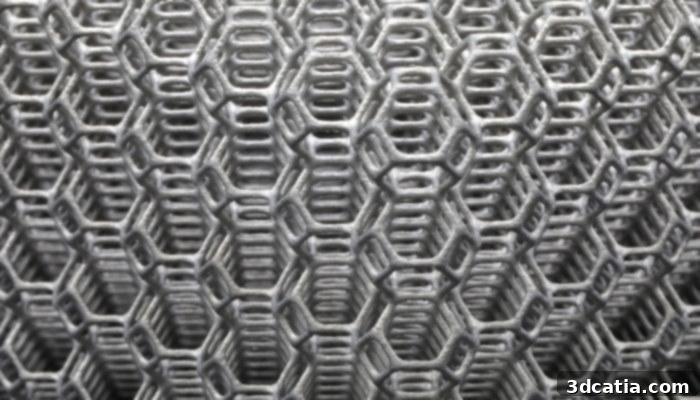
A close up of some of the lattices designed by Dr. Watkins
What are your thoughts on this insightful interview with Dr. Ryan T. Watkins? We encourage you to share your perspectives and engage with the additive manufacturing community by leaving a comment below, or by connecting with us on our official LinkedIn, Facebook, and Twitter pages! Don’t miss out on the latest advancements and news from the world of 3D printing; remember to sign up for our free weekly Newsletter here, delivering the most pertinent updates straight to your inbox! Additionally, you can explore all our engaging video content and interviews on our dedicated YouTube channel.