

Support-Free Resin 3D Printing: A New Era with Laser Curing Technology
The realm of 3D printing is constantly evolving, pushing the boundaries of what’s possible in manufacturing and design. One of the most exciting recent developments comes from a collaborative effort between researchers at Xiamen University and the University of California, Berkeley. They have pioneered a groundbreaking method in resin 3D printing that could potentially eliminate the need for support structures altogether, streamlining the fabrication process and opening new avenues for complex geometries.
This innovative approach combines Direct Ink Writing (DIW) with a laser curing system, allowing for the creation of parts from thermoset materials without the traditional constraints of support structures. The researchers have successfully demonstrated this technique by printing several test pieces that exhibit remarkable stability and self-supporting capabilities. This begs the question: will these parts maintain their structural integrity and durability over extended periods? Further testing and analysis will be crucial to validate the long-term performance of this method.
The Challenges of Traditional Resin 3D Printing
While resin 3D printing is celebrated for its precision and ability to produce intricate details, it is not without its challenges. A significant bottleneck in the workflow is the extensive post-processing required. This typically involves removing support structures, washing the printed parts to eliminate uncured resin, and, in many cases, additional curing to ensure complete solidification and optimal mechanical properties. These steps can be time-consuming and labor-intensive, adding considerable overhead to the overall production cycle.
Several manufacturers are actively seeking ways to minimize these post-processing requirements, focusing on developing materials and techniques that simplify the process. However, eliminating post-processing altogether remains a significant hurdle. The generation of support structures itself poses a challenge. The material properties of resins often make it difficult to maintain structural stability during the printing process, before the final curing stage. This is where the new research offers a particularly promising alternative, addressing a fundamental limitation of conventional resin 3D printing.
The new method bypasses the limitations associated with traditional support structures. By directly solidifying the material as it is extruded, the need for temporary supports is eliminated, allowing for more complex and intricate designs to be realized. This opens up exciting possibilities for industries that require customized, high-precision components.
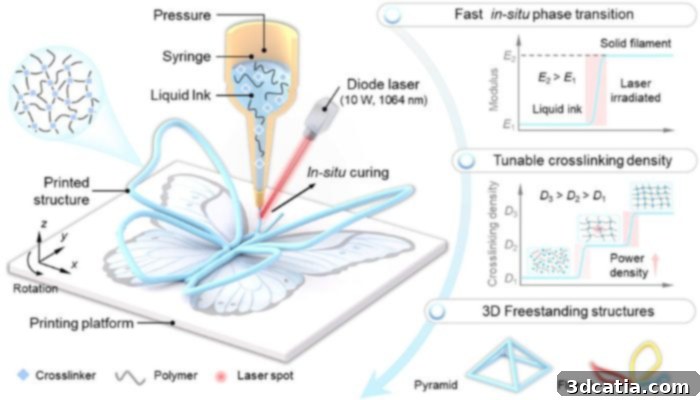
This technique employs a laser to directly solidify the material.
How the Support-Free Method Works
Dezhi Wu, a leading coauthor of the study, elucidates the core principle behind their innovative approach: “Thermoset materials (such as silicones) are widely used in engineering and infrastructure applications. However, their 3D printing processes suffer from prolonged curing time and complicate supporting structures to make freestanding structures as they will sag and collapse before solidification. The laser manufacturing tools in our lab are utilized to directly print thermoset ink materials to cure the ink instantly.“
The key lies in the precise control of the laser, which is directed to solidify the thermoset material immediately as it exits the printing nozzle. This eliminates the need for a traditional resin vat or the projection of droplets onto a build plate. By curing the resin in real-time, the team achieves the remarkable feat of printing directly “in midair,” defying the conventional requirements of support structures. This marks a significant departure from traditional resin 3D printing methods and presents a viable pathway towards more efficient and versatile fabrication.
This method also facilitates a more streamlined printing process, accelerating production times and reducing material waste. The ability to print complex geometries without supports also encourages innovation in design and opens up opportunities for creating parts with intricate internal structures and features.
Programmable Material Properties
Beyond eliminating support structures, this innovative method offers another significant advantage: the ability to program the mechanical and electrical properties of the printed materials. Dezhi Wu further explains, “The properties of printed 3D structures are programmable. For example, the local mechanical stiffness and electrical conductivity can be adjusted by the printing parameters so that different regions can be made softer or stiffer, and their conductivity can be high or low.“
This level of control over material properties opens up exciting possibilities for creating multi-functional components with tailored characteristics. Imagine a single 3D printed object with regions that are flexible and conductive, seamlessly integrated into a rigid, insulating structure. This could revolutionize the design and fabrication of sensors, actuators, and other complex devices, allowing for greater customization and performance optimization.
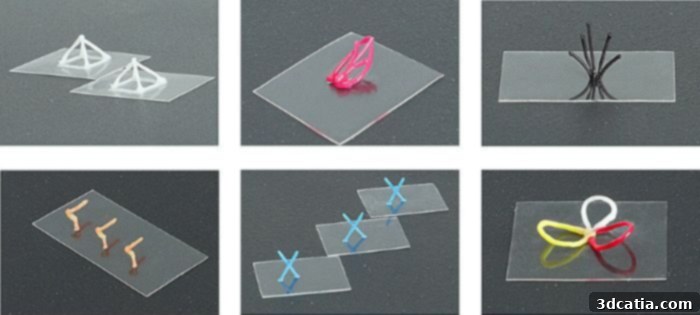
Some examples of the 3D printed components.
Demonstrating the Potential
To showcase the capabilities of their support-free resin 3D printing technique, the research team successfully printed several complex structures, demonstrating the versatility and potential of the method. These included soft sensors capable of detecting subtle changes in pressure or strain, stretchable electronic components that can conform to curved surfaces, and even magnetic robots designed for targeted drug delivery or micro-manipulation tasks. These examples highlight the broad range of applications that could benefit from this technology.
The ability to create such diverse and complex structures without the need for support structures underscores the transformative potential of this new method. It not only simplifies the printing process but also unlocks new design possibilities, paving the way for the development of innovative products and solutions across various industries.
Future Directions and Industrial Applications
Dezhi Wu concludes, “We now plan to build a robust 3D-printing platform for the construction of soft, multi-functional devices,” added Wu. “We will also expand the printable ink toolbox and investigate the optimal printing parameters toward industrial applications, such as flexible electronics, organ chips and so on.”
The researchers envision a future where this support-free resin 3D printing technology is widely adopted in industrial settings, enabling the mass production of customized components with tailored material properties. Potential applications include flexible electronics for wearable devices, organ-on-a-chip systems for drug discovery and personalized medicine, and advanced sensors for environmental monitoring and industrial automation.
Further research and development will focus on expanding the range of printable materials, optimizing the printing parameters for different applications, and developing robust quality control measures to ensure the reliability and consistency of the printed parts. The ultimate goal is to create a versatile and user-friendly 3D printing platform that empowers engineers and designers to create innovative products with unprecedented functionality and performance. The full details of the study can be found HERE.
The development of support-free resin 3D printing represents a significant step forward in additive manufacturing. By eliminating the need for support structures and enabling the programming of material properties, this innovative technology opens up new possibilities for creating complex and customized components with enhanced functionality. As research continues and the range of printable materials expands, this method has the potential to revolutionize various industries, from electronics and healthcare to robotics and aerospace.
What are your thoughts on the potential impact of support-free resin 3D printing? Share your opinions in the comments below and join the discussion on our LinkedIn or Facebook pages! Stay informed about the latest advancements in 3D printing by subscribing to our free weekly Newsletter. You can also find all our videos on our YouTube channel.
*All Photo Credits: Nature Electronics / Xiamen University