

Revolutionizing Additive Manufacturing: A Holistic Design Approach for Optimal Performance and Sustainability
A groundbreaking study from the University of West Attica challenges the conventional approach to additive manufacturing (AM), arguing that its full potential remains untapped due to outdated design practices. The research, published in Advanced Manufacturing, introduces a comprehensive design framework that urges engineers to move beyond geometry-centric rules that have dominated the field for over a decade. This new perspective aims to revolutionize how products are conceived and designed specifically for 3D printing, paving the way for enhanced performance, efficiency, and sustainability.
While additive manufacturing has matured into a reliable production solution for diverse sectors such as aerospace, medical devices, automotive engineering, and specialized tooling, many digital design methodologies still emulate those employed for traditional machining and fabrication. According to the research team, this entrenched mindset significantly limits the capabilities of 3D printing. By adhering to traditional design constraints, engineers are not fully leveraging the unique advantages that AM offers, hindering innovation and optimal product development.
The authors advocate for a holistic, system-level approach to Design for Additive Manufacturing (DfAM). Their proposed framework seamlessly integrates various critical aspects, including design intent, material behavior, build orientation, process parameters, sustainability considerations, and real-world performance. The primary objective is to align digital modeling more closely with the actual behavior of additive manufacturing systems during the printing process and throughout the entire product lifecycle. This comprehensive integration aims to bridge the gap between design and manufacturing, enabling the creation of products that are not only functional but also optimized for performance, efficiency, and environmental responsibility.
Dr. Alexandros Kantaros, the lead author of the study, emphasizes that “Design for Additive Manufacturing should not merely ensure printability. It must connect material-process interactions, build orientation, tolerancing, and sustainability considerations to create designs that are innovative, reliable, and efficient.” This statement underscores the need to move beyond basic printability and embrace a more integrated approach that considers all aspects of the manufacturing process and product lifecycle.
This perspective fundamentally challenges the prevailing emphasis on geometry optimization within the field. Traditional DfAM guidelines often revolve around rules and constraints related to overhangs, support structures, and lightweighting techniques. However, these guidelines frequently overlook crucial factors such as thermal distortions, anisotropic mechanical properties, and emissions-related environmental impacts. The research highlights the increasing importance of these factors as companies transition from using additive manufacturing for prototyping to employing it for full-scale production. Ignoring these considerations can lead to suboptimal designs, reduced performance, and increased environmental footprint.
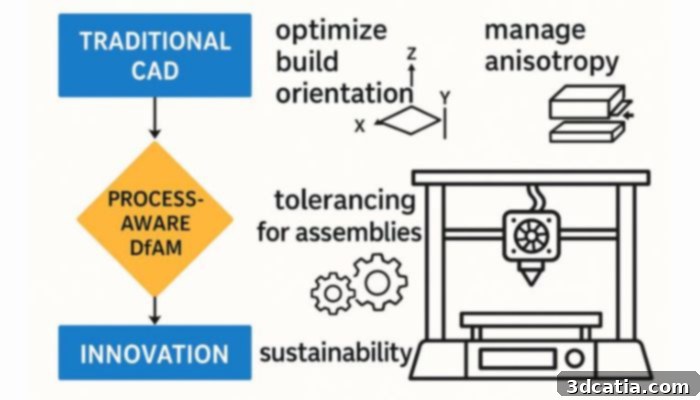
A visual overview of the research team’s proposed workflow, showing how modern DfAM integrates process awareness, material behavior, and sustainability into the digital design stage. (Photo Credit: Antreas Kantaros / University of West Attica)
To address these identified shortcomings, the authors advocate for the development and implementation of digital design environments that seamlessly integrate simulation capabilities, AI-assisted manufacturability tools, and closed-loop optimization processes. These advanced platforms would empower engineers to anticipate potential deformation issues, make informed decisions regarding material selection strategies, and understand the direct impact of sustainability goals on design choices. By leveraging these tools, engineers can create more robust, efficient, and environmentally responsible designs.
The research team emphasizes that these advanced workflows can unlock a new realm of ambitious applications, including the creation of functionally graded materials, mass customization strategies, and multi-part consolidation techniques. Functionally graded materials offer the ability to tailor material properties within a single component, optimizing performance for specific applications. Mass customization enables the production of highly personalized products tailored to individual customer needs. Multi-part consolidation allows for the integration of multiple components into a single, unified design, reducing assembly time and improving overall product reliability.
Co-author Professor Theodore Ganetsos stresses that fostering innovation requires a shift in perspective, where design and manufacturing are no longer treated as isolated stages. “By merging these perspectives, we can achieve sustainable, high-performance engineering solutions,” he asserts. This integrated approach encourages collaboration and communication between design and manufacturing teams, leading to more efficient and effective product development processes.
The team also highlights the growing need for interdisciplinary collaboration, encompassing expertise from various fields such as engineering, materials science, industrial design, and environmental analysis. This collaborative approach ensures that all relevant factors are considered during the design process, leading to more holistic and sustainable solutions. By bringing together diverse perspectives and skill sets, companies can unlock new opportunities for innovation and address complex challenges more effectively.
The publication of this research is particularly timely, as companies and researchers worldwide are actively pursuing more efficient and intelligent additive manufacturing systems. By emphasizing a holistic approach to design, rather than relying on rule-based design shortcuts, the University of West Attica team positions DfAM as a strategic enabler of sustainable industrial transformation. This forward-thinking perspective has the potential to reshape the future of additive manufacturing, driving innovation, improving product performance, and promoting environmental responsibility.
The shift towards a holistic DfAM approach necessitates a fundamental change in mindset and skillset for engineers and designers. It requires a deeper understanding of materials, processes, and their interactions, as well as the ability to leverage advanced simulation and optimization tools. Companies that embrace this new approach will be well-positioned to capitalize on the full potential of additive manufacturing, gaining a competitive edge in the marketplace and contributing to a more sustainable future.
The benefits of adopting a holistic DfAM approach extend beyond improved product performance and sustainability. It can also lead to reduced material waste, lower energy consumption, and shorter lead times. By optimizing designs for manufacturability and minimizing the need for support structures, companies can significantly reduce material waste and associated costs. Similarly, optimizing process parameters and build orientation can minimize energy consumption during the printing process. Furthermore, by streamlining the design and manufacturing process, companies can significantly reduce lead times, enabling faster product development cycles and quicker time-to-market.
In conclusion, the research from the University of West Attica provides a valuable roadmap for the future of additive manufacturing. By advocating for a holistic, system-level approach to DfAM, the authors challenge the conventional wisdom and pave the way for more innovative, efficient, and sustainable product development. As companies increasingly adopt additive manufacturing for full-scale production, the importance of this holistic approach will only continue to grow. Embracing this new perspective will be crucial for unlocking the full potential of additive manufacturing and driving the next wave of industrial innovation.