

Rock Island Arsenal: Forging the Future of US Defense Manufacturing with Hybrid 3D Printing and Traditional Craftsmanship
Nestled along the Mississippi River, Rock Island Arsenal in Illinois stands as a unique testament to the evolution of defense manufacturing. For over a century and a half, this historic military installation has been a bedrock of American industrial capability, renowned for its formidable forging traditions. Today, it is undergoing a profound transformation, seamlessly integrating these time-honored techniques with cutting-edge 3D printing technology. This strategic fusion is not merely about modernization; it is a critical initiative aimed at bolstering the U.S. Army’s supply chain, enhancing its resilience, and ensuring its readiness in an ever-changing global landscape. Within the very same sprawling complex where skilled artisans meticulously pour molten steel into intricate molds, echoing practices perfected over generations, the distinct hum of advanced robotic arms and industrial-grade 3D printers now signals the dawn of a new era. Rock Island Arsenal is rapidly emerging as a pivotal hub for advanced manufacturing, a place where the wisdom of past craftsmanship converges powerfully with the innovation of digital fabrication, creating a truly hybrid approach to defense production.
This dynamic interplay between the old and the new allows the Arsenal to leverage the strengths of both methodologies. Traditional forging and casting provide the robustness, material integrity, and large-scale production capabilities essential for many critical military components, while additive manufacturing introduces unparalleled speed, design flexibility, and the ability to produce highly customized parts on demand. This dual-pronged strategy ensures that the Army’s manufacturing base remains adaptable, capable of producing everything from legacy system parts to advanced components for future warfare. The integration isn’t just about co-existence; it’s about synergistic innovation, where each technology complements the other to overcome the limitations of a singular approach, ultimately delivering superior results for national defense.
Among the most revolutionary advancements at Rock Island Arsenal is the widespread adoption of sand 3D printing, specifically tailored for mold production. This technology directly addresses one of the most significant bottlenecks in traditional manufacturing processes: the time and labor involved in creating complex molds. Historically, fabricating a precise wooden pattern for sand casting – a craft requiring immense skill and meticulous attention to detail – could span several months. This lengthy lead time not only delayed production but also limited the ability to quickly adapt to design changes or urgent demands.
With the advent of industrial sand 3D printers, this paradigm has shifted dramatically. What once took months can now be achieved in a fraction of the time; complex molds can be digitally designed, printed, and ready for casting in as little as 24 hours. The molten metal can then be poured into these newly printed molds the very next day. This astonishing reduction in lead time translates into a profound strategic advantage for the U.S. Army. It means critical spare parts, custom components, or prototypes can be moved from concept to physical reality in days, rather than weeks or months. Such rapid iteration capabilities are invaluable for maintaining operational readiness, ensuring that military equipment remains functional, and swiftly responding to unforeseen needs in the field. This increased flexibility not only streamlines the supply chain but also significantly enhances the Army’s overall responsiveness and agility.
The process itself involves depositing a binder onto layers of sand, solidifying it into the desired mold geometry directly from a digital design file. This method eliminates the need for physical patterns, reducing material waste and allowing for much more intricate and optimized mold designs than traditional methods. Furthermore, it allows for on-demand production, meaning parts can be manufactured precisely when and where they are needed, minimizing inventory costs and storage requirements. This capability is especially crucial for older or specialized equipment where traditional molds might no longer exist or be prohibitively expensive to recreate, effectively extending the lifespan and serviceability of vital military assets.
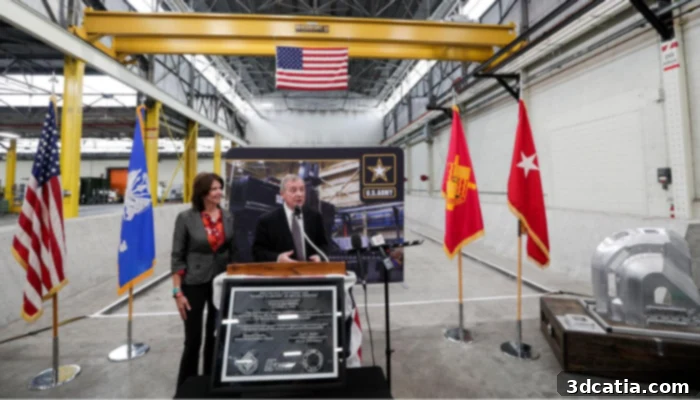
Rock Island Arsenal is also home to the world’s largest 3D metal printer. (Photo Credit: US Army)
While the dramatic increase in speed is a cornerstone of additive manufacturing’s appeal, its advantages at Rock Island Arsenal extend significantly further. The facility is at the forefront of metallurgical innovation, actively experimenting with novel alloys and developing advanced, more precise mold techniques. This focus on material science and process refinement is yielding profound improvements in production efficiency and adaptability. By leveraging 3D printing, engineers can rapidly prototype and test new material compositions, such as lightweight, high-strength aluminum alloys or specialized superalloys designed for extreme temperatures and pressures. These advancements lead to components that are not only more durable but also potentially lighter and more effective in their intended applications, translating directly into enhanced performance for military vehicles, weapons systems, and aircraft.
The ability to create highly precise molds also means that castings have tighter tolerances, requiring less post-processing and reducing material waste. This precision is critical for complex geometries and internal features that are difficult or impossible to achieve with traditional methods. Such capabilities make the entire manufacturing workflow more streamlined and cost-effective in the long run.
A significant milestone for Rock Island Arsenal’s commitment to excellence and high-quality production is its recent achievement of AS9100 certification. This internationally recognized standard is a testament to the arsenal’s rigorous quality management system, specifically tailored for the aerospace industry. Earning AS9100 certification is not merely a bureaucratic formality; it categorically positions Rock Island Arsenal to produce aerospace-grade components that meet the exceptionally stringent demands of aviation applications. This opens up unprecedented opportunities to support both Army and Air Force aviation programs, manufacturing critical parts for helicopters, fixed-wing aircraft, and other aerial assets. The certification underscores the facility’s capability to adhere to the highest quality standards, ensuring reliability and safety for components operating in extreme and mission-critical environments. It signifies trust and competence, enabling the arsenal to take on projects that require unparalleled accuracy and material integrity, thereby broadening its strategic importance within the defense industrial base.
Beyond traditional military hardware, 3D printing is also playing an increasingly pivotal role in the U.S. Army’s ambitious initiative to significantly scale up drone production. Unmanned Aerial Vehicles (UAVs) have become indispensable assets in modern warfare, providing critical intelligence, surveillance, reconnaissance, and even strike capabilities. Recognizing this, Rock Island Arsenal is poised to become a key contributor to the Army’s objective of manufacturing 1,000 UAVs by the end of the current fiscal year. This aggressive production target highlights the urgency and strategic importance placed on drone technology within military operations.
The arsenal will leverage its expertise in composite-based additive manufacturing to fabricate drone bodies, airframes, and various other critical components. This method allows for the creation of lightweight yet robust structures, essential for maximizing flight endurance and payload capacity. Furthermore, additive manufacturing enables rapid prototyping of new drone designs, allowing engineers to quickly test and refine aerodynamic shapes, internal component layouts, and specialized mounting points. This agility is crucial for adapting to evolving battlefield requirements and developing specialized drones for diverse missions.
To further augment this capability, a state-of-the-art large-format 3D printer is scheduled for installation in early 2026. This significant investment will substantially expand Rock Island Arsenal’s capacity to manufacture larger, more complex composite components at an industrial scale. Such a printer will be instrumental in producing entire drone airframes, large structural elements, or even multiple smaller parts simultaneously, vastly accelerating the production pipeline. This expansion signifies a strategic commitment to on-demand, localized drone manufacturing, reducing reliance on external suppliers and enhancing the Army’s self-sufficiency in this critical technological domain. The ability to rapidly produce and customize drones offers a significant tactical advantage, ensuring soldiers have access to the latest and most effective unmanned systems when and where they need them most.
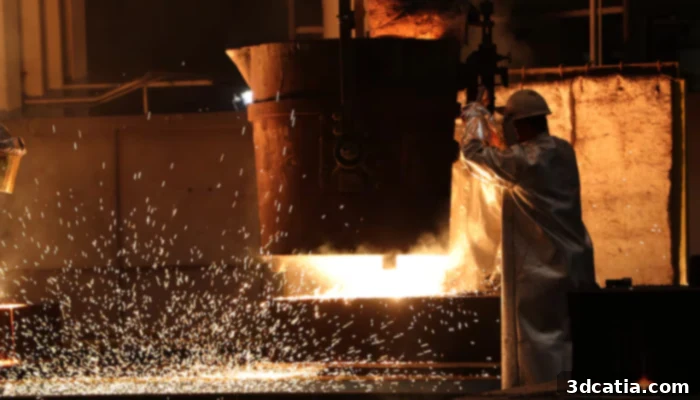
Rock Island Arsenal also specializes in casting molds using molten steel. (Photo Credit: RIA-JTMC)
The ongoing evolution at Rock Island Arsenal serves as a compelling blueprint for how traditional military infrastructure can not only endure but also thrive and adapt in the face of modern challenges. This strategic blend of advanced 3D printing technologies with time-honored, proven craftsmanship is more than just an operational upgrade; it represents a fundamental paradigm shift in defense manufacturing. The U.S. Army is actively cultivating a manufacturing base that is inherently more agile, profoundly resilient, and significantly more responsive to the dynamic and complex demands of contemporary warfare. This innovative approach is yielding tangible benefits across multiple fronts, including a dramatic reduction in lead times for critical components, a substantial improvement in production flexibility, and an enhanced capacity for rapid iteration and customization. These advantages collectively ensure that the military can equip its forces with the right tools, at the right time, and respond with unparalleled speed to rapidly evolving operational requirements and geopolitical shifts.
By embracing digital manufacturing while upholding its legacy of excellence in traditional forging and casting, Rock Island Arsenal is not just modernizing; it is setting a new standard for national defense industrial capabilities. It reinforces the importance of domestic manufacturing, reduces reliance on vulnerable global supply chains, and fosters an environment of continuous innovation. This synergistic integration empowers the Army to maintain its technological edge, support its personnel with superior equipment, and ultimately safeguard national security for decades to come. The arsenal’s journey showcases a powerful vision where heritage and innovation are not mutually exclusive but rather foundational pillars of future strength.
What are your thoughts on these innovative developments at Rock Island Arsenal? We invite you to share your perspective in a comment below, or join the conversation on our LinkedIn or Facebook pages! Furthermore, don’t miss out on the latest 3D printing news – sign up for our free weekly Newsletter to receive updates directly in your inbox. You can also explore our extensive video library on our YouTube channel. For more in-depth coverage of 3D printing news specifically within the aerospace and defense sectors, we encourage you to visit our dedicated page HERE.
*Cover Photo Credits: Rock Island Arsenal