
Revolutionary 3D-Printable Aluminum Alloy: MIT’s Machine Learning Breakthrough for Stronger, Lighter Materials
The creation of new alloys is a cornerstone of modern engineering, enabling the development of materials with enhanced properties such as superior strength, increased durability, or improved resistance to corrosion. Traditionally, the quest for the perfect alloy has involved an exhaustive trial-and-error process, where researchers meticulously test countless combinations of metals and elements. This often lengthy and resource-intensive method can stretch over months or even years, significantly delaying innovation. While computational simulations have offered a promising path to accelerate this discovery, a team of pioneering engineers at MIT has taken an even more efficient approach, leveraging the power of machine learning to revolutionize alloy design. Their recent groundbreaking study unveiled a lightweight, 3D-printable aluminum alloy that boasts an astounding strength, performing five times better than conventionally manufactured aluminum. What’s truly remarkable is the efficiency of their method: instead of sifting through over a million potential simulations, their advanced machine learning model rapidly narrowed the search to a mere 40 combinations, pinpointing the ideal mix with unprecedented speed and accuracy.
Upon the successful 3D printing of this innovative aluminum alloy, its performance precisely matched the predictions made by the machine learning model. The resulting material demonstrated strength comparable to, if not exceeding, the most robust aluminum alloys currently produced through traditional, energy-intensive casting methods. This represents a significant leap forward in materials science, offering a new class of materials capable of creating exceptionally strong, lightweight, and highly heat-resistant components. Such advancements could have a profound impact across various industries, particularly in areas like aerospace, where components such as fan blades in jet engines demand peak performance under extreme conditions. Mohadeseh Taheri-Mousavi, who spearheaded this transformative research during her postdoc at MIT and is now an assistant professor at Carnegie Mellon University, highlighted the immense potential: “If we can use lighter, high-strength material, this would save a considerable amount of energy for the transportation industry.” This statement underscores the dual benefits of this invention: not only does it offer superior material properties, but it also promises substantial energy savings and environmental advantages by reducing the weight of critical components in vehicles, aircraft, and other transport systems.
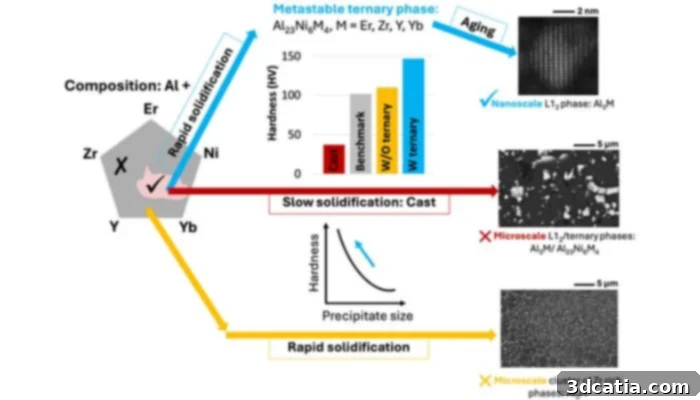
The alloy design concept (Credit: Taheri-Mousavi et al.)
The Pivotal Role of Machine Learning in Advanced Alloy Design
The genesis of this groundbreaking research can be traced back to a course Taheri-Mousavi undertook at MIT in 2020. During this course, students were tasked with utilizing computational simulations to engineer high-performance aluminum alloys. A fundamental principle in achieving robust alloys lies in optimizing their microscopic structure, specifically by ensuring that their constituent particles, known as “precipitates,” are as miniscule and densely packed as possible. These precipitates act as barriers to dislocation movement, which is the primary mechanism of plastic deformation in metals, thus contributing significantly to the material’s overall strength. The conventional approach involved systematically combining aluminum with various types and concentrations of alloying elements to simulate and predict the resulting alloy’s strength. However, this methodical yet laborious process often failed to yield significantly stronger results, prompting Taheri-Mousavi to question if the nascent field of machine learning could offer a more efficient and insightful pathway to discovering novel, high-strength materials.
Delving into the complexities of materials science, Taheri-Mousavi articulated the challenge that traditional methods face: “At some point, there are a lot of things that contribute nonlinearly to a material’s properties, and you are lost.” She emphasized the transformative capability of machine learning, stating, “With machine-learning tools, they can point you to where you need to focus, and tell you for example, these two elements are controlling this feature. It lets you explore the design space more efficiently.” This highlights machine learning’s unparalleled ability to sift through vast datasets of elemental properties and processing parameters, identifying subtle yet critical non-linear correlations that are often imperceptible to human analysis or conventional simulations. For her subsequent, pivotal study, Taheri-Mousavi deployed sophisticated machine-learning techniques specifically engineered to analyze these intricate datasets. The goal was to identify key connections and correlations among various elements that would predictably lead to a more desirable outcome in terms of alloy strength and stability. Her meticulous application of this AI-driven approach yielded astounding results. Through the analysis of a mere 40 carefully selected combinations of aluminum and other alloying elements, the machine learning model was able to pinpoint an ideal composition. This optimal combination was predicted to yield a significantly higher volume fraction of uniformly distributed, small precipitates, which directly translates to superior mechanical strength, far exceeding the performance of alloys identified through previous, less efficient studies.
The Strategic Imperative of 3D Printing for Enhanced Material Performance
The fact that this groundbreaking aluminum alloy is 3D printable is no mere coincidence; it was a deliberate and strategic design choice made by the MIT team. They specifically engineered this advanced material to be compatible with additive manufacturing processes, recognizing that traditional casting methods would inevitably compromise its exceptional strength. The core issue with conventional metal casting lies in its cooling process: molten aluminum is poured into a mold and allowed to cool and solidify. The slower this cooling process, the more time atoms have to diffuse and coalesce, leading to the formation of larger, irregularly shaped precipitates. These larger precipitates are less effective at impeding dislocation movement, consequently reducing the overall strength and performance of the material. In stark contrast, 3D printing technologies, particularly laser powder bed fusion (L-PBF), offer an incredibly rapid cooling rate. As the laser selectively melts metal powder layer by layer, the molten metal solidifies almost instantaneously. This extremely fast freezing preserves a fine, homogeneous microstructure with finely dispersed precipitates, which are crucial for maintaining the alloy’s predicted high strength. Study co-author John Hart articulated this critical synergy: “Sometimes we have to think about how to get a material to be compatible with 3D printing. Here, 3D printing opens a new door because of the unique characteristics of the process — particularly, the fast cooling rate. Very rapid freezing of the alloy after it’s melted by the laser creates this special set of properties.” This highlights how additive manufacturing isn’t just a fabrication method but an integral part of the material’s intrinsic design and performance. For their research, the team meticulously formulated the alloy and then sent it to their collaborators in Germany. There, advanced laser powder bed fusion (L-PBF) equipment was utilized to precisely 3D print test samples. These printed parts were subsequently shipped back to MIT for comprehensive mechanical testing, where the experimental results unequivocally validated their predictions: the printed alloy exhibited the desired fine precipitates and exceptional high strength that their sophisticated machine learning model had accurately forecast.
Notably, this newly developed material stands out for several unparalleled characteristics:
-
Five times stronger than its traditionally cast aluminum counterpart, setting a new benchmark for aluminum alloys.
-
Fifty percent stronger than other advanced aluminum alloys designed using conventional simulation methods without the strategic integration of machine learning, underscoring the efficiency and superiority of the AI-driven approach.
-
Stable at remarkably high temperatures, up to 400°C. This is an exceptionally high threshold for aluminum alloys, traditionally known for their lower melting points and reduced strength at elevated temperatures, thereby opening up new possibilities for high-temperature applications where aluminum was previously unsuitable.
Transformative Applications: From Transportation to Advanced Industries
The introduction of this extraordinary 3D-printable aluminum alloy holds the potential to revolutionize various industries, with a particularly significant impact anticipated in the transportation sector. Consider jet engine blades, which are typically manufactured from titanium alloys. While titanium offers excellent strength and heat resistance, it comes with considerable drawbacks: it is more than 50 percent heavier and approximately ten times more expensive than aluminum. Alternatively, these blades are sometimes made from advanced composites, which can be complex and costly to manufacture. The ability to 3D print high-performance components like jet engine blades from this new aluminum alloy could dramatically reduce the overall weight of jet engines, leading to substantial improvements in fuel efficiency and a significant decrease in operational costs for airlines. This shift from heavier, more expensive materials to lightweight, cost-effective aluminum could also contribute to reducing the environmental footprint of air travel.
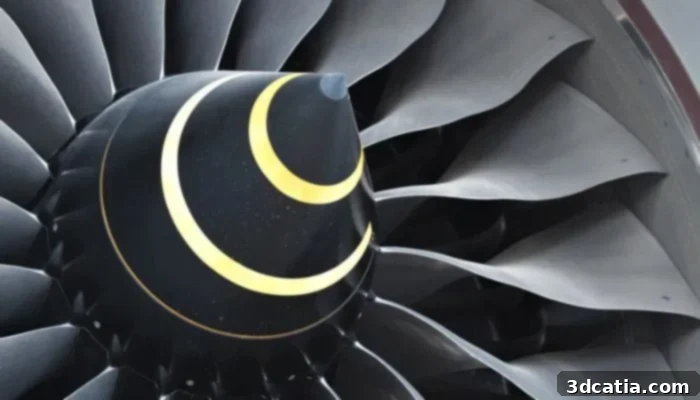
Jet engine blades (Credit: Wevolver)
The versatility of additive manufacturing further enhances the appeal of this novel alloy. As John Hart, who heads the Department of Mechanical Engineering at MIT, elaborates, “Because 3D printing can produce complex geometries, save material, and enable unique designs, we see this printable alloy as something that could also be used in advanced vacuum pumps, high-end automobiles, and cooling devices for data centers.” This points to a future where intricate, customized parts can be rapidly produced on-demand, optimizing performance and reducing material waste across a spectrum of applications. In the automotive industry, lightweight aluminum components can lead to more fuel-efficient vehicles and improved performance. For advanced vacuum pumps, the alloy’s strength and stability at elevated temperatures could enhance durability and operational efficiency. Furthermore, its application in cooling devices for data centers is particularly compelling; here, lightweight, high-thermal-conductivity aluminum structures could lead to more efficient heat dissipation, which is crucial for managing the enormous heat generated by modern computing infrastructure. The MIT team is not resting on its laurels; they are actively pursuing further research, applying similar machine-learning techniques to continually optimize other properties of the alloy, such as fatigue resistance or specific thermal conductivity profiles, to unlock even greater potential. To delve deeper into the specifics of this groundbreaking aluminum alloy and the scientific methodologies behind its discovery, interested readers can access their comprehensive research paper, which was published in the esteemed journal Advanced Materials, by following the link here.
What are your thoughts on MIT’s revolutionary 3D-printable aluminum alloy and its potential to transform industries? We invite you to share your perspectives in a comment below or join the conversation on our LinkedIn or Facebook pages! Additionally, don’t miss out on the latest advancements in additive manufacturing by signing up for our free weekly Newsletter, delivered straight to your inbox. You can also explore our extensive video content on our YouTube channel.
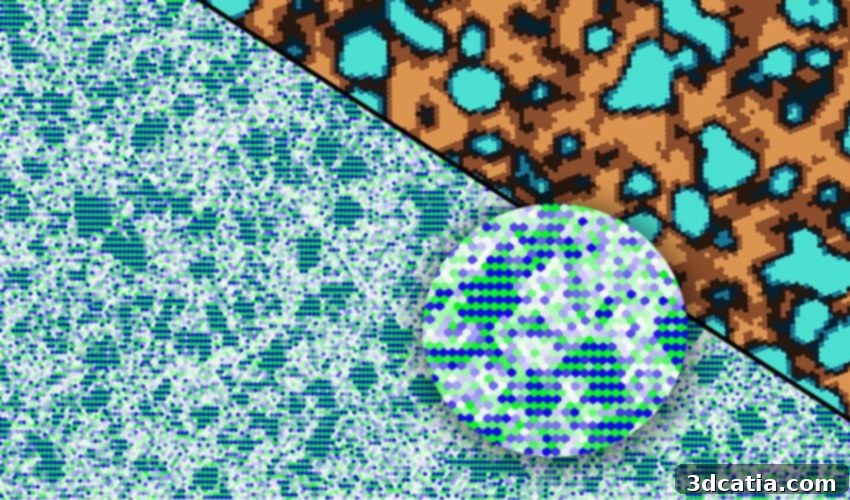
*Cover Image: Aluminum (in brown) with nanometer scale precipitates (in light blue). The precipitates are arranged in regular, nano-scale patterns (blue and green in circle inset) that impart exceptional strength to the printed alloy. Credit: Felice Frankel