

Revolutionizing Wireless: The Future of Adaptive 3D Printed Antennas with Shape Memory Alloys
Antennas are indispensable components in the fabric of modern connectivity, serving as critical enablers for a myriad of technologies that define our everyday lives and propel advanced scientific endeavors. From the seamless flow of wireless communications and precision navigation systems to sophisticated radar applications, essential radio communication, and groundbreaking scientific research, their fundamental role remains constant: to efficiently receive or transmit electromagnetic waves. For decades, antennas have been characterized by their fixed, rigid structures, tailored for specific functions and environments. However, this inherent inflexibility is now poised for a monumental shift, thanks to a pioneering project initiated by a team of innovative researchers at the Johns Hopkins Applied Physics Laboratory (APL) in Baltimore.
Launched in 2019, the core objective of this ambitious project was to harness the transformative power of advanced 3D printing technologies in conjunction with state-of-the-art shape-memory alloys. The researchers aimed to develop a new generation of antennas capable of deforming and reconfiguring their physical shape autonomously, primarily in response to changes in temperature. This groundbreaking approach promises to birth 3D printed antennas that possess unprecedented levels of adaptability and versatility. Such intelligent, reconfigurable antennas are expected to play a crucial role in shaping the future of both military technology and advanced space exploration, where the ability to adapt to dynamic, often extreme, conditions is paramount for operational success.
The innovative 3D printed antenna design offers a compelling solution to the limitations of conventional antenna systems. Its inherent capability to dynamically adapt to a significantly broader range of radio frequencies positions it as a potential replacement for traditional antennas, offering enhanced flexibility and multi-functionality. The initial spark for this visionary project came from Jennifer Hollenbeck, an APL antenna researcher, who found inspiration in the popular science fiction series The Expanse. The series features alien civilizations utilizing advanced organic technology that possesses the remarkable ability to change its form and function dynamically. Hollenbeck recognized the profound real-world implications of such adaptive technology for antenna design, envisioning a world where communication devices could similarly reconfigure themselves to optimize performance.
Hollenbeck openly shared the frustrations that had long underpinned her professional endeavors, emphasizing the driving force behind her innovative quest: “I have spent my career working with antennas and wrestling with the constraints imposed by their fixed shape. I knew APL had the expertise to create something different.” This sentiment perfectly encapsulates the challenge that traditional, static antennas present. Their fixed geometries limit their operational efficiency to specific frequency bands and environmental conditions. This rigidity often necessitates carrying multiple specialized antennas for different tasks or facing performance degradation when conditions deviate from the design parameters. Hollenbeck’s ambition, therefore, was not merely to improve existing antenna technology, but to fundamentally redefine it, transforming static components into dynamic, intelligent systems capable of self-adaptation.
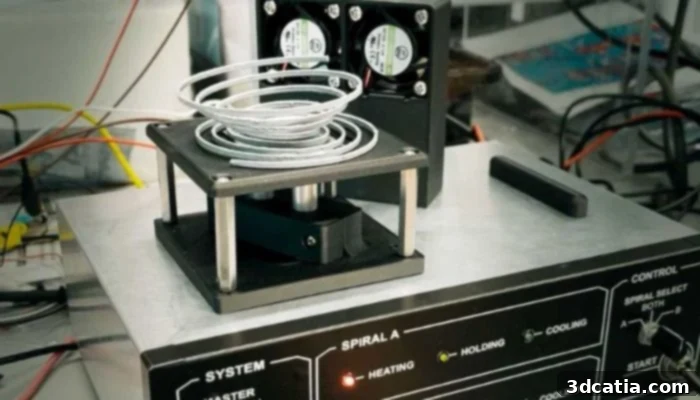
Photo Credits: Johns Hopkins Applied Physics Laboratory
The key enabling material behind this extraordinary antenna is a nickel-titanium alloy, widely recognized by its trade name, Nitinol. Nitinol is celebrated as one of the most popular and extensively researched shape-memory alloys, distinguished by its unique thermomechanical properties. At its core, Nitinol exhibits a remarkable shape-memory effect, meaning it can be deformed into a secondary shape at a lower temperature and then completely recover its original, pre-programmed form when heated above a specific transition temperature. This intrinsic capability, often coupled with superelasticity (the ability to undergo large elastic deformations), makes Nitinol an unparalleled choice for applications where materials must dynamically adapt to changing conditions. For an adaptive antenna, this means the material itself can act as an actuator, changing the antenna’s geometry without the need for complex external mechanical systems, thereby simplifying design and reducing weight.
Despite Nitinol’s ideal properties, integrating it into complex structures via 3D printing introduced a significant array of engineering hurdles. Additive manufacturing, while offering unparalleled design freedom, posed specific challenges when working with this particular alloy. The localized heating inherent in the 3D printing process—such as in laser powder bed fusion—caused the Nitinol to prematurely deform or react in unforeseen ways during fabrication. This made it exceedingly difficult to maintain the structural integrity and achieve the precise geometries required for a functional antenna, especially one designed for shape-shifting capabilities. Hollenbeck frankly admitted the initial difficulties, stating, “It turned out to be a really complicated design, and it didn’t work as well as I would have liked.” This highlights the cutting-edge nature of their research; developing a reliable 3D printing process for Nitinol to create complex, functional components was largely uncharted territory, demanding a combination of deep material science expertise and innovative additive manufacturing techniques.
The APL team, demonstrating remarkable tenacity, systematically tackled these problems through extensive experimentation and rigorous optimization. This iterative process involved refining printing parameters, tweaking design methodologies, and meticulously observing material behavior under various conditions. Their persistence ultimately culminated in a significant engineering triumph: the successful creation of the first planar spiral antenna that reliably transforms into a conical shape when heated. This transformation from a flat, two-dimensional structure to a three-dimensional cone is crucial because it allows the antenna’s electrical properties – such as its resonant frequency and radiation pattern – to be dramatically reconfigured. Furthermore, a key innovation involved developing a novel conductor specifically designed to heat the Nitinol antenna to its required shape-memory activation temperature without introducing detrimental electrical interference or compromising the antenna’s performance. Samuel Gonzalez, an additive manufacturing engineer on the project, emphasized the unique challenges they overcame: “We have a lot of experience optimizing processing parameters and designs for alloys, but this was a step beyond. There aren’t many people out there, if anyone, printing this material, so there’s no recipe for how to process it.” This underlines the pioneering and truly experimental nature of their work.
The developmental journey was not without its moments of intense trial and error. Mary Daffron, a colleague on the project, vividly recounted some of the more dramatic challenges encountered during the additive manufacturing phase. She explained, “We made shrapnel in the printer a few times because the antenna is trying to change shape as you’re printing it, due to the heat. It wants to peel apart.” This firsthand account perfectly illustrates the complex interaction between the 3D printing process’s inherent heat and Nitinol’s temperature-dependent shape-memory properties. The material’s tendency to self-actuate or delaminate during fabrication demanded ingenious solutions to control its behavior at a micro-structural level, ensuring that the desired final form and functionality could be achieved. This intricate balance between material science and manufacturing engineering truly set this project apart, pushing the boundaries of what is possible with smart materials and advanced fabrication.
Looking ahead, the development of these flexible, 3D printed antennas heralds a new era of possibilities across several vital sectors. For military operations, the capability for dynamic communication in the field represents a transformative tactical advantage. Traditional fixed-frequency antennas limit operational flexibility in unpredictable combat zones. However, an adaptive antenna could reconfigure its properties on demand, maintaining optimal connectivity for personnel, vehicles, and drones in rapidly changing environments, from dense urban settings to remote, mountainous terrain. This ensures robust communication links, enhances intelligence gathering, improves command and control capabilities, and ultimately boosts mission effectiveness and troop safety.
In the expansive realm of telecommunications and industry, the inherent adaptability of these antennas promises to revolutionize mobile networks and IoT deployments. Their ability to dynamically cover a wide array of mobile networks means a single antenna could seamlessly switch between different communication standards (e.g., 4G, 5G, satellite links) and frequency bands, optimizing signal strength, bandwidth, and latency on the fly. This versatility is particularly impactful for applications requiring adaptation between short-range and long-range communication needs. Consider a scenario where a device needs high-bandwidth local connectivity for data transfer within a smart factory, then effortlessly transitions to a long-range satellite link for transmitting aggregated data from a remote industrial sensor. Such multi-functional adaptability significantly reduces hardware complexity, optimizes resource utilization, and simplifies the deployment and management of complex communication infrastructures.
Another profoundly impactful application lies in the challenging domain of space exploration. As an adaptive solution for missions extending far beyond Earth’s atmosphere, these antennas offer crucial advantages. Spacecraft and deep-space probes are subjected to extreme temperature variations, intense radiation, and vast, dynamic distances from Earth. An antenna capable of autonomously adjusting its shape and electrical properties could maintain optimal communication links with ground stations, regardless of its orientation, orbital position, or the atmospheric conditions encountered on other celestial bodies. This innovation could lead to the development of more compact, lightweight, and versatile communication systems for satellites, planetary landers, and interplanetary probes, thereby extending mission lifespans and significantly enhancing the volume and quality of data returned from the furthest reaches of our solar system. The potential for miniaturization and multi-functionality in such resource-constrained and demanding environments makes this technology truly transformative for aerospace engineering and scientific discovery.
The pioneering work by the Johns Hopkins Applied Physics Laboratory signifies a monumental leap forward in antenna technology, ingeniously blending the precision of additive manufacturing with the remarkable properties of shape-memory alloys. This innovation directly addresses long-standing limitations in wireless communication, envisioning a future where antennas are no longer static, purpose-built components, but rather dynamic, intelligent systems capable of real-time adaptation to their environment and evolving communication demands. This project not only underscores the incredible potential residing at the intersection of advanced materials science and cutting-edge manufacturing but also sets a new benchmark for creating adaptable, resilient, and highly efficient communication infrastructure across critical defense, telecommunications, and space exploration sectors.
What are your thoughts on this groundbreaking Nitinol 3D printed antenna and its immense potential to reshape the future of wireless communication and beyond? We invite you to share your valuable insights and comments below, or connect with us and join the discussion on our LinkedIn, Facebook, and Twitter pages! Don’t miss out on the latest advancements and breaking news in the dynamic world of 3D printing; sign up for our free weekly Newsletter here to get essential updates and exclusive content delivered straight to your inbox. You can also explore all our fascinating videos, technological deep dives, and expert interviews on our dedicated YouTube channel for more engaging visual content.