
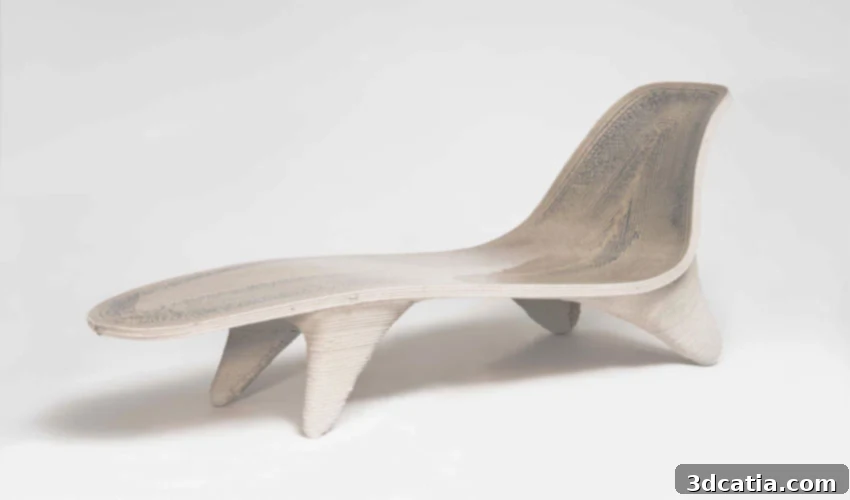
Innovating Furniture Design: Philipp Aduatz and Incremental3d’s 3D Printed Concrete Chaiselongue
The world of construction has witnessed a remarkable transformation with the rise of 3D concrete printing, a technology rapidly gaining momentum for its ability to create complex and robust structures with unprecedented efficiency. This revolutionary approach isn’t confined solely to large-scale buildings; it’s increasingly permeating the realms of art and industrial design, offering designers unparalleled freedom to craft intricate and unique objects, including bespoke furniture pieces. A prime example of this innovative convergence is the captivating project spearheaded by acclaimed designer Philipp Aduatz, in collaboration with the Austrian additive manufacturing specialist, Incremental3d, resulting in an extraordinary 3D printed concrete lounge chair.
The International Furniture Fair in Milan, renowned globally as Salone del Mobile, consistently serves as a pivotal platform for unveiling the latest innovations and avant-garde designs in the furniture sector. While previous editions have showcased groundbreaking concepts like 3D printed chairs from Nagami, Philipp Aduatz and Incremental3d’s collaboration introduced a fresh perspective: leveraging the strength and sculptural potential of concrete through additive manufacturing. Their joint effort culminated in the design and production of a sophisticated lounge chair, pushing the boundaries of what is traditionally achievable with conventional concrete fabrication. Incremental3d, an industry leader, specifically developed a bespoke 3D concrete printing method that allows for significantly greater freedom in exploring geometric complexity and organic forms, a crucial factor in realizing Aduatz’s ambitious vision for this unique furniture piece.
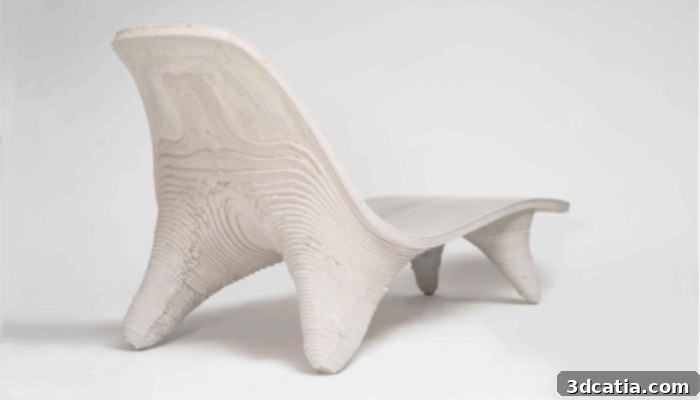
Digital Chaiselongue: A Masterpiece Blending Craftsmanship with Cutting-Edge 3D Concrete Printing
The fruit of this innovative partnership is the “Digital Chaiselongue,” a sculptural concrete lounge chair meticulously crafted through advanced 3D printing techniques. The creation of this remarkable piece involved a multi-stage process, beginning with the digital design and simulation phases to optimize both form and structural integrity. One of the most intriguing aspects of its production was the initial 3D printing of a negative mold directly from concrete. This unconventional approach allowed for the incorporation of highly specific, intricate details and textures that would be exceptionally difficult, if not impossible, to achieve with traditional mold-making techniques. Once the negative mold was complete, the concrete mixture was precisely extruded layer by layer onto this foundational structure, gradually building up the final form of the chaiselongue.
The efficiency of the additive manufacturing process was highlighted by the impressive printing time, which reportedly took less than an hour for the main structure. This rapid production capability not only accelerates the design iteration cycle but also opens new avenues for on-demand manufacturing of custom concrete elements. To ensure the long-term stability and enhance the tensile strength of the structure, particularly in its most sensitive and load-bearing areas, carbon fibers were strategically integrated into the concrete mix during the printing process. Carbon fiber is celebrated for its exceptional strength-to-weight ratio, boasting properties that are comparable to steel in terms of strength, yet significantly lighter. This reinforcement is vital for concrete, which, while excellent under compression, can be vulnerable to tensile forces. The judicious use of carbon fiber ensures the durability and resilience of the Digital Chaiselongue, transforming concrete into a material capable of elegant, slender forms.
The Art of Finishing: Merging Digital Precision with Human Touch
Following the successful 3D printing of the concrete chair, the design journey embraced a crucial step involving traditional craftsmanship. A UV-resistant polyurethane coating was meticulously applied by hand, adding a layer of protection and enhancing the aesthetic appeal of the piece. This final manual application perfectly illustrates the philosophy behind Aduatz’s work: the seamless integration of cutting-edge additive manufacturing with time-honored manual finishing techniques. This hybrid approach demonstrates how the automation offered by 3D printing can streamline the creative process, allowing for the rapid production of complex forms, while still reserving space for the invaluable human touch that adds character, precision, and durability to the finished product. Aduatz’s exhibition frequently explores this compelling synergy, showcasing how modern technologies can complement, rather than replace, traditional artisanal skills. Beyond the Digital Chaiselongue, his portfolio often features other innovative chairs that blend diverse materials and manufacturing methodologies, consistently pushing the boundaries of contemporary design.
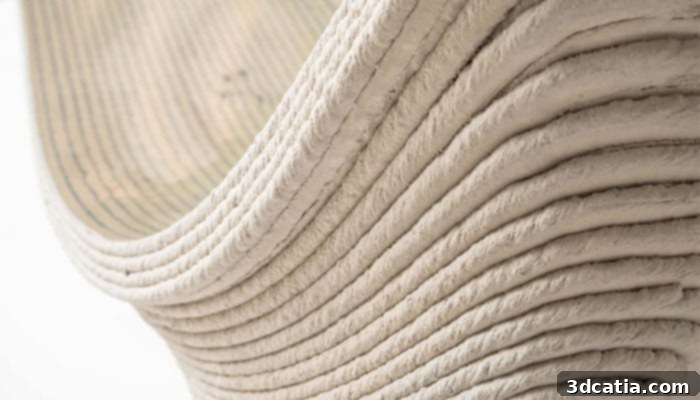
The advanced process developed by Incremental3d applies concrete layer-by-layer with exceptional precision.
The Pioneering Technology by Incremental3d
The success of the Digital Chaiselongue project owes much to the advanced 3D concrete printing technology developed by Incremental3d. Their method stands out for its ability to control the deposition of concrete with extreme accuracy, enabling the creation of intricate internal structures and smooth, complex external geometries that are virtually impossible with conventional casting. This precision allows designers like Aduatz to move beyond blocky, monolithic concrete forms into a realm of fluid, organic, and truly sculptural expressions. The controlled layer-by-layer application minimizes material waste, contributing to a more sustainable manufacturing process, and allows for tailored material properties in different sections of the design. This technological leap not only facilitates aesthetic innovation but also contributes to the functional strength and efficiency of the final product, solidifying 3D concrete printing’s position as a game-changer in both architectural and product design.
For those interested in delving deeper into the technological advancements and further projects from this innovative company, more comprehensive information is available on the official website of Incremental3d. Their commitment to research and development continues to propel the capabilities of additive manufacturing in concrete, setting new benchmarks for design and production possibilities.
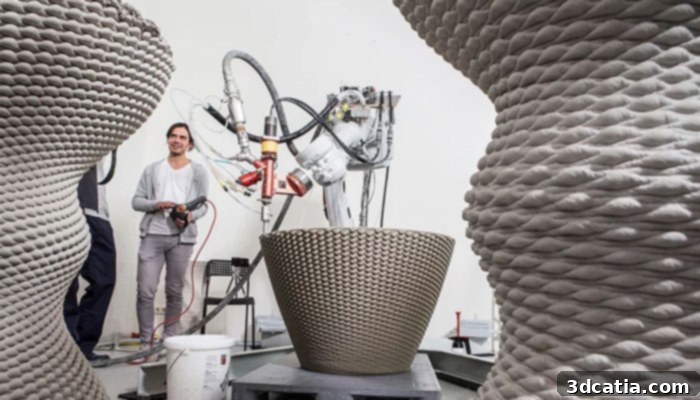
Showcasing the sophisticated technology developed by Incremental3d that enables complex concrete forms.
The Future of Furniture and Architectural Design with 3D Printing
The Digital Chaiselongue is more than just a piece of furniture; it is a powerful statement about the future of design and manufacturing. It exemplifies how 3D concrete printing can empower designers to transcend traditional limitations, enabling the creation of bespoke, highly customized objects that are both aesthetically striking and structurally sound. This project highlights several key advantages of additive manufacturing, including the ability to rapidly prototype and produce complex geometries, integrate advanced materials like carbon fiber for enhanced performance, and minimize waste through precise material deposition. Such innovations pave the way for a new era of sustainable design, where resources are utilized more efficiently and products can be tailored to individual needs without exorbitant costs.
The collaboration between visionary designers like Philipp Aduatz and technological pioneers like Incremental3d demonstrates the immense potential when artistic creativity meets engineering excellence. This synergy is critical for pushing the boundaries of what is possible, not just in furniture, but across the broader spectrum of architectural applications, public installations, and even in humanitarian construction efforts. Imagine custom urban furniture perfectly integrated into public spaces, or uniquely designed building facades that were once only conceptual. The possibilities are boundless, suggesting a future where concrete is no longer perceived as a purely utilitarian material but as a versatile medium for artistic and functional expression, shaped with digital precision and reinforced with smart materials.
What are your thoughts on this groundbreaking 3D printed concrete chaiselongue? How do you envision 3D printing shaping the future of design and construction? We invite you to share your insights in a comment below or join the conversation on our Facebook and Twitter pages! For those eager to stay abreast of the latest developments and innovations in the world of additive manufacturing, don’t forget to sign up for our free weekly Newsletter, delivering all the essential news straight to your inbox.