
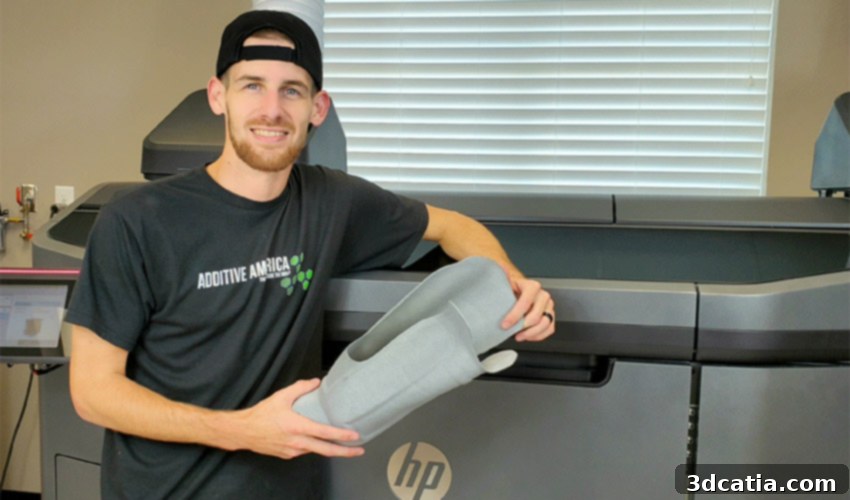
Pioneering the Digital Age of Prosthetics: Zac Holcomb and Additive America’s Vision for 3D Printing Excellence
Recognizing a significant and growing skills gap within the rapidly evolving additive manufacturing industry, visionary leader Zac Holcomb embarked on a mission to drive innovation. Alongside two esteemed partners, he co-founded Additive America, a pioneering startup dedicated to propelling the prosthetics industry into the heart of the digital manufacturing age. We recently had the distinct pleasure of engaging in a conversation with Zac, delving into the origins of this innovative company, his profound insights into the market’s current landscape, and his forward-thinking perspective on its future trajectory.
3DN: Can you present yourself and your link with additive manufacturing?
My name is Zac Holcomb, and I proudly identify as a creative leader in the field of additive manufacturing, particularly specializing in the transformative HP Multi Jet Fusion technology. My passion lies in connecting with engineers and manufacturing practitioners, guiding them to explore perspectives where traditional manufacturing rules no longer hold dominion. Witnessing an industry veteran, accustomed to conventional methods, experience that pivotal “aha!” moment – realizing the immense advantages that additive manufacturing offers – is incredibly gratifying. It’s truly rewarding to hear them exclaim, “wow, I just needed to think outside the box.” This realization perfectly encapsulates the spirit of innovation we champion, and I often remind them that they need to #ThinkOutsideTheMold! This mantra isn’t just a catchy phrase; it’s a fundamental shift in mindset crucial for harnessing the full potential of 3D printing.
My journey in 3D printing commenced many years ago as a dedicated Stereolithography technician. In those early days, I was deeply involved in programming complex builds on foundational 3D Systems machines like the venerable SLA-250 and SLA-3500. This hands-on experience in the nascent stages of the industry instilled in me an invaluable open-mindedness, a willingness to experiment with novel approaches even when met with skepticism from more established, experienced professionals. This early exposure to the intricacies and limitations of earlier technologies provided a robust foundation, shaping my understanding of the industry’s evolution and fostering a deep appreciation for ongoing innovation.
3DN: What is your vision of the industry? Can you give us some idea of how it’s changed over the last few years?
My vision for the 3D printing industry operates on several interconnected levels, yet at its core, I foresee a future characterized by a vast network of highly localized digital manufacturing hubs strategically positioned across the globe. This decentralized model, I believe, will emerge as one of the most profound benefits and impactful transformations brought about by additive manufacturing. Logistics companies, traditionally focused on physical movement of goods, will need to significantly reorient their strategies, shifting their core focus towards robust IP control and developing commercialized frameworks for companies to license the ability to print or manufacture products on demand. While we could delve into the intricate nuances of this topic for an entire day, the essence is this: consumers will source products from companies worldwide, but these items will be manufactured at the digital hub closest to their physical location. This paradigm shift holds the potential to fundamentally redefine global logistics, drastically altering international duties and fees until regulatory frameworks inevitably adapt and catch up to this new reality. It promises a more efficient, sustainable, and responsive global supply chain.
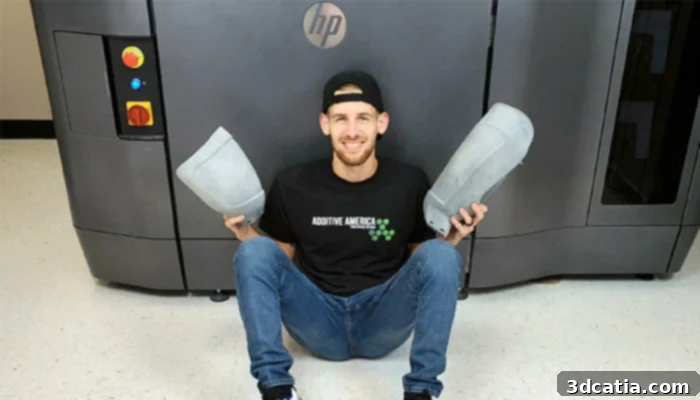
The mission of Additive America is to advance the prosthetics industry deep into the digital manufacturing age
It has been genuinely inspiring to witness the industry’s remarkable evolution over the past few years. However, I also sense a subtle return to a phase where companies, perhaps inadvertently, are beginning to imitate each other once again. My earnest hope is that as businesses grow and mature, they would remain more steadfast in their core competencies, avoiding the temptation to indiscriminately venture into every single additive technology merely for the sake of offering a comprehensive suite of services. True strength lies in recognizing and relentlessly pursuing what you excel at. I would much prefer to see a greater emphasis on specialized expertise and deep mastery within specific niches, rather than the pervasive notion that every enterprise must offer an exhaustive array of everything simultaneously. This focused approach, in my view, fosters genuine innovation and delivers higher value.
3DN: Can you tell us more about the startup you co-founded, Additive America?
Additive America is a venture I proudly co-founded with two exceptional partners, Brent Wright and Paul Sugg. Our shared motivation stemmed from observing a profound and critical skills gap currently plaguing the additive manufacturing sector. There is a strikingly low number of truly qualified individuals who possess a deep, nuanced understanding of how to effectively manipulate and optimize additive workflows to precisely meet specific application needs. This challenge, I believe, largely arises from a prevalent perception among many professionals that they simply lack the necessary time in their demanding schedules to pause, assess their current inefficient processes, and invest in learning how to implement more streamlined, effective digital solutions. It’s the classic analogy of being too busy dragging the cart to stop and put wheels under it.
Furthermore, another significant hurdle we identified was the considerable difficulty in sourcing a consistently reliable supplier for additively manufactured parts, especially within the highly sensitive and precise field of prosthetics. Finding a partner who can consistently deliver the exacting quality standards required for prosthetics, while simultaneously maintaining impeccable surface finish quality, competitive pricing, clear and consistent communication, and efficient logistics, is exceptionally challenging. It became clear that there was a critical void. Therefore, our core proposition at Additive America is to establish an education-first business model. We are intensely focused on empowering our clients by educating them on how they can independently construct and refine additive workflows that are directly applicable to their unique mission and operational requirements. Given our extensive collective experience in the critical fields of prosthetics and orthotics, these areas will naturally serve as the initial cornerstone for our specialized education programs. These comprehensive programs are designed to attract prosthetists from across the globe to our state-of-the-art facility in Kinston, NC. Here, they will receive unparalleled hands-on training and direct access to our exact best practices and methodologies. Critically, we are committed to sustaining these vital relationships with our program participants throughout the entire duration of their manufacturing agreements with us, providing ongoing support and guidance. To complement our educational efforts and provide robust practical support on the manufacturing side, we have made a significant investment in our own cutting-edge HP Multi Jet Fusion 4210 machine. This strategic investment ensures that small businesses and independent practices, which might otherwise find the prohibitive cost of such advanced technology insurmountable, now have direct access to its transformative capabilities.
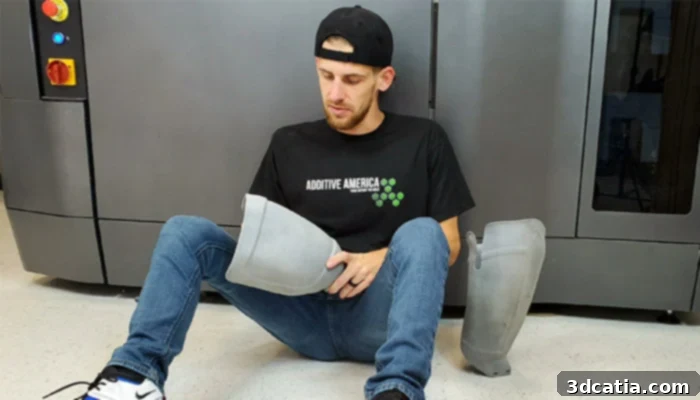
The startup has invested into their own HP Multi Jet Fusion 4210 machine
The overarching mission of Additive America is to decisively advance the prosthetics industry deep into the digital manufacturing age. We aim to achieve this not by guarding our knowledge, but by generously sharing all of our accumulated best practices and meticulously teaching every student who participates in our program how to provide a demonstrably higher-quality prosthesis to their patients. The ultimate, profound impact of this endeavor is to significantly increase the quality of life for as many amputees as we can possibly reach. We firmly believe that by consistently providing superior quality training, coupled with sustained access to expertise and ongoing support, and anchored by a robust backbone of digital manufacturing capabilities and proven best practices, we can genuinely elevate the standard of care across the board. This approach is particularly vital for numerous independently-owned practices that remain dedicated to delivering a more intimate, patient-centric level of care, yet often lack the resources or knowledge to fully embrace digital advancements. We envision a future where advanced, customized prosthetic solutions are accessible and achievable for a much broader segment of the population in need.
3DN: How does Additive America help companies with their 3D printing projects?
Additive America provides invaluable assistance to clients on a range of 3D printing projects, building upon the foundational principles we’ve outlined. A prime example of our transformative impact is our partnership with Eastpoint Prosthetics and Orthotics, which we’ve helped completely revolutionize into an almost 100% digital workflow. This monumental shift encompassed the comprehensive development of new workflows across several distinct processes, spearheaded by Brent Wright, who is a highly credentialed, board-certified prosthetist and one of our co-founders. These innovative new methods have undergone rigorous testing and meticulous training, successfully implemented across multiple branch offices to ensure consistent adoption and alignment among all personnel. As a direct result of this intensive process and our collaborative efforts, Eastpoint Prosthetics and Orthotics is projected to be fully digital by the beginning of 2020, establishing them as one of the leading companies in the United States setting a benchmark for digital transformation within the prosthetics and orthotics industry.
3DN: Have you seen a shift in the adoption rate of 3D printing by companies in recent years?
Absolutely, there has been a noticeable and encouraging shift in recent years, with a growing number of companies becoming increasingly receptive to the idea of integrating 3D printed components into their end-use products. We are undoubtedly making significant progress towards widespread adoption! However, it’s also clear that some industries are embracing these advancements at a much faster pace than others. For instance, I’ve observed considerable discussion about the automotive industry finally catching up, though in my opinion, they historically lagged behind for quite some time. Conversely, medical industries consistently appear to be among the most agile and willing to innovate, often trying new methodologies and technologies that haven’t necessarily been proven elsewhere yet. Even within the expansive medical space, there are still notable variations in adoption rates. The dental industry, for example, has seemingly gone “all-in” with digital manufacturing technology, fully integrating it into their practices. Yet, here we are, still discussing the tremendous, untapped opportunity that remains within the prosthetics sector. So, while the landscape is diverse, I am confident that the targeted boost and specialized support that Additive America is providing to the prosthetics industry will significantly accelerate its digital transformation and adoption.
3DN: Any projects, startups or initiatives in the 3D printing industry that have caught your eye recently?
In the spirit of continually updating and upgrading one’s workflow, I’ve been particularly impressed with what I’ve observed from Link3D. Their approach truly resonates with me because they genuinely prioritize listening to their customers. They demonstrate a remarkable willingness to fine-tune and adapt their offerings to precisely meet the unique objectives that each client is striving to achieve. I’ve had the pleasure of communicating with Janet Kar and Kenny Pearson at Link3D, and they have consistently been exceptional – very supportive and always a pleasure to engage with. And to be clear, this isn’t a paid endorsement! I haven’t personally purchased their product or utilized it for my own operational needs, but their dedication to customer-centricity and the dynamic nature of their product are truly outstanding and incredibly relevant in today’s rapidly evolving market. Link3D is definitely a company worth keeping a close eye on, as they are instrumental in helping businesses navigate and make sense of this new, complex landscape of additive manufacturing and digital workflows.
3DN: Any last words for our readers?
My final message to our esteemed readers is simple yet profoundly impactful: Dare to try something new, especially if those around you are telling you it won’t work. More often than not, they are mistaken, and you simply haven’t yet proven its viability to yourself. Embrace innovation, challenge the status quo, and #ThinkOutsideTheMold. The greatest advancements in any field often stem from precisely this kind of bold, unconventional thinking. It is this spirit that drives Additive America, and it is this spirit that will continue to propel the additive manufacturing industry forward.
What are your thoughts on Additive America’s pioneering mission to revolutionize the prosthetics industry? We encourage you to share your insights and comments below, or engage with us on our vibrant Facebook and Twitter pages! For those eager to stay at the forefront of additive manufacturing news and developments, be sure to sign up for our free weekly Newsletter, delivering all the latest in 3D printing directly to your inbox!