
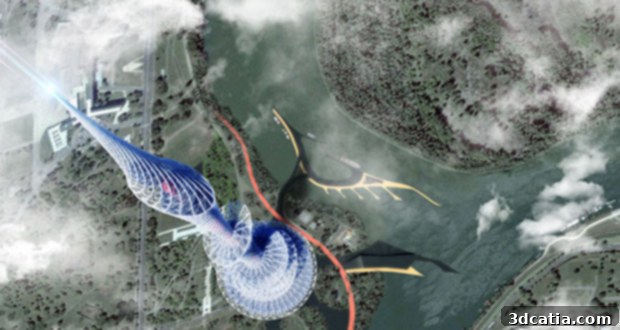
Revolutionizing Urban Skylines: Dubai’s Ambitious Vision for the First 3D Printed High-Rise Building
The architectural landscape of the United Arab Emirates has long been a testament to innovation, with Dubai frequently at the forefront of adopting groundbreaking technologies. The city has firmly established itself as a global leader in additive manufacturing, making the concept of 3D printed buildings not merely a futuristic fantasy but a tangible reality. Building on its pioneering spirit, Dubai made headlines in May of the previous year with the unveiling of the world’s first fully functional 3D printed office building. Now, the emirate is set to elevate its ambitions even further, announcing plans in cooperation with the innovative startup Cazza Construction Technologies, for the development of what promises to be the world’s first 3D printed high-rise building. This groundbreaking initiative marks a significant leap in construction technology, pushing the boundaries of what is conventionally considered possible in urban development.
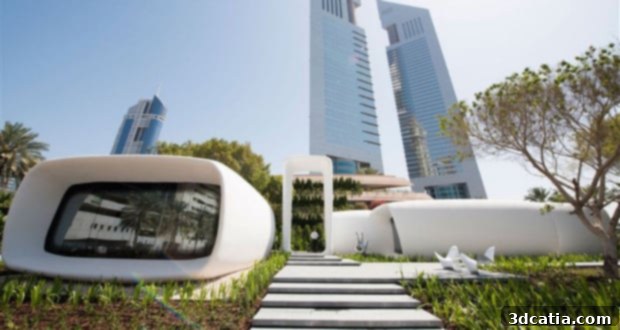
This innovative office building was constructed in a remarkable 17 days, showcasing the speed and efficiency of 3D printing in construction.
Dubai’s Strategic Vision: A Quarter of All Buildings to Be 3D Printed by 2030
Dubai’s commitment to transforming its construction sector is not a recent phenomenon but a strategically planned endeavor. Towards the end of 2016, the emirate formalized a pivotal partnership with Cazza Construction Technologies, underscoring its long-term vision. This collaboration is a cornerstone of Dubai’s ambitious goal: to ensure that an impressive 25% of all new buildings constructed in its development projects will be achieved through 3D printing by the year 2030. This target highlights a bold commitment to sustainable development, cost efficiency, and accelerated construction timelines. The partnership with Cazza is crucial for this objective, as the startup brings novel approaches and proprietary technologies to the table, essential for tackling the complexities of large-scale additive manufacturing in urban environments.
For this latest, ambitious high-rise project, Cazza is poised to introduce a revolutionary methodology known as “Crane Printing.” This innovative technology is specifically designed to overcome the height limitations of previous 3D printing construction methods. While traditional 3D printing in construction has largely been confined to smaller, low-rise structures, Crane Printing promises to unlock entirely new possibilities, allowing for the construction of buildings exceeding 80 meters (approximately 262 feet) in height. This represents a monumental shift in capability, opening the door for 3D printed skyscrapers to become an integral part of future cityscapes.
From Low-Rise to High-Rise: The Evolution of 3D Printing in Construction
The journey to 3D printed high-rises began with more modest aspirations. As industry experts reflect, the initial applications of 3D printing in the construction sector were predominantly focused on residential homes and smaller commercial structures. “When we first thought about implementing 3D printing [in the construction industry], it was mostly houses and low buildings,” recounts a representative from Cazza. However, the inherent potential of the technology quickly sparked greater ambitions. “Developers always asked us if it was possible to produce 3D printed skyscrapers. This has prompted us to carry out extensive research on this technology for larger structures.” This proactive curiosity from the development community, combined with Cazza’s dedication to innovation, has been a key driver in pushing the boundaries of additive manufacturing towards vertical expansion.
Unveiling “Crane Printing” Technology: How Does It Work?
Cazza Construction Technologies, while previously experienced primarily with constructing horizontal structures, is now poised to literally raise the bar with its groundbreaking “Crane Printing” technology. This innovative system represents a significant evolution in construction robotics and additive manufacturing processes. At its core, the technology is designed to seamlessly integrate with and utilize existing, widely available construction materials such as concrete and steel, ensuring compatibility and reducing the need for entirely new material supply chains. The brilliance of Crane Printing lies in its operational mechanism: mobile 3D printing robots are ingeniously mounted onto conventional construction cranes. These cranes then provide the necessary vertical lift and structural support, enabling the robots to apply building materials layer by layer at elevated heights.
According to Fernando De Los Rios, COO of Cazza, a crucial advantage of this system is its universal compatibility. “The system is compatible with all cranes, and no special designs have to be made for this project,” he explains. This means that existing construction infrastructure can be readily adapted, significantly lowering the barrier to entry and accelerating adoption. Furthermore, Cazza is committed to ensuring that the entire construction process is as cost-efficient and environmentally friendly as possible. This commitment is realized through a strategic hybrid approach: combining the precision and material optimization of mobile robots for additive production with proven conventional construction methods for structural integrity and finishing. This synergy aims to maximize efficiency, minimize waste, and deliver sustainable building solutions.
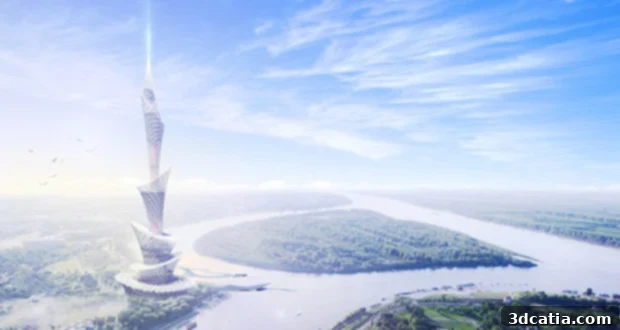
The conceptual design for the “Belgrade Tower,” envisioned by Aleksandar Grusanovic, showcases the architectural possibilities of 3D printing.
One of the primary advantages of Cazza’s advanced additive manufacturing technologies is the ability to construct architecturally complex buildings in significantly reduced timeframes. This speed and design freedom are major selling points in a rapidly developing urban landscape like Dubai. While the initial investment in cutting-edge technology can be substantial, CEO Chris Kelsey is optimistic about future cost reductions. “Through our technologies, we can build architecturally complex buildings in the shortest possible time. The high costs for the technology will be reduced as soon as we go into mass production,” he states, outlining a clear path towards making 3D printed high-rises more economically viable on a broader scale.
Cazza’s Grand Plans: The “Belgrade Tower” Concept
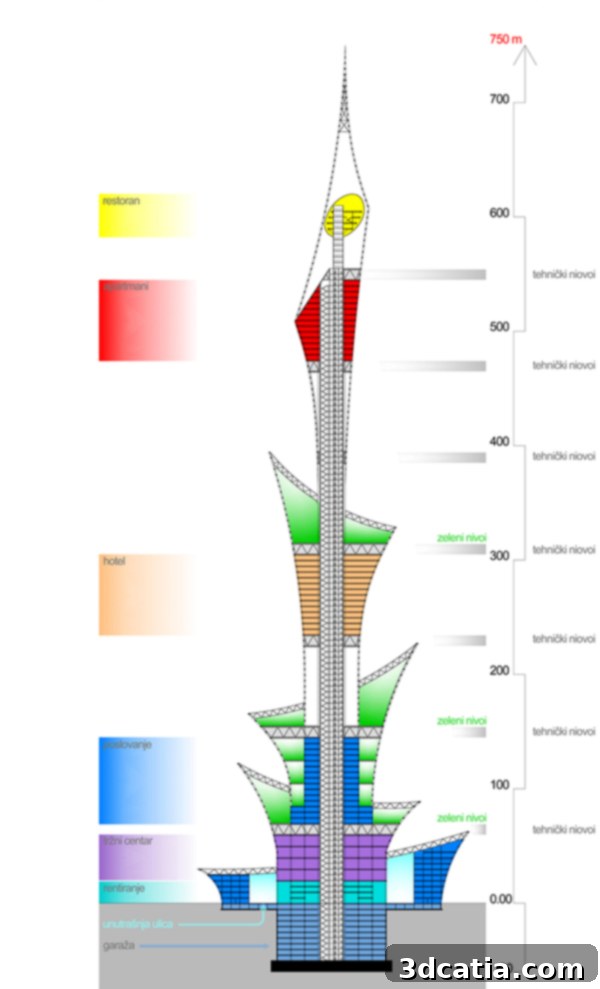
The architectural concept for the 3D printed high-rise includes diverse facilities such as luxury hotels and vibrant restaurants.
While the exact height of the planned high-rise remains officially undisclosed, details emerging from an interview with Construction Week Online shed light on the ambitious scope of the project. The conceptual design slated for implementation is the remarkable “Belgrade Tower,” a creation by renowned architect Aleksandar Grusanovic. This iconic structure is celebrated for its unique and distinctive form, designed not just as a residential or office space, but as a vibrant vertical ecosystem. The concept explicitly includes plans to accommodate a diverse range of facilities, including upscale restaurants, luxurious apartments, and a world-class hotel, transforming it into a self-contained urban hub.
According to official design drawings, the proposed Belgrade Tower measures an astounding 750 meters (approximately 2,460 feet) in height. Such an undertaking would represent a truly gargantuan task, a monumental challenge that would push the limits of modern construction and engineering. For Cazza, a relatively young startup, embarking on a project of this scale as its inaugural high-rise endeavor would indeed be a “Goliath task.” The immense technical complexities, material requirements, and structural integrity considerations for a building of this magnitude are considerable. Naturally, there’s immense curiosity surrounding the proprietary technology that Cazza intends to employ to achieve such a feat, but the company, understandably, remains guarded about its trade secrets, preferring to reveal its hand closer to the execution phase.
Investment and Future Prospects: The Cazza Phenomenon
Despite the nascent stage of the high-rise project and the proprietary nature of its technology, Cazza Construction Technologies has already generated considerable excitement within the global construction industry. Its audacious vision for 3D printed skyscrapers has captured the imagination of innovators and traditional builders alike, and consequently, it has garnered significant interest from a diverse pool of investors. The startup’s potential to disrupt conventional construction methods, offering faster, more sustainable, and potentially more cost-effective solutions, positions it as a highly attractive venture in the burgeoning market of advanced manufacturing.
In a clear testament to its perceived value and future potential, Cazza recently received a substantial acquisition offer from an anonymous Saudi investor, proposing to buy the company for an impressive $38.6 million. However, CEO Chris Kelsey firmly rejected the bid, indicating a strong belief in the company’s long-term trajectory and its intrinsic value far exceeding the proposed offer. Cazza Construction Technologies is currently not for sale, emphasizing its commitment to independent innovation and growth. Nevertheless, the company remains strategically open to partnerships and welcomes investors who are keen to contribute to and help push forward their revolutionary creations. This approach suggests Cazza is looking for strategic alliances that can provide more than just capital, but also expertise, market access, and a shared vision for the future of construction.
The planned 3D printed high-rise in Dubai, spearheaded by Cazza, symbolizes a pivotal moment in the evolution of architecture and construction. It’s not just about building taller structures, but about fundamentally reimagining how buildings are designed, constructed, and integrated into our urban fabric. This initiative has the potential to redefine efficiency, sustainability, and architectural freedom, setting a new global benchmark for innovative construction practices and solidifying Dubai’s reputation as a true pioneer in the 21st century built environment. As the world watches, the realization of this project could catalyze a global movement towards adopting additive manufacturing for complex, large-scale structures, ushering in an era where the only limit to a city’s skyline is the imagination of its innovators.
What are your thoughts on Cazza and the exciting prospect of 3D printed high-rise buildings? Share your opinions in a comment below and make sure to follow us on Twitter and Facebook for the latest updates in 3D printing and construction technology!