
Revolutionizing COVID-19 Testing: 3D Printing Powers Rapid Breathalyzer Kiosks by Worlds Protect and Essentium
As the global community navigates the ongoing challenges of COVID-19, a nuanced approach to public health remains paramount. While many regions have seen a significant loosening of pandemic-related restrictions, the virus continues to circulate, necessitating innovative and efficient testing solutions. Even with widespread vaccination efforts, the persistence of cases globally underscores the crucial need for readily available and accurate mass testing. In a significant leap forward, the dedicated team at Worlds Protect, in collaboration with additive manufacturing leader Essentium, has unveiled a groundbreaking solution: functional COVID-19 breathalyzer kiosks developed with advanced 3D printing technology. These innovative kiosks are designed to provide rapid and highly accurate disease detection, marking a pivotal moment in the fight against infectious diseases.
Since the earliest days of the pandemic, 3D printing, also known as additive manufacturing (AM), has consistently emerged as a vital tool, offering unparalleled speed and adaptability in addressing urgent medical and logistical challenges. The ability of AM to quickly prototype, iterate, and produce complex components has made it instrumental in overcoming supply chain disruptions and developing novel solutions for the health crisis. From personalized protective equipment (PPE) and ventilator parts to critical diagnostic tools, 3D printing has demonstrated its immense value. These newly developed breathalyzer kiosks represent the latest in a series of transformative projects where AM has proven indispensable in providing superior solutions to combat COVID-19 and prepare for future health emergencies. Blake Teipel, Ph.D., CEO of Essentium, emphasized this impact, stating, “Throughout the pandemic, the 3D printing industry has been instrumental in innovating and producing essential medical gear. Essentium stepped in early to deliver 3D printed protective masks for first responders. Now we are proud to support the Worlds Protect team to speed the development of kiosks that represent a significant leap forward in the COVID-19 fight and tackling other infectious diseases.” This statement highlights not only the immediate benefits but also the long-term potential of such 3D-printed solutions.
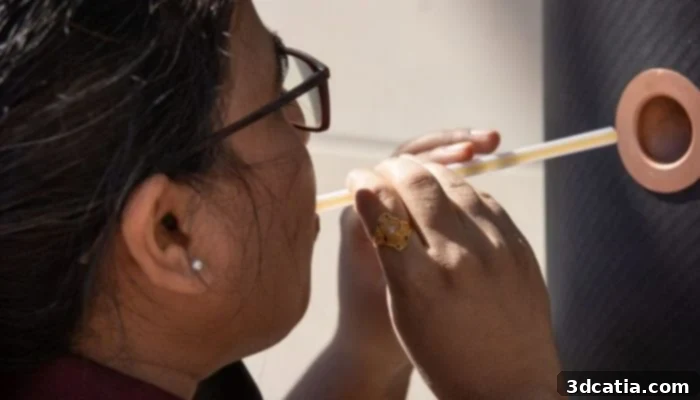
The breathalyzer kiosks allow participants to blow directly into a copper inlet with a disposable straw, providing almost instantaneous results (photo credits: The Texas A&M University System).
A Closer Look at the Breakthrough Breathalyzer Kiosk Technology
While the term “breathalyzer” is most commonly associated with detecting blood alcohol content, the underlying technology has far broader applications, particularly in the realm of infectious disease detection. In this pioneering project, the Worlds Protect team – a dynamic collaboration comprising experts from The Texas A&M University System, Worlds Inc., and the U.S. Air Force – has engineered these advanced kiosks specifically for COVID-19 screening. The user-friendly design allows individuals to simply blow into a copper inlet using a disposable straw. What sets this system apart is its remarkable speed and accuracy: results are transmitted directly to the participant’s smartphone in under a minute, boasting accuracy levels comparable to a traditional PCR test. This is a game-changer, considering that PCR tests, while renowned for their high accuracy, typically require at least 24 hours (and often longer) for results, involving complex laboratory processing and specialized personnel. The Worlds Protect breathalyzer kiosks dramatically streamline the testing process, making it far more accessible and practical for widespread, rapid deployment. The development leveraged Essentium’s cutting-edge High Speed Extrusion (HSE™) 3D Printing Platform, utilizing robust industrial-grade materials to ensure performance and durability.
The decision to employ 3D printing for the production of these kiosks was driven by a critical set of requirements: the need for complex internal part designs, the imperative for rapid prototyping and production, and the non-negotiable demand for exceptional mechanical properties and robustness. Traditional manufacturing methods often struggle to achieve intricate geometries quickly and affordably, especially for limited production runs or rapid iterations. Additive manufacturing, however, excels in creating highly complex structures with internal channels and precise fits, which are often essential for sensitive medical devices. Furthermore, the inherent agility of 3D printing allowed the Worlds Protect team to move from design concepts to functional prototypes and then to production parts at an unprecedented pace, significantly accelerating the entire development cycle. Robustness was another particularly crucial factor, given the intended deployment environments for these breathalyzer kiosks. Many units are slated for use with the military, which means they must withstand challenging and diverse conditions, including extreme temperatures in hot and dry regions, as well as other harsh operational settings where reliability is paramount. Thanks to Essentium’s advanced HSE™ technology and high-performance industrial materials, the project not only achieved its ambitious performance goals but also realized substantial efficiencies. The production of key kiosk components was completed in less than a day, representing an astonishing 66% faster turnaround time compared to conventional manufacturing processes. Moreover, the team successfully reduced overall production costs by an impressive 90%, demonstrating the immense economic advantages of industrial 3D printing for specialized applications.
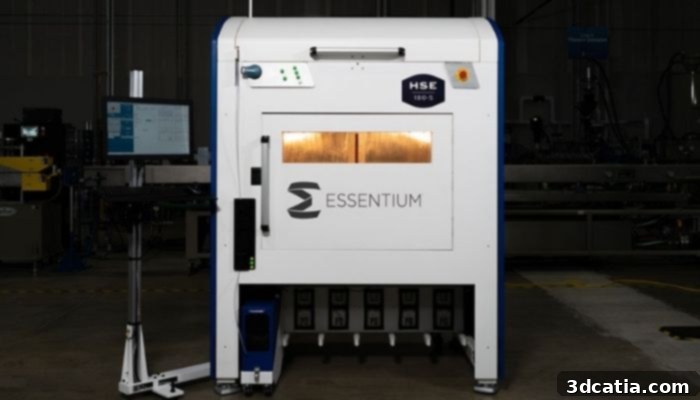
The Essentium High Speed Extrusion (HSE™) 3D Printing Platform was instrumental in creating the robust and efficient breathalyzer kiosks (photo credits: Essentium).
The successful deployment of these 3D-printed breathalyzer kiosks represents a monumental achievement, opening new avenues for rapid, accurate, and accessible infectious disease testing, particularly in scenarios requiring large-scale screening or operation in remote and challenging environments. Maulik Kotecha, a distinguished doctoral student at Texas A&M University, eloquently summarized the project’s impact: “Essentium’s High Speed Extrusion 3D Printing Platform is a game-changer in fast tracking the design and development of these much-needed COVID-19 breathalyzer kiosks. We need the ability to rapidly screen large groups of people, with targeted expanse into austere environments. Together with Essentium, we have made this a reality in the fastest time possible.” This sentiment underscores the critical role of additive manufacturing in not only responding to current health crises but also in building more resilient and responsive public health infrastructures for the future. Beyond COVID-19, the modular and adaptable nature of these 3D-printed kiosks suggests immense potential for detecting other airborne infectious diseases, offering a versatile platform for global health security. This project exemplifies how strategic partnerships between academic institutions, private industry, and defense sectors, bolstered by cutting-edge technology like industrial 3D printing, can yield transformative results in record time. For those interested in delving deeper into this innovative collaboration and its outcomes, more information is available in the official press release found HERE.
What are your thoughts on these innovative 3D-printed COVID-19 breathalyzer kiosks and their potential impact on public health and beyond? We encourage you to share your insights and engage with our community. Let us know in a comment below or join the conversation on our Linkedin, Facebook, and Twitter pages! Don’t forget to sign up for our free weekly Newsletter here to receive the latest 3D printing news directly to your inbox. You can also explore our video content and interviews on our YouTube channel for more insights into the world of additive manufacturing.