

Rosalía Dazzles in Iris van Herpen’s 3D Printed ‘Synthesis’ Dress at British Fashion Awards: Fashion’s Future Unveiled
Last week, the fashion world turned its gaze to London for the annual British Fashion Awards (BFA), a prestigious ceremony renowned for celebrating the crème de la crème of British design talent. Often hailed as London’s magnificent counterpart to the illustrious New York Met Gala, the BFA is a globally anticipated event, serving as a pivotal moment for industry leaders, emerging talents, and fashion enthusiasts alike. This year, however, marked a significant departure from tradition. While the ongoing global pandemic necessitated a shift to an innovative virtual format, the core essence of the awards underwent a profound transformation. Moving beyond conventional accolades for modelling and design, the British Fashion Council made a conscious decision to spotlight and honour individuals and organizations who had championed positive change and made a substantial impact within the fashion industry, reflecting a broader shift towards purpose-driven fashion.
Amidst an evening dedicated to celebrating transformative forces, the presenters themselves became beacons of innovation. Among the distinguished guests, the acclaimed Catalan singer Rosalía captured immediate global attention, gracing the virtual red carpet in an awe-inspiring, daring, and utterly original 3D printed dress. This extraordinary garment was the brainchild of Iris van Herpen, the visionary Dutch designer who has consistently pushed the boundaries of haute couture by masterfully integrating cutting-edge technologies. Rosalía’s choice of attire was more than a fashion statement; it was a powerful affirmation of additive manufacturing’s growing prominence and disruptive potential within the elite echelons of the fashion world. Her appearance underscored the increasing synergy between digital fabrication and high fashion, showcasing how 3D printing offers unparalleled design freedom, enabling the creation of intricate, unique, and revolutionary pieces that redefine sartorial expression.
Entrusted with the significant task of presenting the Creativity Award, Rosalía herself embodied the innovative spirit of the category. This particular accolade is designed to honour designers and brands whose groundbreaking creativity has left an indelible global impact in recent years. This influence can manifest in myriad ways: through their pioneering designs, impactful campaigns, influential collaborations, a robust and forward-thinking business model, or by fundamentally reshaping the very form and future of fashion. Rosalía’s partnership with Iris van Herpen for this event perfectly mirrored the ethos of the award, highlighting how visionary design, empowered by advanced technology, can indeed define the next generation of fashion. Her striking presence amplified the message that true creativity often lies at the intersection of artistic vision and technological advancement.
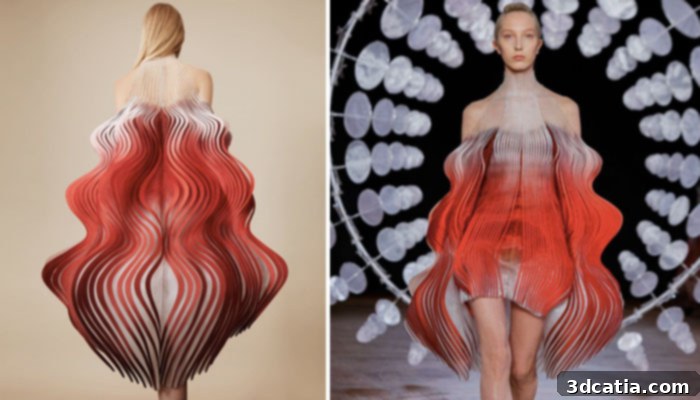
The 3D printed dress, “Synthesis”
In a poignant introductory speech, Rosalía eloquently declared that “fashion is a language that allows you to be creative and express who you are”. Her statement resonated profoundly, especially as she stood adorned in a garment that epitomized this very philosophy: a meticulously crafted 3D printed dress. The particular piece worn by Rosalía is known as ‘Synthesis’, an iconic creation by Iris van Herpen. While Rosalía’s appearance brought renewed global attention to this remarkable design, it was not the first time ‘Synthesis’ had graced high-profile platforms. The dress had previously been showcased by model Winnie Harlow on the cover of Fashion Canada magazine, demonstrating its versatility and visual impact. Furthermore, in 2019, the acclaimed performer Gwendoline Christie captivated audiences in a strikingly similar, equally intricate version of a 3D printed gown, also masterfully developed by Iris van Herpen. These high-profile endorsements solidify the garment’s status as a symbol of fashion’s technological frontier.
Iris van Herpen has, without question, cemented her status as an undisputed benchmark in the avant-garde fashion and design industry, particularly for her pioneering integration of 3D printing and other advanced technologies into haute couture. Her distinctive approach blurs the lines between fashion, art, science, and technology, resulting in collections that are not merely clothing but wearable sculptures. Van Herpen’s work is characterized by its organic forms, intricate geometries, and an exploration of the human body’s relationship with its environment, often drawing inspiration from natural phenomena and scientific concepts. She utilizes additive manufacturing not as a gimmick, but as an essential tool to realize complex forms and textures that would be impossible to achieve through traditional garment construction. Her designs challenge conventional notions of textile and silhouette, propelling the industry into uncharted territories of innovation and artistic expression.
Beyond the ‘Synthesis’ dress, Iris van Herpen’s extensive body of work consistently showcases her mastery of additive manufacturing. One notable example is her Spring/Summer 2019 collection, evocatively titled Shift Souls. This collection was a profound exploration of philosophical and scientific themes, drawing heavily on inspiration from “the evolution of the human form, its idealization over time, and the hybridization of female forms in mythology.” Each piece in Shift Souls was a testament to the transformative power of 3D printing, featuring ethereal, otherworldly structures that appeared to float around the body, mimicking avian anatomy and mythological metamorphoses. The collection demonstrated how technological precision could translate into fluid, organic aesthetics, pushing the boundaries of what is physically possible with fabric and material, and cementing van Herpen’s reputation as a true visionary at the forefront of fashion innovation.
Rosalía’s choice to wear a 3D printed gown at this year’s British Fashion Awards was more than a sartorial triumph; it was a clear statement that left an indelible mark on observers worldwide. Her daring appearance served as a high-visibility testament to the incredible potential of additive manufacturing technologies, which are rapidly gaining traction and increasingly opening up new frontiers within the traditionally conservative fashion industry. What was once relegated to futuristic concepts or niche experimental projects is now emerging as a viable and vibrant component of haute couture and celebrity red-carpet events. The visual spectacle provided by Rosalía’s dress perfectly encapsulated how this technology allows for unparalleled intricacy and organic structures that defy conventional textile manipulation.
The burgeoning adoption of 3D printing in fashion is fueled by several compelling advantages. Firstly, it offers unprecedented design freedom, allowing designers to create complex geometric patterns, biomimetic structures, and fluid forms that are impossible to achieve with traditional sewing or tailoring techniques. This opens up entirely new aesthetic possibilities and allows for the creation of truly unique, one-of-a-kind pieces. Secondly, 3D printing facilitates bespoke customization on a grand scale, enabling garments to be perfectly tailored to an individual’s body measurements and preferences, moving towards a future of truly personalized fashion. Thirdly, the technology holds significant promise for sustainability. By enabling on-demand production, it can drastically reduce waste associated with mass manufacturing and overproduction. Furthermore, research into novel, sustainable 3D printable materials offers exciting prospects for eco-conscious fashion. As such, the presence of these cutting-edge 3D printed models on international stars is not just a trend; it’s a powerful demonstration of technology’s capacity to reshape the entire fashion paradigm, from design and production to consumption.
Events like the British Fashion Awards, especially with their renewed focus on positive change and innovation, serve as crucial platforms for showcasing such transformative advancements. Rosalía’s bold fashion statement, deeply rooted in Iris van Herpen’s visionary design, perfectly aligned with the awards’ theme, highlighting how creativity, when coupled with technological foresight, can indeed drive global impact and define the very future of how we conceive and interact with clothing. The synergy between art, technology, and sustainability is setting a new precedent for the industry, promising a future where fashion is not only beautiful but also intelligent, customized, and environmentally responsible. As 3D printing continues to evolve, its influence will undoubtedly extend far beyond celebrity appearances, gradually making its way into more accessible and mainstream fashion applications, forever changing the landscape of style.
You can watch Rosalía’s BFA speech here:
What do you think of Rosalía’s 3D printed dress? Let us know in a comment below or on our Facebook and Twitter pages. Don’t forget to sign up for our free weekly newsletter, with all the latest news in 3D printing delivered straight to your inbox!