
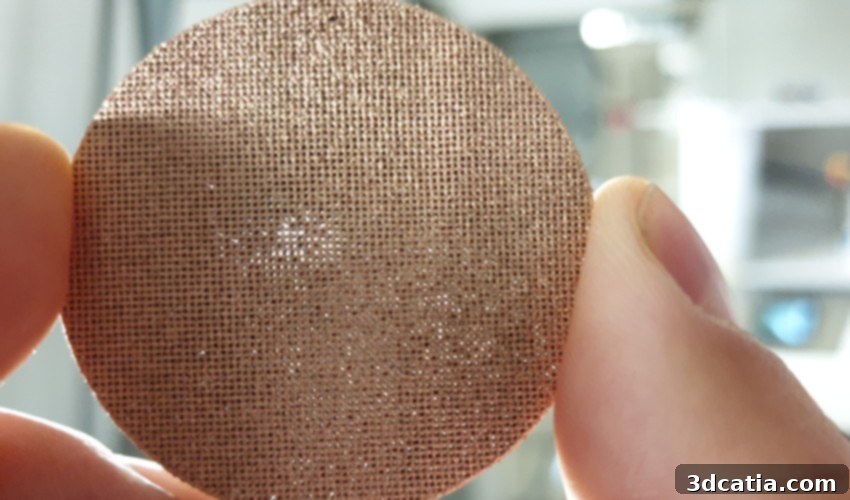
Innovating Against COVID-19: The Breakthrough of 3D Printed Antiviral Materials
The global health crisis instigated by COVID-19 has profoundly reshaped our world, presenting unprecedented challenges across every sector. Yet, amidst the adversity, it has also served as a powerful catalyst, propelling the field of additive manufacturing, commonly known as 3D printing, into the public spotlight. This advanced technology has demonstrated its immense potential to deliver rapid, adaptable, and localized solutions during times of critical need. From the earliest days of the pandemic, a surge of innovations leveraging 3D printing to combat the virus rapidly emerged, highlighting its indispensable role in modern medical and public health responses. Among these groundbreaking developments, a research group at the University of Wolverhampton has achieved a significant milestone: the creation of a novel 3D printed antiviral material specifically engineered to neutralize the COVID-19 virus.
The Science Behind the Breakthrough: A Potent Antiviral Composition
The innovative material developed by the AMFM (Additive Manufacturing Functional Materials) research group at the University of Wolverhampton represents a formidable weapon in the fight against viral transmission. This advanced composite is ingeniously formulated from a blend of silver, copper, and tungsten – elements renowned for their inherent antimicrobial properties. Each component plays a crucial role in creating a synergistic effect that targets and incapacitates viral pathogens. Copper, for instance, is well-documented for its oligodynamic effect, where its ions can rupture viral envelopes and degrade nucleic acids. Silver also releases ions that interfere with viral replication and protein synthesis, effectively rendering the virus inactive. Tungsten contributes to the material’s structural integrity and may further enhance its antiviral capabilities.
This unique combination is designed to tackle one of the primary modes of virus spread: surface contamination. By integrating these potent antiviral agents directly into 3D printable materials, the potential to significantly reduce contagion rates through contact transmission becomes a tangible reality. Furthermore, by limiting the viability of airborne viral particles once they settle on treated surfaces, the material could indirectly contribute to mitigating the aerial spread of the virus. John Robinson, a leading researcher at the University of Wolverhampton, underscored the material’s impressive efficacy: “Our antiviral material displayed a 100% viral inactivation within five hours against a biologically-safe sample of COVID-19. This is a significant improvement on previous copper coating results as all of the COVID-19 virus is eliminated.” This complete inactivation is a critical advancement, surpassing the partial effectiveness often seen in earlier antiviral surface treatments.
Precision Manufacturing: The Role of Laser Powder Bed Fusion
Achieving such a precise and effective material required a sophisticated manufacturing technique. The research group utilized laser powder bed fusion (L-PBF), an advanced form of additive manufacturing, to create the antiviral composite. L-PBF is particularly well-suited for processing metal powders, allowing for the fabrication of highly dense and complex geometries with exceptional material properties. In this process, a high-power laser selectively fuses layers of metallic powder based on a digital 3D model. The precision of L-PBF ensures that the silver, copper, and tungsten particles are uniformly distributed and integrated within the material structure, optimizing their antiviral performance. This method not only enables the creation of intricate designs but also ensures the durability and stability of the antiviral properties, making the material robust enough for real-world applications. The ability to control the microstructure and surface characteristics through L-PBF further enhances the material’s ability to interact with and inactivate viral particles efficiently.
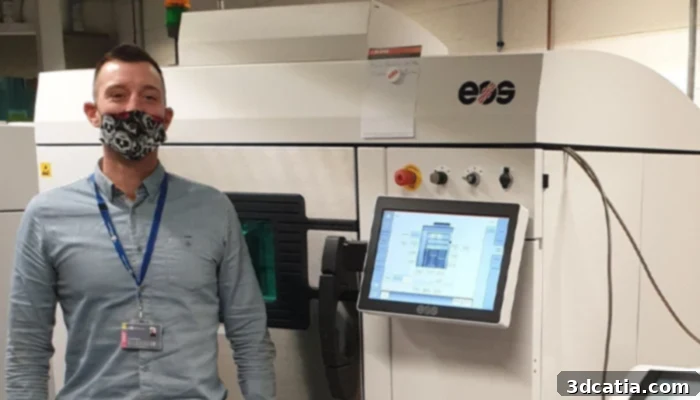
John Robinson and the advanced 3D printer utilized for developing the groundbreaking antiviral material. (Photo credits: University of Wolverhampton)
Broadening the Horizon: Applications and Future Vision
The potential applications of this novel antiviral material extend far beyond the laboratory. John Robinson and his dedicated team envision a future where this technology plays a pivotal role in public health infrastructure. Their immediate goal is to leverage this innovation to develop open-source 3D printed masks. The open-source approach is crucial for democratizing access to this advanced protective equipment, allowing individuals, communities, and smaller organizations globally to produce effective masks locally and affordably. This strategy not only promotes widespread adoption but also empowers communities to respond rapidly to localized outbreaks, reducing reliance on centralized supply chains that can be vulnerable during crises.
However, the vision of the AMFM research team does not stop at masks. They are actively exploring a multitude of other application cases to maximize the impact of their innovation in actively combating the pandemic and preparing for future health challenges. The inherent flexibility offered by laser powder bed fusion is a significant advantage in this endeavor. This manufacturing method allows scientists to create components with highly complex and customized geometries, enabling them to adapt the antiviral material for diverse purposes. Imagine antiviral coatings for high-touch surfaces in public transport, hospitals, schools, and offices, or even integrated into ventilation systems to filter out airborne pathogens. Door handles, lift buttons, medical equipment, and other frequently touched objects could all benefit from surfaces that actively neutralize viruses, dramatically reducing the risk of indirect transmission. The ability to constantly improve and iterate on their models, incorporating feedback and new scientific insights, ensures that the material can evolve to meet emerging threats effectively.
Navigating the Pandemic’s Evolution with Cutting-Edge Technology
The timing of this material’s development could not be more critical. As the world continues to grapple with the complexities of COVID-19, the emergence and rapid spread of new variants, such as Omicron and Delta (and earlier, the UK and South African variants mentioned in the original context), have underscored the persistent need for robust protective measures. While vaccine development has been a monumental success, variants have proven capable of evading some immune responses and often exhibit increased transmissibility, leading international health officials to continually reassess and enhance protection strategies. Although the full extent to which these newer variants impact disease severity is still under investigation, their heightened contagiousness makes it unequivocally clear that innovative solutions to curb their spread are not just beneficial, but absolutely necessary. Combining the versatility of 3D printing with a highly effective antiviral material presents an extremely potent and adaptable solution.
This approach offers a proactive defense against an ever-evolving viral threat. Rather than solely relying on measures that react to infection, integrating antiviral surfaces creates a continuous layer of protection in our environment. This can significantly reduce the viral load in public spaces and on personal items, thereby lowering the overall risk of transmission. The on-demand nature of 3D printing means that solutions can be deployed rapidly and scaled according to regional needs, a critical advantage in dynamic pandemic scenarios. As Robinson eloquently concludes, “As the pandemic continues to evolve, various situations are likely to appear unpredictably. To enable an immediate response and rapid solution, we created an antiviral material that could be 3D printed and therefore can create antiviral surfaces when and where they are needed.” This philosophy of agile, localized manufacturing is a cornerstone of effective future pandemic preparedness, leveraging technology to build more resilient health systems globally.
Beyond COVID-19: A Paradigm Shift for Public Health
The implications of the University of Wolverhampton’s research extend far beyond the immediate context of COVID-19. This breakthrough signifies a paradigm shift in how we approach public health and pathogen control. The ability to integrate potent antiviral properties directly into functional materials, manufactured precisely through 3D printing, opens doors for tackling a wide array of infectious diseases, including seasonal flu, superbugs, and potential future pandemics. Imagine hospitals with actively antiviral surfaces, reducing healthcare-associated infections, or public transport systems designed to continuously self-disinfect. This technology paves the way for a new generation of smart, hygienic environments that are inherently safer. It highlights the immense value of interdisciplinary research, bringing together materials science, engineering, and virology to create solutions that were once confined to science fiction. Furthermore, the development underscores the growing importance of additive manufacturing as a strategic technology for national and global security, capable of providing critical infrastructure and supplies when traditional manufacturing chains falter. This innovation not only helps us fight the current pandemic but also equips us with powerful tools to build a more resilient and healthier future.
What are your thoughts on this groundbreaking new antiviral material and its potential impact? We encourage you to share your insights in a comment below or join the conversation on our Facebook, Twitter, and LinkedIn pages! For the latest updates in the world of 3D printing and additive manufacturing delivered straight to your inbox, don’t forget to sign up for our free weekly Newsletter here.