
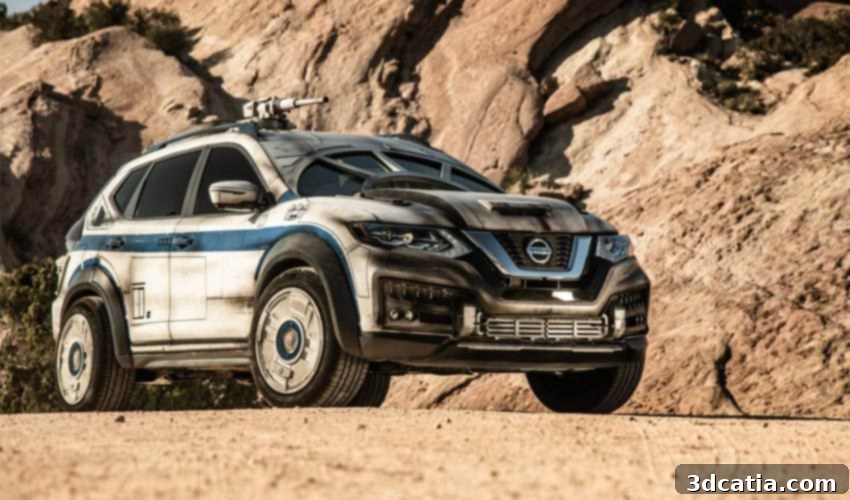
Nissan Transforms Rogue into Millennium Falcon with 3D Printing: The Ultimate Star Wars Custom Car
As the Star Wars saga continues to captivate audiences worldwide, celebrating legendary characters like Han Solo with new cinematic adventures, the excitement isn’t confined solely to the silver screen or Hollywood’s red carpets. Beyond the glittering constellation of film stars, an equally innovative star shone brightly: additive manufacturing, championed by none other than Nissan. For the grand world premiere of the latest Star Wars film, Nissan embarked on an ambitious project, masterfully transforming one of their popular vehicles into an unmistakable homage to the saga’s most iconic spacecraft – the Millennium Falcon. This breathtaking customization, made possible through the power of advanced 3D printing technologies, offers a thrilling spectacle that delights not just ardent Star Wars fans but also enthusiasts of cutting-edge automotive design and 3D printing alike.
This wasn’t Nissan’s first foray into the galaxy far, far away. The automaker has a history of integrating the Star Wars universe into its marketing and vehicle designs. Notably, the Nissan Rogue, a limited-edition model previously developed for the standalone film *Rogue One: A Star Wars Story*, already featured bespoke 3D printed elements. Among these was a meticulously crafted replica helmet of a formidable Death Trooper, demonstrating early applications of 3D printing in automotive promotional efforts. Building on this legacy, Nissan escalated its ambition, transforming its versatile crossover into a vehicle that unmistakably evokes the spirit and intricate design of the Millennium Falcon. While this extraordinary vehicle might not possess the ability to jump into hyperspace or outrun Imperial starships, its aesthetic parallels to Han Solo’s famous freighter are striking. It stands as a testament to what’s achievable in the realm of 3D creations inspired by the expansive Star Wars universe. Jeremy Tucker, Vice President of Marketing and Media Communications at Nissan, encapsulated the team’s achievement perfectly, stating, “The result is hands-down the most complete and thrilling vehicle we’ve ever done.” This statement underscores not only the visual impact but also the technical prowess invested in the project.
The Force of Additive Manufacturing: Bringing the Millennium Falcon to Life
The creation of this custom demonstration vehicle stands as a powerful testament to the capabilities of modern 3D printing technologies. Every detail, from the macro structure to the intricate inserts, was carefully considered to incorporate several iconic elements of the legendary Millennium Falcon. The exterior of the Nissan Rogue was reimagined with custom aluminum panels, giving it a rugged, spaceship-like aesthetic. Crucially, numerous 3D printed inserts were integrated into these panels, allowing for complex geometries and fine details that would be arduous, if not impossible, to achieve with traditional manufacturing methods. These inserts contribute significantly to the ship’s instantly recognizable appearance, adding texture and depth to the vehicle’s bodywork. Furthermore, the car was outfitted with a distinctive radar dish mounted on the roof, a quintessential feature of the Falcon, alongside a menacing laser cannon. The windshield was also custom-designed with multiple panes, perfectly mimicking the cockpit glass of the iconic starship. These elements collectively transform the car’s silhouette, making it instantly identifiable as a terrestrial manifestation of the fastest hunk of junk in the galaxy.
Additive manufacturing played a pivotal role in this transformation, showcasing its immense opportunities within the automotive sector. For a project requiring such bespoke, one-off components, 3D printing offers unparalleled design freedom and speed. Designers could iterate rapidly, creating complex parts with internal structures or specific surface finishes that are difficult to achieve with conventional molding or machining. Whether through Fused Deposition Modeling (FDM) for larger structural elements, Stereolithography (SLA) for fine details, or Selective Laser Sintering (SLS) for durable, functional prototypes, various 3D printing technologies likely contributed to crafting these unique exterior modifications. This project serves as a clear demonstration that 3D printing is not just for prototyping but is increasingly viable for creating highly customized, functional end-use parts, especially in low-volume or unique production runs like this show car.
Inside the Cockpit: An Immersive Star Wars Experience
The immersive experience of the Nissan Millennium Falcon car extends well beyond its stunning exterior. The interior of the vehicle was meticulously designed to echo the famous ship’s legendary cockpit, creating an authentic Star Wars ambiance that aims to delight fans of all generations. To achieve this, Nissan’s designers crafted custom front and rear seats, drawing direct inspiration from the distinctive seating arrangements and control panels found within the Millennium Falcon. These aren’t just covers; they are bespoke structures, likely incorporating 3D printed elements for their unique forms and ergonomic profiles, providing both comfort and an authentic Star Wars feel. The level of detail here is extraordinary, suggesting a deep dive into the Falcon’s interior blueprints to capture its essence.
Adding to the sensory immersion, the automaker integrated a sophisticated range of sound and light effects throughout the cabin. Imagine buckling into the driver’s seat and being greeted by the iconic hum of the Falcon’s engines, or seeing internal lights flicker and glow reminiscent of the ship’s complex console. This attention to auditory and visual detail transforms a mere car interior into a dynamic, interactive environment. Nissan even went so far as to introduce a detailed hyperdrive control panel, complete with buttons and switches that look like they could send you soaring through hyperspace, and a uniquely designed single shift lever that further enhances the feeling of piloting a spacecraft rather than driving a car. While Nissan remained discreet about the specific 3D printing methods employed for the interior components, it’s evident that these technologies were instrumental. They allowed for the creation of intricate bezels, unique dashboard elements, custom switchgear, and panel inserts that would be economically unfeasible or structurally challenging to produce using traditional mass-production techniques for a one-off vehicle. This level of customization underscores how additive manufacturing facilitates access to unprecedented design freedom and a higher degree of personalization, pushing the boundaries of what’s possible in automotive design and experiential marketing.
Beyond the Premiere: The Impact of Nissan’s Innovative Creation
The Nissan Millennium Falcon Rogue represents more than just a spectacular promotional stunt for a blockbuster film. It serves as a vivid demonstration of how additive manufacturing is revolutionizing the automotive industry, particularly in areas of bespoke design, rapid prototyping, and extreme customization. This project showcases the ability to move beyond merely adding superficial decals or minor accessories, delving into fundamental vehicle transformation both aesthetically and functionally. For a single-production show car, 3D printing offers significant advantages in cost-effectiveness and speed compared to traditional tooling and manufacturing methods for complex, unique parts. This capability extends beyond promotional vehicles, hinting at a future where car owners could personalize their vehicles to an unprecedented degree, from custom interior consoles to unique exterior body kits, all facilitated by accessible 3D printing services.
Furthermore, this collaboration highlights the growing convergence of entertainment, technology, and engineering. By leveraging the universal appeal of Star Wars and marrying it with cutting-edge 3D printing technology, Nissan not only generated immense media buzz but also positioned itself as an innovative and forward-thinking brand. It’s a powerful statement about how creativity, when empowered by advanced manufacturing, can produce tangible, awe-inspiring results that resonate deeply with consumers. The Millennium Falcon Rogue stands as an emblem of possibilities, illustrating that the future of automotive design is increasingly open to intricate, personalized, and imaginative expressions, driven by the flexible and potent capabilities of 3D printing and additive manufacturing processes.
For those eager to experience the cinematic inspiration firsthand, the film was released on May 23rd in the United States and May 25th in the UK. This custom car served as a perfect prelude to the film’s release, building anticipation and celebrating the beloved saga in a truly unique way.
You can delve deeper into the specifics of this groundbreaking project and explore more about Nissan’s innovative approach on their official website. Additionally, a captivating video documenting the transformation and showcasing the car in action is available below for an even closer look:
What are your thoughts on this incredible vehicle, brought to life in part by the wonders of 3D printing technologies? Do you believe this level of customization marks a new era for automotive design, or is it primarily a brilliant marketing spectacle? We’d love to hear your perspectives! Share your comments below or engage with us on our vibrant Facebook and Twitter pages! And for those keen to stay at the forefront of additive manufacturing news, don’t forget to sign up for our free weekly Newsletter, delivering all the latest advancements and stories in 3D printing directly to your inbox!