

Revolutionizing Runway: Gert-Johan Coetzee’s 3D Printed Gown at Miss Universe
The stage of the world-renowned Miss Universe pageant in El Salvador became a canvas for groundbreaking innovation in mid-November, thanks to the visionary work of South African artist and designer Gert-Johan Coetzee. His exquisite creation for Bryoni Govender, representing South Africa, captivated audiences and judges alike. For the grand finale, Miss South Africa graced the stage in a breathtaking gown that seamlessly integrated several intricately designed 3D-printed components. This striking showcase served as undeniable proof that additive manufacturing is not just a fleeting trend but holds a significant and transformative place within the highly competitive fashion industry. It’s also noteworthy that Coetzee’s talent extended beyond a single candidate, as he designed outfits for several contestants during the 72nd edition of Miss Universe, an event ultimately won by Sheynnis Palacios of Nicaragua.
Gert-Johan Coetzee: A Pioneer in Additive Fashion
This wasn’t Gert-Johan Coetzee’s first foray into the realm of additive manufacturing for his sartorial masterpieces. He has consistently championed and adopted this cutting-edge technology in numerous past collections and designs. Coetzee’s enduring commitment to 3D printing stems from its unparalleled ability to unlock imaginative shapes, complex geometries, and unprecedented associations that would be impossible or exceedingly difficult to achieve through traditional garment construction methods. This forward-thinking approach is part of a broader, accelerating trend we’ve witnessed for some time across the global fashion landscape. In particular, within the exclusive world of haute couture, designers and stylists worldwide are in a perpetual quest for novel ideas, unique forms, and innovative textures that allow their creations to distinguish themselves and leave an indelible mark. Increasingly, the integration of advanced technologies like 3D printing is elevating creative expression to extraordinary new heights, pushing the boundaries of what is aesthetically and functionally possible in clothing design.
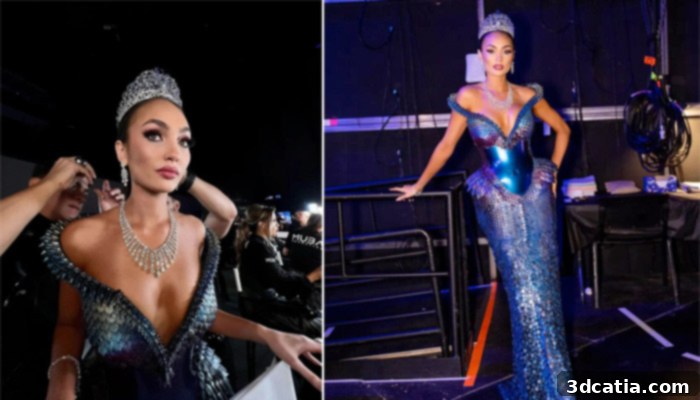
The dress features 3D-printed parts
The Miss Universe Gown: A Fusion of Technology and Craftsmanship
The gown worn by Miss South Africa, Bryoni Govender, stands as another shining example of this innovative synergy, with a significant portion of its design meticulously brought to life using 3D printing. While the acclaimed designer has remained somewhat discreet about the precise processes and materials employed in its creation, he did reveal a staggering commitment of 530 hours dedicated to the garment’s development. This intricate piece features a distinct composition of ‘scales,’ evocative of a mermaid’s shimmering skin, carefully integrated into the fabric. It is highly plausible that these unique, textured scales were the primary elements produced through multi-stage 3D printing, subsequently assembled and meticulously hand-finished onto the dress. Beyond its avant-garde 3D-printed components, the dress was further embellished with an astonishing count of over 3,000 genuine Swarovski crystals. This lavish addition considerably elevated the outfit’s opulence, transforming it into a true masterpiece befitting a queen and making a powerful statement on the international stage.
Additive Manufacturing’s Growing Influence in Fashion
The integration of 3D printing into haute couture, exemplified by Coetzee’s Miss Universe gown, represents a pivotal moment for both the fashion and additive manufacturing industries. This technology offers designers unprecedented control over form, texture, and structure, allowing for the creation of complex geometries and intricate details that are either impossible or prohibitively expensive to produce with traditional methods. The ability to customize each component precisely also opens doors for bespoke fashion, where garments can be tailored to an individual’s exact measurements and aesthetic preferences, pushing the boundaries of personalized luxury. Beyond aesthetics, 3D printing contributes to more sustainable practices by reducing material waste through precise deposition, and enabling the use of innovative, often recycled or bio-based, materials. Designers are continuously experimenting with flexible filaments, resins, and even powdered metals to achieve diverse tactile and visual effects, proving that the potential for creative expression is virtually limitless.
The Creative Vision and Symbolism Behind the Azure Gown
Even though Gert-Johan Coetzee maintained a degree of secrecy regarding the specific manufacturing processes, he was eloquently forthcoming about the profound inspiration and potent symbolism embedded within the dress. He shared, “Embracing the spirit of powerful women who stand as guardians and defenders, the dress honors the courage and fortitude exemplified by women in protecting their communities and fostering a better world for all.” This powerful message resonated deeply, reflecting the qualities of leadership, resilience, and compassionate strength that Miss Universe contestants embody. The azure blue hue of the gown further amplified this symbolism, often associated with serenity, stability, and depth, perhaps hinting at the vast, protective qualities of water or the boundless skies. The ‘mermaid scales’ were not merely decorative but likely represented the strength and adaptability required to navigate life’s currents, much like a guardian protecting her realm. This thoughtful narrative, combined with the dress’s visual grandeur, undoubtedly contributed to the significant stir it caused at the event. It served as a powerful testament to how sophisticated 3D technologies can be harnessed not just for technical innovation, but to craft profound masterpieces that tell a story and inspire an audience.
The Future of Fashion: Where Technology Meets Artistry
The impact of Gert-Johan Coetzee’s 3D-printed creation at Miss Universe extends far beyond the pageant stage. It signals a paradigm shift in how the fashion industry perceives and integrates advanced manufacturing techniques. Such high-profile exposure at an event watched globally demystifies additive manufacturing for a broader audience, demonstrating its practical and artistic applications in a tangible, visually stunning manner. It inspires other designers to explore these tools, driving further innovation and competition. From rapid prototyping of new designs to creating intricate accessories, footwear, and even entire garments, 3D printing is redefining design possibilities. As the technology continues to evolve, becoming faster, more affordable, and capable of handling a wider range of materials, its role in enabling truly bespoke, sustainable, and groundbreaking fashion is set to expand exponentially. We are witnessing the dawn of an era where traditional craftsmanship harmonizes with digital fabrication, leading to a vibrant future where fashion is more innovative, personalized, and environmentally conscious than ever before. Coetzee’s work is not just about a dress; it’s a glimpse into the future of couture.
What are your thoughts on this remarkable 3D-printed dress showcased at the Miss Universe pageant? We invite you to share your insights in a comment below or join the conversation on our Linkedin, Facebook, and Twitter pages! Don’t forget to sign up for our free weekly Newsletter here, bringing the latest 3D printing news directly to your inbox every week! You can also find all our compelling videos and interviews on our dedicated YouTube channel.
*All Photo Credits: Gert-Johan Coetzee