

Streamlining 3D Workflows: The Power of Seamless Scan-to-CAD Solutions for Additive Manufacturing
The convergence of 3D scanning and 3D printing has become a cornerstone of modern manufacturing, unlocking unprecedented potential across various industries. From enabling rapid customization and the reconstruction of obsolete parts through reverse engineering to accelerating innovative product development, the synergy between these two technologies is undeniable. While high-quality 3D scanners are adept at capturing intricate geometries with remarkable detail, the journey from raw scan data to a clean, usable, parametric CAD file for printing presents a significant challenge. This crucial transformation, often referred to as Scan-to-CAD, can be notoriously time-consuming, labor-intensive, and prone to inefficiencies when traditional methods are employed. In today’s fast-paced world, where speed and precision are paramount, such bottlenecks are simply unacceptable. The demand for integrated Scan-to-CAD solutions that simplify this transition, enhance workflow efficiencies, and help companies overcome persistent obstacles has never been greater.
Navigating the Hurdles of Traditional Scan-to-CAD Processes
To truly appreciate the value of advanced Scan-to-CAD solutions, it’s important to understand the complexities inherent in conventional processes. Once a 3D scan is successfully completed, the raw data, typically in the form of a mesh, requires meticulous cleanup and preparation before it can be used to generate a CAD model. This often involves several intricate steps, each with its own set of potential pitfalls:
- Data Alignment Challenges: The first critical step is accurately aligning multiple scans or aligning scan data to a known reference system. Without precise reference points, misalignment issues can easily arise, leading to dimensional inaccuracies in the final CAD model. Correcting these alignment errors can consume considerable time, requiring manual adjustments and iterative fixes that delay the entire process.
- Cleaning Noisy and Imperfect Data: Raw scan data frequently contains noise, artifacts, or unwanted gaps. These imperfections stem from various factors, including scanning environment conditions, surface reflectivity, or sensor limitations. Removing this extraneous data without compromising the integrity of the essential geometry is a delicate task. If not properly cleaned, these imperfections can propagate into the CAD model, affecting its accuracy and suitability for subsequent manufacturing steps.
- Mesh-to-CAD Conversion Complexity: The inherent difference between mesh-based scan data (a collection of interconnected polygons) and parametric CAD models (mathematically defined surfaces and solids) creates a fundamental conversion challenge. This is particularly true for complex or organic shapes, where translating a faceted mesh into smooth, editable surfaces and features requires sophisticated algorithms and significant manual intervention. Traditional methods often struggle to accurately represent freeform surfaces, making the process labor-intensive and requiring highly specialized skills.
- Tedious Quality Assurance: Ensuring the accuracy and fidelity of the converted CAD model is a multi-stage process that typically involves switching between different capture tools and CAD software. This constant back-and-forth for validation and modification is time-consuming and can introduce further delays.
These time-intensive and costly processes not only delay product launches but also demand a significant investment in trained professionals, specialized software, and hardware. The cumulative effect is often higher operational costs and reduced competitiveness. The question then becomes: how can a truly seamless, efficient, and precise transition from scan data to a robust CAD model be achieved?
An Efficient Scan-to-CAD Solution for Faster Prototyping and Market Launch
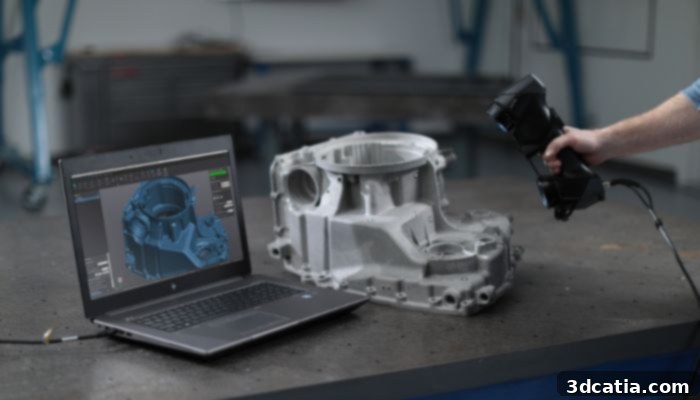
The answer lies in integrating high-quality data acquisition with intelligent, purpose-built processing software. Creaform, a division of AMETEK based in Lévis, Québec, has pioneered a comprehensive Scan-to-CAD ecosystem designed to eliminate these traditional bottlenecks. Their approach combines advanced portable 3D scanners with specialized software solutions, creating a cohesive platform for efficient data processing.
Creaform’s extensive range of portable and highly accurate 3D scanners caters to diverse user needs, from versatile handheld devices for general applications to high-performance systems for demanding metrology tasks. These cutting-edge hardware solutions are complemented by innovative software that streamlines data acquisition and processing, ensuring precision and ease of use. This unique blend of hardware and software empowers users to accelerate their journey from rapid prototyping to final product market launch, thereby gaining a crucial competitive edge.

Introducing the Creaform Metrology Suite: Bridging the Gap
At the heart of Creaform’s solution is the Metrology Suite, a robust and adaptable platform engineered to seamlessly bridge the divide between 3D scanning and CAD, ultimately facilitating high-precision 3D printing. This comprehensive suite supports a wide array of applications critical to modern product lifecycle management, including product development, advanced reverse engineering, rigorous inspection, dynamic tracking, and the creation of accurate digital twins. By consolidating these functions, the Metrology Suite significantly optimizes workflow efficiency and data integrity.
To further enhance reverse engineering and accelerate rapid prototyping specifically for additive manufacturing, Creaform has integrated an advanced Scan-to-CAD module within the Metrology Suite. This module is available in both a standard version and a more powerful Scan-to-CAD Pro version. These dedicated tools complement the suite’s broader capabilities, which also include modules for inspection, automation, and dynamic tracking, thereby establishing a scalable and adaptable metrology ecosystem that can evolve with user needs and technological advancements.
“Before, users struggled to turn raw scan data into a usable CAD file,” explained David Robichaud, Product Manager at Creaform. “Now, Scan-to-CAD Pro offers the most intuitive reverse engineering toolkit for mechanical engineers and designers. Scan-to-CAD Pro democratizes reverse engineering processes for businesses and users who do not want to invest time and resources in advanced CAD software. It’s truly a market game changer.”
Scan-to-CAD and Scan-to-CAD Pro: Advanced Features for Enhanced Productivity
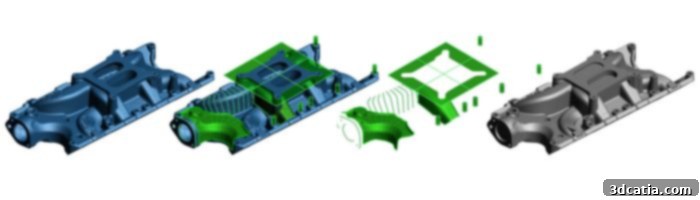
The Scan-to-CAD module, an evolution of Creaform’s former VXmodel software package, establishes a direct and efficient link between 3D scanning and 3D printing. It empowers engineers to effortlessly align scan data, refine mesh models by cleaning imperfections and filling gaps, and ultimately generate CAD-ready models with unparalleled precision. This foundational capability significantly reduces the manual effort and expertise traditionally required for these tasks, speeding up the initial stages of product development.
Building upon these capabilities, the Scan-to-CAD Pro version introduces a comprehensive set of advanced 2D sketching and 3D modeling tools. These tools are specifically designed to accelerate the conversion of complex scan data into precise parametric CAD models, making it ideal for sophisticated reverse engineering projects. With Scan-to-CAD Pro, users can define features, extract geometric entities, and create fully editable solid or surface models directly from mesh data. This level of control streamlines the entire design, manufacturing, and additive production workflow, from initial concept to final part, ensuring accuracy and reducing iterative cycles.
Wide-Ranging Applications and Industry Impact
With Scan-to-CAD, Creaform offers product developers, designers, and engineers a solution that guarantees a smooth, user-friendly workflow, precise results, and intuitive operation. Its versatility makes it suitable for a broad spectrum of applications, ranging from heavy industry and aerospace to the automotive sector. These are industries where additive manufacturing is increasingly gaining traction due to its potential for sustainability, customization, and rapid innovation.
For instance, in the aerospace sector, where precision and material integrity are non-negotiable, Scan-to-CAD facilitates the accurate replication of legacy components or the optimization of new designs for weight reduction and performance. In the automotive industry, it enables rapid iteration of prototypes, custom part creation, and precise reverse engineering of existing components for aftermarket solutions or modernization projects. The ability to quickly and accurately generate CAD models from physical objects significantly reduces development cycles and time-to-market across all these demanding environments.
Creaform actively supports users across these critical industries by consistently focusing its comprehensive product portfolio on compatibility and seamless integration with additive manufacturing workflows. Their portable scanning solutions, which include a variety of models from versatile all-rounders to high-performance versions, are continuously enhanced with new features and optimized algorithms. This ongoing innovation, according to the company, is aimed at pushing the boundaries of precision and efficiency in 3D measurement. By combining these advanced scanning solutions with versatile software packages, Creaform creates a truly seamless ecosystem for processing 3D data, which can then be directly utilized for high-quality 3D printing. This integrated approach ensures that users can achieve their design and manufacturing goals with greater speed, accuracy, and confidence. Find out more about Creaform’s solutions HERE.
What are your thoughts on Scan-to-CAD from Creaform? Do you believe integrated solutions are the future of 3D workflows? Let us know in a comment below or on our LinkedIn, Facebook, and Twitter pages! Don’t forget to sign up for our free weekly Newsletter here to get the latest 3D printing news straight to your inbox! You can also find all our videos on our YouTube channel.
*All Photo Credits: Creaform