

COSM and NASA Propel Space Manufacturing with Advanced Electron Beam 3D Printing for Artemis and Beyond
The advancement of humanity’s presence beyond Earth hinges on developing innovative solutions for constructing and maintaining infrastructure in challenging extraterrestrial environments. In a significant stride forward for space exploration, COSM Advanced Manufacturing Systems, a pioneering company headquartered in Massachusetts, has officially announced its critical involvement in the final development stages of state-of-the-art electron beam metal 3D printing systems. These sophisticated systems are meticulously engineered to cater to a diverse range of future in-space, lunar, and Martian applications, promising to revolutionize how components are manufactured, assembled, and repaired off-world.
This ambitious and transformative project receives substantial backing through a pivotal Small Business Innovation Research (SBIR) contract awarded by NASA. The SBIR program is instrumental in stimulating technological innovation within U.S. small businesses, and this specific contract is strategically aligned to support the overarching goals of the Artemis program’s mission to return humanity to the Moon. Indeed, NASA’s commitment to fostering a sustainable lunar presence under Artemis led to the selection of three additional small U.S. businesses last September to mature a suite of technologies. COSM was specifically chosen to address NASA’s pressing need for robust capabilities in in-space manufacturing, autonomous assembly, crucial modification, and efficient repair of components vital for long-duration missions.
The groundbreaking technology advanced by COSM is fundamentally based on the Directed Energy Deposition (DED) additive manufacturing process. What distinguishes COSM’s approach is its innovative use of a high-energy electron beam to meticulously deposit metal from a spool of wire, layer by layer, directly onto a substrate to create large, complex parts. The company leverages an impressive foundation of several decades of experience in designing and implementing charged particle beam systems, initially honed for high-precision imaging and metrology applications within the semiconductor industry. This profound institutional knowledge has been seamlessly translated into their new 3D printing system, which features unparalleled autonomous capabilities to monitor and dynamically adjust the printing process in real-time as it occurs. This ensures exceptional precision, verifiable quality, and unwavering reliability, even in the most demanding environments beyond Earth.
Richard Comunale, Founder and CEO of COSM, eloquently emphasizes the profound implications of this technological leap for future space endeavors. He states, “Producing large metal parts autonomously to verifiable specifications and quality in-space will be an enabling part of man’s permanent presence on the Moon and further missions to Mars.” This vision underscores the critical need for on-demand manufacturing capabilities that can drastically reduce the logistical burden and costs associated with transporting every single component from Earth. Enabling astronauts and robotic missions to fabricate, repair, and upgrade essential structures and tools directly in the extraterrestrial environment is not merely a convenience; it is an absolute necessity for establishing truly self-sufficient and sustainable outposts on celestial bodies.
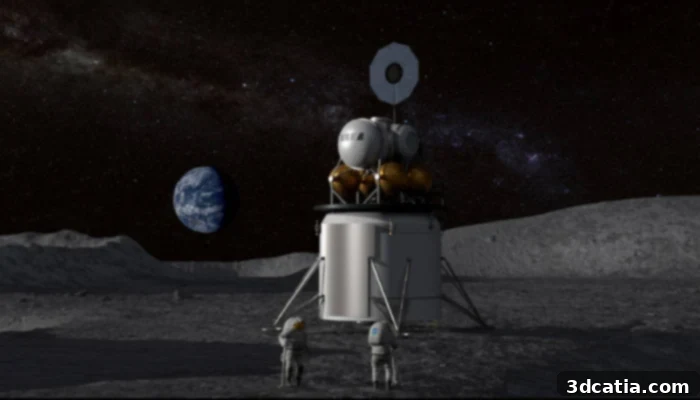
Illustration | Credits: NASA
The Artemis program, with its bold ambition to land the first woman and next man on the Moon, aims to employ innovative technologies to explore and utilize more of the lunar surface than ever before. While the specific 2024 target has been adjusted, the core mission remains steadfast: to establish a sustainable presence on and around the Moon. NASA envisions building robust elements of lunar infrastructure that will allow its robotic explorers and human astronauts to conduct more extensive scientific experiments and prepare for future journeys. Additive manufacturing, or 3D printing, stands as a cornerstone technology in this grand vision for space exploration and expansion. Its inherent flexibility, particularly the capability for in-situ production of parts on demand and the potential utilization of local resources, offers unparalleled advantages for off-world operations, minimizing reliance on Earth-based supply chains.
COSM Advanced Manufacturing was selected in September 2020 following a significant increase in NASA’s investment, with an additional $11.9 million allocated to mature critical lunar capabilities for the Artemis program. The selection of COSM’s advanced electron beam technology was primarily driven by its exceptionally high degree of active process control, its ability to perform real-time inspection, and its sophisticated flaw detection mechanisms. These attributes are absolutely vital for guaranteeing the structural integrity, quality, and reliability of components produced in the harsh and unforgiving vacuum of space, where the consequences of failure are catastrophic. The capacity to autonomously monitor, adjust, and verify the entire printing process in real-time provides an indispensable layer of assurance for missions that are both incredibly complex and immensely costly.
The capability to autonomously produce large metal parts, a hallmark of COSM’s current development, is not a recent innovation but rather the culmination of extensive prior research and collaboration. Richard Comunale further clarifies that this “is made possible by fundamental technology developed by COSM with support from NASA’s Langley Research Center.” This statement underscores a long-standing and productive partnership between the company and NASA. The next crucial step in this technology’s evolution will involve the rigorous validation of its core system components for successful launch, seamless operation during transit, and robust functionality once deployed on the Moon and subsequently on Mars. This thorough validation process is paramount to ensuring the technology’s resilience and effectiveness in the extreme conditions of space travel and extraterrestrial environments.
COSM’s collaborative engagement with NASA is extensive and multifaceted, indicating a sustained commitment to advancing in-space manufacturing capabilities. This current endeavor serves as a direct follow-on to previous successful work undertaken with NASA’s Langley Research Center on their pioneering Electron Beam Free Form Fabrication (EBF3) program. The EBF3 program itself has been at the forefront of exploring advanced manufacturing techniques for various space applications. Karen Taminger, Senior Materials Research Engineer and Technical Lead for Metal AM Research at NASA Langley, expresses profound excitement about this continuing partnership: “We are excited by the prospect of adding COSM’s high precision electron beam capabilities into the EBF3 process to enhance in-space welding and additive manufacturing for future exploration missions.”
Taminger further highlights the distinct advantages that COSM brings to this collaboration, noting that “COSM’s experience enables integrated visualization and sensing in real time to control and inspect work being performed in remote areas.” This cutting-edge capability for real-time, integrated sensing and visualization is absolutely critical for ensuring quality, precision, and efficiency when manufacturing operations are conducted millions of miles away from Earth, often with significant communication delays. It essentially provides ground control (or on-site autonomous systems) with an unprecedented level of insight and control over the manufacturing process, allowing for immediate adjustments and validation. This advanced remote control and inspection capability represents a transformative leap for the reliability and effectiveness of extraterrestrial construction. For a more comprehensive understanding of this exciting development, you can access the original press release HERE.
The far-reaching implications of COSM’s electron beam 3D printing technology for the future of space exploration are immense. Imagine a future where lunar bases are constructed largely from indigenous regolith-derived metals, or where Martian explorers can fabricate essential replacement parts for their rovers on demand, eliminating the arduous and time-consuming process of waiting for resupply missions from Earth. This technology effectively paves the way for true autonomy in space, significantly reducing the prohibitive costs and inherent logistical complexities associated with launching every single component from Earth. It actively fosters a vision of sustainable self-sufficiency, where astronauts are empowered not only as explorers but also as builders and maintainers of their own habitats and tools, capable of adapting to unforeseen challenges with readily available, on-site manufacturing capabilities.
Beyond mere repair and construction, the profound ability to modify existing structures or tools in-situ adds an unparalleled layer of operational flexibility. This means that designs can be rapidly optimized, or entirely new functionalities can be integrated into existing equipment, based on real-time scientific discoveries and evolving mission needs identified on the Moon or Mars. This dynamic and iterative design-and-manufacturing process, enabled by advanced additive manufacturing systems like COSM’s DED technology, will undoubtedly accelerate the pace of scientific discovery and technological advancement in space. It fundamentally shifts the paradigm from merely transporting everything we need from Earth to the groundbreaking capability of creating what we need, precisely where and when we need it, by intelligently utilizing local resources and local ingenuity.
Ultimately, the pioneering collaboration between COSM Advanced Manufacturing Systems and NASA is about much more than simply building individual parts; it’s about meticulously building a sustainable future for humanity in space. A future where our presence beyond Earth is not merely transient but becomes permanent, flourishing, and continuously expanding. Electron beam metal 3D printing, with its unparalleled precision, robust autonomy, and versatile material capabilities, stands as a foundational cornerstone of this ambitious future. It represents a monumental leap towards establishing enduring outposts on both the Moon and Mars, facilitating deeper scientific exploration, enabling efficient resource utilization, and, ultimately, dramatically expanding the very boundaries of human civilization into the cosmos.
What are your thoughts on the revolutionary and ever-expanding role of additive manufacturing in shaping the future of space exploration and establishing humanity’s permanent presence among the stars? We warmly invite you to share your insightful perspectives in the comments section below or to engage in further discussion on our Facebook and Twitter pages. To stay thoroughly informed with all the latest groundbreaking advancements and essential news in the dynamic world of 3D printing, be sure to sign up for our completely free weekly Newsletter, delivered directly to your inbox!