
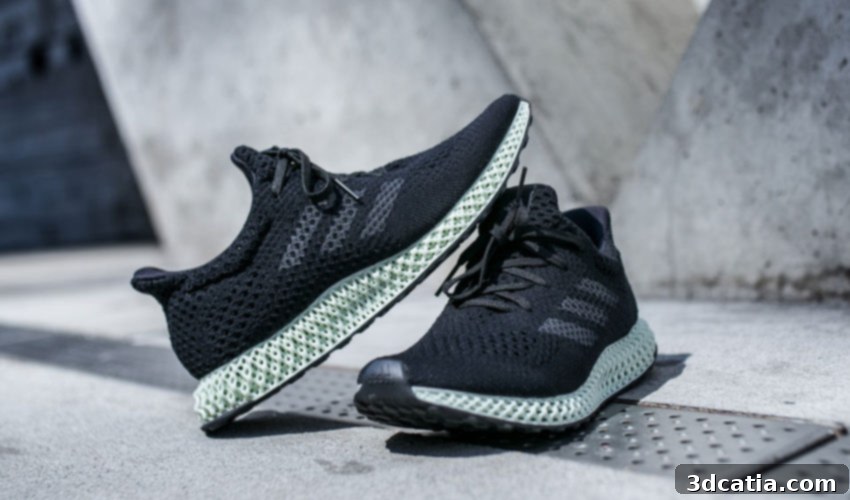
Revolutionizing Footwear: The Adidas Futurecraft 4D and Carbon 3D Partnership
The world of footwear innovation took a monumental leap forward with the collaboration between athletic giant Adidas and cutting-edge 3D printing pioneer, Carbon 3D. Their groundbreaking creation, the Futurecraft 4D sneakers, marked a pivotal moment, ushering in an era where personalized performance and advanced manufacturing techniques converge. Initially rolled out with a highly anticipated, limited release through a raffle system at select US retailers, these shoes quickly became a symbol of what’s possible when traditional craftsmanship meets digital fabrication. Carbon, the ambitious startup behind the revolutionary printing technology, set an impressive target, aiming to ship over 100,000 pairs of these intricately designed 3D printed shoes by the close of 2018, underscoring their confidence in scaling additive manufacturing for consumer markets. This partnership wasn’t just about launching a new sneaker; it was about reimagining the entire manufacturing process and setting a new benchmark for speed, precision, and sustainability in the global sportswear industry.
The Genesis of Futurecraft 4D: A Vision Realized
The journey of the Futurecraft 4D began long before its public release. Adidas, renowned for its relentless pursuit of innovation, had been exploring additive manufacturing for years through its “Futurecraft” initiative, a testament to its commitment to pioneering new production methods and materials. Their vision was clear: to create footwear that could be precisely tailored to an athlete’s individual needs, offering unparalleled comfort, support, and performance. Traditional manufacturing often involves compromises, but 3D printing offered the potential for unprecedented geometric complexity and material optimization. It allowed for the creation of intricate lattice structures that could precisely control cushioning, stability, and energy return, all customized down to the millimeter. The partnership with Carbon 3D was the catalyst that transformed this ambitious vision into a tangible reality, bringing their unique technology to the forefront of footwear production. The “4D” in Futurecraft 4D refers not only to the three dimensions of physical space but also to the fourth dimension of time, emphasizing the dynamic, real-time manufacturing process enabled by Carbon’s technology, and the potential for a new era of on-demand, responsive production.
Carbon 3D: A Force in Additive Manufacturing
Carbon 3D isn’t just another player in the burgeoning 3D printing landscape; they are a startup that has fundamentally reimagined the speed and scalability of additive manufacturing. Their innovative approach recently garnered significant attention, evidenced by securing over $200 million in investment, a clear signal of investor confidence in their technology and business model. This substantial capital injection was earmarked for expanding their production capabilities, a crucial step for a company partnering with a global brand like Adidas to produce commercial products at scale. Dr. Joseph DeSimone, CEO of Carbon, eloquently captured the essence of their achievement, stating that this collaboration “illustrates the power of true digital 3D manufacturing at scale and the infinite possibilities ahead.” This statement perfectly encapsulates the ambition driving Carbon 3D – to move beyond prototyping and into genuine mass production, disrupting traditional manufacturing paradigms with digital precision and agility.
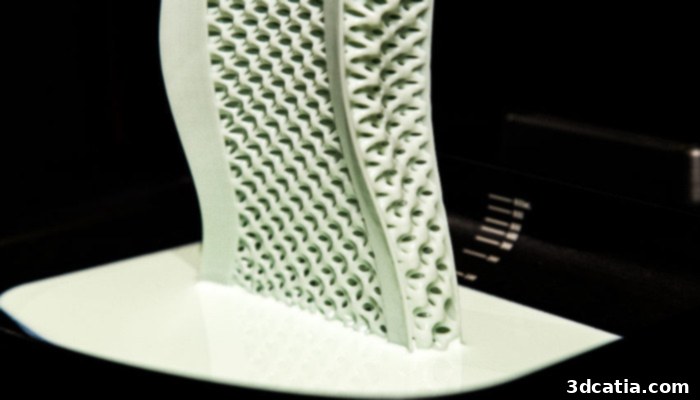
The Adidas Futurecraft 4D being printed using their CLIP 3D technology, highlighting the precision and innovation involved in its production.
Unpacking CLIP Technology: Speed, Precision, and Scale
At the heart of Carbon 3D’s success is its patented Continuous Liquid Interface Production (CLIP) technology. Unlike conventional 3D printing methods, CLIP stands out for its remarkable speed and efficiency, making it uniquely suited for industrial-scale manufacturing. While it shares some conceptual similarities with stereolithography (SLA), which also uses UV light to cure liquid resin, CLIP introduces a critical innovation: a continuous process facilitated by an oxygen-permeable window. This window creates a “dead zone” of uncured resin between the part and the window, preventing the part from sticking and allowing for continuous, rapid curing. This ingenious mechanism allows CLIP to 3D print objects up to 100 times faster than many traditional methods, effectively transforming additive manufacturing from a slow, iterative process into a viable option for high-volume production.
The CLIP process involves precisely orchestrating photopolymerization, where a digital light projector shines UV images through the oxygen-permeable window into a reservoir of specially formulated liquid resin. This light cures the resin layer by layer, forming a solid object from the bottom up, all without the start-and-stop movements characteristic of other 3D printing technologies. This continuous approach not only accelerates printing but also results in parts with smoother surfaces and consistent mechanical properties throughout, critical for performance footwear. Carbon has developed a range of resins, or “materials,” specifically tailored for different applications, including elastomeric polyurethanes that provide the perfect balance of cushioning and responsiveness required for athletic shoes. Many in the tech and manufacturing communities were introduced to Carbon 3D and its revolutionary technology through the impactful TED Talk of Dr. Joseph DeSimone, which remains an excellent resource for understanding the principles behind CLIP.
Carbon’s Unique Business Model: Scaling Innovation
Beyond its technological prowess, Carbon 3D distinguishes itself with a business model that deviates significantly from the industry norm. Rather than selling its advanced CLIP printers outright, Carbon opts for a rental-only model. This strategy provides several key advantages. For customers, it lowers the initial capital expenditure, making the adoption of cutting-edge 3D printing technology more accessible. For Carbon, it ensures a recurring revenue stream and allows them to maintain tighter control over the quality, maintenance, and material supply for their machines, optimizing performance and ensuring customer success. This model also facilitates rapid iteration and updates to their technology, as they manage the fleet of printers directly. This forward-thinking approach has clearly paid off, as evidenced by their impressive $200 million investment round, which valued the company at an estimated $1.7 billion. This valuation underscores the perceived value and potential of their technology and strategic business model within the additive manufacturing space.
“The Futurecraft 4D launch is a testament to the deep and dynamic partnership between Adidas and Carbon, and illustrates the power of true digital 3D manufacturing at scale and the infinite possibilities ahead for personalized production.”
Strategic Leadership: Adidas Executive Joins Carbon 3D Board
The depth of the partnership between Adidas and Carbon 3D was further cemented with a significant strategic move: the announcement that Eric Liedtke, a highly respected executive from Adidas, had joined Carbon’s board of directors. This appointment was a clear signal of the long-term commitment and strategic alignment between the two companies. Carbon CEO Joseph DeSimone expressed his enthusiasm for Liedtke’s addition, stating, “I am thrilled to welcome Eric to our Board. Eric is an experienced and respected leader, and his track record for driving creativity and innovation at Adidas makes him a valuable addition…as we continue to deliver on Carbon’s growth strategy.” Liedtke’s extensive experience in product development, brand strategy, and global marketing at Adidas brings invaluable consumer insights and industry expertise to Carbon 3D. His presence on the board is expected to significantly contribute to Carbon’s understanding of market needs and accelerate the adoption of their technology across various consumer product sectors, not just footwear. This collaboration at the executive level indicates a shared vision for transforming manufacturing and bringing innovative products to market more efficiently and sustainably.
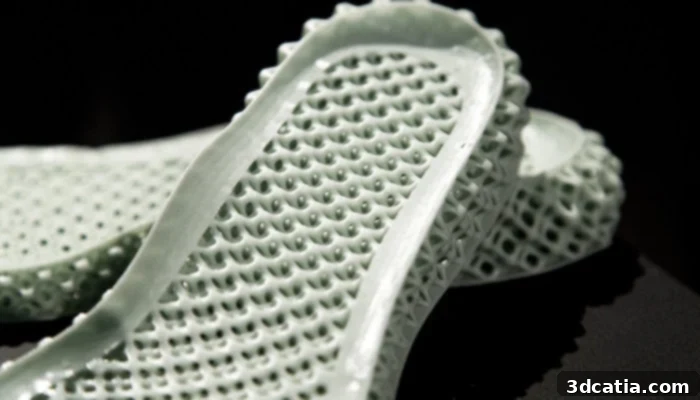
The intricately designed 3D printed shoe sole of the Adidas Futurecraft 4D, a marvel of additive manufacturing.
Market Dynamics: Demand, Production, and the Future of Availability
The initial rollout of the Futurecraft 4D mirrored the high-demand, limited-supply strategy often seen with other coveted Adidas releases, such as the Yeezy sneakers. However, the underlying reasons for scarcity differed significantly. While Yeezy drops often involve intentional understocking to create hype and drive secondary market value, the Futurecraft 4D’s limited availability was more likely a reflection of the inherent challenges of scaling a revolutionary manufacturing process. Carbon 3D faced the formidable task of ramping up production of complex, high-performance components using a relatively new technology. The goal of shipping 100,000 pairs by the end of 2018 was ambitious, signaling a genuine attempt to push the boundaries of additive manufacturing scalability rather than a deliberate strategy of artificial scarcity.
This challenge highlights a crucial point in the evolution of 3D printing for consumer goods: transitioning from rapid prototyping to mass customization and production requires significant investment in infrastructure, material science, and process optimization. For consumers, this meant that acquiring a pair of Futurecraft 4D shoes was initially a difficult feat, often requiring participation in raffles and having access to specific retailers. As 3D printing technologies mature and become more efficient, the expectation is that such products will become more widely available and potentially more affordable, democratizing access to personalized, high-performance footwear. The insights gained from the initial production phase of the Futurecraft 4D undoubtedly provided invaluable lessons for both Adidas and Carbon 3D, paving the way for future advancements in large-scale additive manufacturing.
The Broader Impact: A Glimpse into the Future of Manufacturing
The Adidas Futurecraft 4D partnership with Carbon 3D represents more than just a new shoe; it’s a powerful case study in the transformative potential of additive manufacturing for the entire consumer goods sector. This collaboration demonstrates how 3D printing can move beyond niche applications to deliver tangible, high-performance products at a scale that challenges conventional production methods. The ability to rapidly iterate designs, create highly complex geometries that are impossible with traditional molding, and potentially customize products on demand opens up exciting possibilities. Imagine shoes perfectly molded to an individual’s foot, optimized for their gait and specific athletic needs, produced locally and on demand. This vision of hyper-personalized, distributed manufacturing is no longer science fiction but a rapidly approaching reality, with Futurecraft 4D at its vanguard. Furthermore, 3D printing offers significant environmental benefits, including reduced material waste through optimized designs and the potential for on-demand production to minimize overstock and transportation emissions. As both companies continue to refine their processes and expand their capabilities, the Futurecraft 4D serves as a compelling blueprint for the future of product development and supply chains in a digitally driven world.
Join the Conversation
What are your thoughts on the revolutionary Futurecraft 4D 3D printed shoes and the pioneering partnership between Carbon and Adidas? Do you believe 3D printing will truly transform mass-market consumer goods? We invite you to share your perspectives and engage with our community. Let us know your thoughts in a comment below or join the discussion on our Facebook and Twitter pages! For all the latest news, breakthroughs, and insights in the dynamic world of 3D printing, make sure to sign up for our free weekly Newsletter, delivered straight to your inbox. Stay ahead of the curve with cutting-edge industry updates.