

Supernova’s Viscogels: Pioneering High-Performance Materials for Industrial and Transportation 3D Printing
Supernova is making significant strides in the additive manufacturing landscape with its innovative Pulse Production Platform, powered by the revolutionary Viscogels technology. Launched at the end of last year, this platform utilizes a unique viscous material formulation capable of producing parts that boast a superior, molded-like finish. This advancement is crucial for industries where surface quality and aesthetic appeal are as vital as functional performance. Recently, the company announced the strategic release of four new material variants, meticulously engineered to address the rigorous demands of industrial applications. A particular emphasis has been placed on achieving essential certification for critical sectors, most notably the transportation industry. Supernova confidently states that these cutting-edge materials deliver performance characteristics comparable to, and in some cases exceeding, the traditionally molded plastics frequently employed in high-stakes components such as electrical connectors and advanced sealing systems. This development marks a pivotal moment, bridging the gap between the design flexibility of 3D printing and the stringent performance requirements of conventional manufacturing methods.
One of the most compelling aspects of these newly introduced materials is their seamless compatibility with the innovative VLM (Vat Lithography Multi-material) process, particularly when utilized in dual-material mode. This advanced capability empowers manufacturers to produce intricate components featuring both rigid and flexible zones within a single, streamlined operation. Imagine a single part that integrates a stiff structural element with a compliant seal or damping feature, all printed in one go. This level of functional integration opens up unprecedented design possibilities and significantly simplifies assembly processes. Beyond the functional advantages, this technology offers substantial economic benefits. Supernova’s internal data suggests that adopting this approach can slash unit costs by more than 50% by entirely eliminating the need for expensive and time-consuming tooling, a significant barrier in traditional manufacturing. This cost efficiency makes high-performance additive manufacturing a viable solution not only for rapid prototyping and low-volume production but also for more widespread industrial adoption. To provide a clearer picture of this groundbreaking launch, let’s delve deeper into the specific characteristics and intended applications of these new materials.
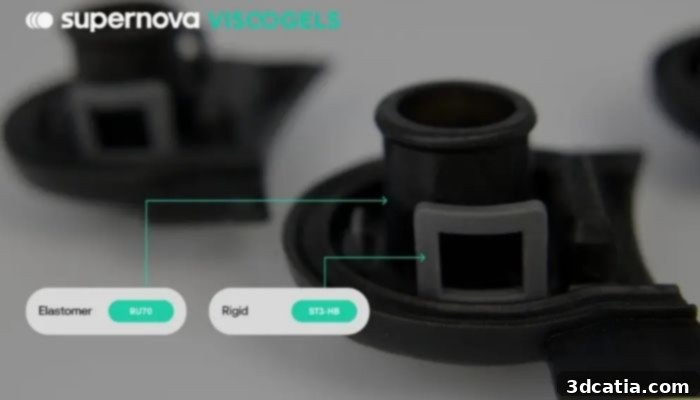
The new materials can be printed in a single part and in a single process, enabling complex multi-material components.
Supernova’s initial two material offerings are high-performance elastomers, designated as RU55 and RU50. These materials are meticulously formulated to emulate the robust behavior and performance profiles of traditionally molded EPDM elastomers (ethylene propylene diene rubber). EPDM is widely recognized for its excellent resistance to weathering, ozone, UV radiation, and a broad spectrum of chemicals, making it a preferred choice for outdoor and harsh environment applications. Supernova’s new elastomers not only replicate these essential properties but also introduce significant added advantages, including superior dimensional stability and enhanced chemical resistance. This makes them exceptionally well-suited for applications that demand consistent performance under extreme operating conditions, such as wide temperature fluctuations, exposure to corrosive fluids, or constant mechanical stress. According to the company, these innovative elastomers are ideally suited for critical components like advanced sealing systems, durable gaskets, and robust cable glands – applications where material integrity and reliability are absolutely non-negotiable for safety and operational efficiency.
Complementing the elastomers are the other two new materials, ST1-V0 and ST3-HB, collectively categorized as “Rigids.” These materials are specifically engineered to excel in demanding structural applications where high mechanical strength, stiffness, and paramount fire safety are critical requirements. Examples include robust electrical connector housings, intricate structural brackets, and other functional parts that must withstand significant loads and operate safely. A distinguishing feature of these rigid materials is their inherent flame-retardant properties, which have earned them certification to the stringent UL94 V0 standard at a remarkably thin thickness of 1.8 mm. This achievement is particularly noteworthy and uncommon within the realm of additive manufacturing materials, as many 3D printable plastics struggle to meet such rigorous fire safety classifications at thin geometries. The UL94 V0 rating signifies that the material will self-extinguish within 10 seconds on a vertical part, with no flaming drips, which is a critical safety criterion for many industrial and consumer products. Supernova envisions these materials as ideal candidates for producing high-performance parts across a wide array of sectors, including the stringent automotive industry, vital rail transportation, general industrial manufacturing, and even the highly regulated aerospace sector, where safety and reliability are paramount.
Roger Antúnez, the visionary founder and CEO of Supernova, underscored the transformative nature of these new materials during their launch. He stated, “This is the first time in additive manufacturing that materials can meet, and in some cases exceed, the requirements of molded plastics in real transportation applications. By focusing on connectors and sealing systems, we are showing that Viscogels are ready to meet the demands of the most demanding industrial customers.” This powerful statement highlights Supernova’s success in directly addressing one of the longest-standing challenges in additive manufacturing: bridging the performance gap with traditional mass-produced parts. The strategic focus on connectors and sealing systems is particularly insightful, as these components are ubiquitous across industries and often require a delicate balance of mechanical integrity, environmental resistance, and precision, making them ideal testaments to the capabilities of Viscogels. Antúnez’s vision emphasizes that these are not merely prototyping materials but truly production-ready solutions capable of transforming supply chains and enabling new product designs across critical industries.
Currently, all four of Supernova’s groundbreaking materials are undergoing extensive evaluation within rigorous beta programs, conducted in close collaboration with strategic partners across the transportation and industrial sectors. This critical phase is designed to thoroughly confirm their performance against a myriad of industry-specific certification standards and real-world application scenarios, a necessary step before they can be broadly adopted for full-scale production. This meticulous testing ensures that the materials not only perform as expected in laboratory conditions but also withstand the harsh realities of industrial environments and meet all regulatory compliance requirements. Furthermore, the company’s recent press release revealed an ambitious roadmap for future material development. Supernova is already actively engaged in research and development for new silicone-based variants and even more rigid polymer compounds. These upcoming materials are specifically aimed at directly competing with and offering superior alternatives to high-performance glass-fiber-reinforced compounds, which are staples in many demanding engineering applications. This continuous innovation demonstrates Supernova’s commitment to pushing the boundaries of additive manufacturing and providing a comprehensive portfolio of advanced materials for an ever-evolving industrial landscape, promising even greater versatility and performance in the near future.
Supernova’s advancements with the Pulse Production Platform and its new suite of Viscogel-based materials represent a significant leap forward for industrial 3D printing. By offering materials that combine the design freedom and rapid iteration capabilities of additive manufacturing with the performance characteristics, durability, and essential certifications traditionally associated with molded parts, Supernova is not just innovating; it’s actively shaping the future of how critical components are manufactured across a diverse range of industries. The strategic focus on high-performance elastomers for sealing applications and flame-retardant rigids for structural integrity, coupled with the inherent cost-efficiency and multi-material advantages of the VLM process, firmly positions Supernova as a pivotal enabler for advanced manufacturing solutions worldwide. These developments promise to accelerate innovation, reduce lead times, and open up new design possibilities for engineers and product developers seeking robust, reliable, and cost-effective solutions for their most challenging applications.
What are your thoughts on Supernova’s revolutionary new materials and their potential impact on industrial 3D printing? We invite you to share your insights in a comment below or join the conversation on our LinkedIn or Facebook pages! Don’t forget to sign up for our free weekly Newsletter to receive the latest 3D printing news and updates directly in your inbox. You can also explore all our compelling videos and interviews on our YouTube channel. For those particularly interested in more 3D printing news within the dynamic automotive and transportation sectors, we encourage you to visit our dedicated page HERE for in-depth coverage and expert analysis.
All Photo Credits: Supernova