
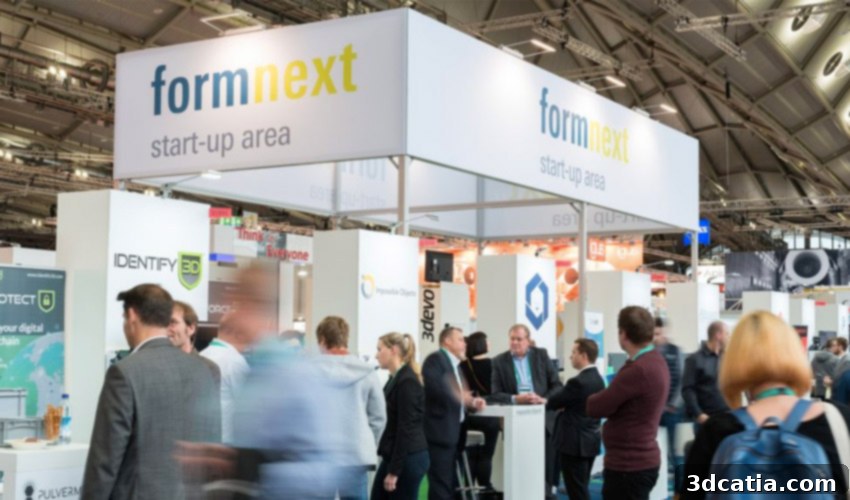
Formnext: Unveiling the Latest Innovations and Future Trends in Additive Manufacturing
Formnext, held annually in Frankfurt, Germany, stands as the undisputed global leading exhibition and conference for additive manufacturing and industrial 3D printing. It is more than just an event; it’s a vital nexus where the entire additive manufacturing ecosystem converges, showcasing the most cutting-edge technologies, materials, and processes. Each year, it draws thousands of industry professionals, innovators, and enthusiasts from around the world, making it the definitive platform for business development, networking, and gaining invaluable insights into the rapidly evolving landscape of 3D printing. The exhibition halls brim with groundbreaking solutions, from advanced machinery to revolutionary software and novel materials, all contributing to the continued transformation of diverse industries.
During its fifth edition in 2019, the 3Dnatives team embarked on a comprehensive exploration of Formnext, immersing themselves in the vibrant atmosphere of innovation. This firsthand experience provided a unique vantage point to observe and analyze the most significant emergent trends shaping the 3D printing industry. Our comprehensive overview allowed us to identify key areas of growth and technological advancement, highlighting the dynamic shifts within additive manufacturing that promise to redefine production capabilities. From novel material developments to the expansion of industrial applications, Formnext 2019 offered a clear snapshot of the industry’s trajectory, emphasizing its rapid evolution and increasing maturity across various sectors.
Key Innovations and Emerging Trends from Formnext 2019
Formnext 2019 served as a critical barometer for the health and direction of the additive manufacturing sector. The insights gathered by the 3Dnatives team revealed several pivotal trends that were, and continue to be, instrumental in pushing the boundaries of what’s possible with 3D printing. These observations underscored the industry’s commitment to overcoming technical limitations, expanding material possibilities, and scaling production for true industrial adoption. The exhibition floor buzzed with discussions around enhanced efficiency, improved part performance, and the integration of additive manufacturing into conventional production lines, signaling a significant leap forward from its earlier prototyping-centric reputation.
The Ascendance of Advanced Materials: Ceramics and Silicone
One of the most compelling trends observed was the significant growth and sophisticated development in advanced materials for 3D printing, particularly ceramics and silicone. These materials, once challenging to process with additive techniques, are now at the forefront of innovation, opening doors to a multitude of high-performance applications. Ceramic 3D printing, for instance, has matured considerably. Its ability to produce parts with exceptional thermal stability, chemical resistance, and biocompatibility makes it invaluable for demanding industries such as aerospace, medical (implants and prosthetics), and high-temperature industrial components. We witnessed solutions enabling the creation of complex geometries with superior surface finishes, pushing ceramics beyond traditional manufacturing limits.
Similarly, silicone additive manufacturing demonstrated remarkable progress. Known for its elasticity, biocompatibility, and resistance to extreme temperatures, silicone is becoming increasingly viable for 3D printing, moving past initial developmental hurdles. Applications range from custom medical devices like hearing aids and prosthetics to soft robotics components, sealing solutions, and consumer goods. The advancements showcased at Formnext 2019 highlighted improved printing accuracy, faster production speeds, and a broader range of available silicone formulations, allowing engineers and designers to leverage the unique properties of this material in ways previously unimaginable, facilitating tailored solutions for highly specialized needs.
Industrial Metal Additive Manufacturing Takes Center Stage
Another prominent trend that underscored the industrialization of 3D printing was the undeniable rise of additive metal manufacturing, particularly among large industrial companies. Metal 3D printing has transitioned decisively from a niche prototyping tool to a robust method for producing end-use parts across critical sectors. Formnext 2019 showcased a profusion of advanced metal 3D printers utilizing various technologies such as Selective Laser Melting (SLM), Electron Beam Melting (EBM), and binder jetting, all designed to meet the rigorous demands of industrial production. Companies exhibited components for aerospace, automotive, and energy sectors, demonstrating significant weight reduction, optimized performance, and consolidated assemblies previously impossible with conventional methods.
This industrial adoption is driven by several factors: the ability to create complex internal structures for improved functionality, rapid iteration of designs, and reduced material waste compared to subtractive manufacturing. Large industrial players are increasingly investing in metal additive manufacturing capabilities not just for specialized parts but for scaling production, optimizing supply chains, and achieving unparalleled design freedom. The focus at Formnext 2019 was clearly on enhancing process reliability, repeatability, and cost-effectiveness, paving the way for metal 3D printing to become a standard manufacturing technique for high-value applications. This shift signifies a maturation of the technology, moving it firmly into the realm of mainstream industrial production.
The Massive Potential of Large-Scale 3D Printing
Beyond material innovations and metal industrialization, the exhibition also brought into sharp focus the immense potential of large-scale 3D printing. The ability to create impressively large parts, demonstrating capabilities such as printing components for a life-size car or substantial molds, truly captivated attendees. This trend signifies a paradigm shift, moving beyond small, intricate components to manufacturing objects of considerable size, addressing limitations that previously constrained the application scope of additive manufacturing. Technologies like large-format fused deposition modeling (FDM/FFF), granular extrusion, and even binder jetting for massive molds are enabling manufacturers to produce robust, full-scale prototypes, tooling, and even end-use products with unprecedented dimensions.
The advantages of large-scale 3D printing are multifaceted. It allows for the rapid production of prototypes and functional parts that would otherwise require extensive lead times and multiple assembly steps. Industries like automotive, aerospace, construction, and marine are directly benefiting, utilizing this technology for creating large jigs, fixtures, custom architectural elements, or even parts of vehicles. This capability reduces assembly complexities, lowers tooling costs, and accelerates product development cycles, providing significant competitive advantages. The advancements showcased at Formnext 2019 highlighted not just the scale but also the improved quality and material diversity available for these substantial builds, signaling a future where size is no longer a limiting factor for additive manufacturing applications.
Beyond 2019: The Evolving Landscape of Additive Manufacturing
While Formnext 2019 provided a snapshot of significant trends, the additive manufacturing industry continues its relentless evolution, building upon these foundations. The observed developments in advanced materials, industrial metal printing, and large-scale capabilities are intertwined with broader movements towards smarter, more integrated manufacturing ecosystems. The industry is not just about printers and materials anymore; it’s about complete digital workflows, advanced analytics, and seamless integration into the broader manufacturing enterprise. These ongoing shifts ensure that additive manufacturing remains a dynamic and transformative force, constantly reshaping how products are designed, developed, and produced.
Digitalization and Automation in AM Workflows
A crucial underlying theme in the progression of additive manufacturing is the increasing emphasis on digitalization and automation throughout the entire workflow. From design optimization using generative AI and topology optimization software to automated post-processing and quality control, every stage is becoming more streamlined and intelligent. This digital thread ensures greater efficiency, repeatability, and consistency, which are paramount for industrial-scale adoption. Automation minimizes human error, reduces labor costs, and significantly boosts throughput, making 3D printing an even more attractive option for mass customization and agile manufacturing. The synergy between hardware, software, and robotics is creating highly sophisticated, interconnected production lines, pushing additive manufacturing towards lights-out operation.
Sustainability and the Circular Economy
As global environmental concerns escalate, additive manufacturing is increasingly recognized for its inherent sustainable advantages. The ability to produce complex parts with minimal material waste, optimize material usage through lightweight designs, and enable on-demand local production significantly reduces carbon footprints. Furthermore, the development of recyclable and bio-based 3D printing materials, alongside processes that reclaim and reuse powders, contributes directly to circular economy principles. Formnext regularly highlights innovations in eco-friendly filaments, energy-efficient machines, and strategies for sustainable supply chains, positioning 3D printing as a key technology for building a greener, more resource-efficient manufacturing future. This focus on sustainability is not just ethical but also a growing economic imperative.
Diversification of Applications and Industries
The versatility of additive manufacturing continues to unlock applications in an ever-widening array of industries. Beyond the traditional strongholds of aerospace, automotive, and medical, 3D printing is making significant inroads into sectors such as fashion (customized footwear, intricate jewelry), food (personalized nutrition, complex confections), energy (optimized components for renewables), and construction (large-scale architectural elements, affordable housing solutions). Each Formnext event showcases new, unexpected applications, demonstrating how 3D printing’s capacity for customization, complexity, and rapid prototyping is being harnessed to solve unique challenges and create entirely new product categories across a vast spectrum of human endeavor. This continuous diversification is a testament to the technology’s adaptability and growing maturity.
The Future Outlook for Additive Manufacturing
Looking ahead, the future of additive manufacturing appears exceptionally bright, characterized by relentless innovation, increasing accessibility, and deeper integration into global supply chains. The trends observed at Formnext 2019, such as the advancement of materials and the scaling of production capabilities, serve as strong indicators of the industry’s trajectory. We can anticipate further breakthroughs in multi-material printing, even faster and more precise printing technologies, and a greater emphasis on artificial intelligence and machine learning to optimize every facet of the additive process. Events like Formnext will continue to play a pivotal role in accelerating this progress, fostering collaboration, and bringing these transformative technologies to the global stage.
The journey from niche technology to industrial powerhouse is well underway for additive manufacturing. As it continues to mature, its impact will extend far beyond manufacturing floors, influencing product design, supply chain resilience, and even the skills required in the workforce. Formnext remains the premier venue for witnessing these changes unfold, offering a glimpse into the innovations that will define the next generation of industrial production. It’s a testament to human ingenuity and the power of technological advancement to solve complex problems and create a more efficient, customized, and sustainable world.
Formnext Trends: A Visual Recap
What are your thoughts on these profound Formnext trends and the future trajectory of additive manufacturing? We invite you to share your insights and engage with our community. Let us know in a comment below, or connect with us on our LinkedIn, Facebook, and Twitter pages! For the very latest updates, breaking news, and in-depth analyses straight to your inbox, don’t forget to sign up for our free weekly Newsletter here. You can also explore all our compelling videos and industry coverage directly on our dedicated YouTube channel, where we continually share insights into the world of 3D printing.