
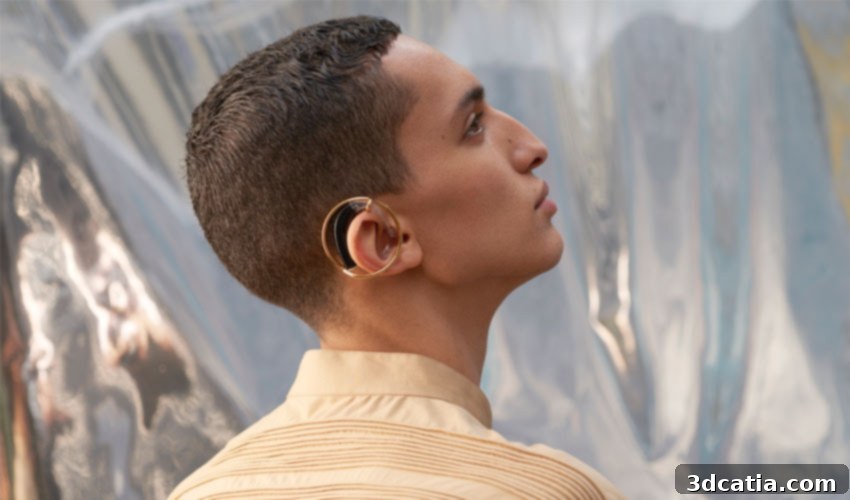
Transforming Hearing Aids: How 3D Printing Unlocks Personalized Style and Self-Acceptance for the Hearing Impaired with Project H(earring)
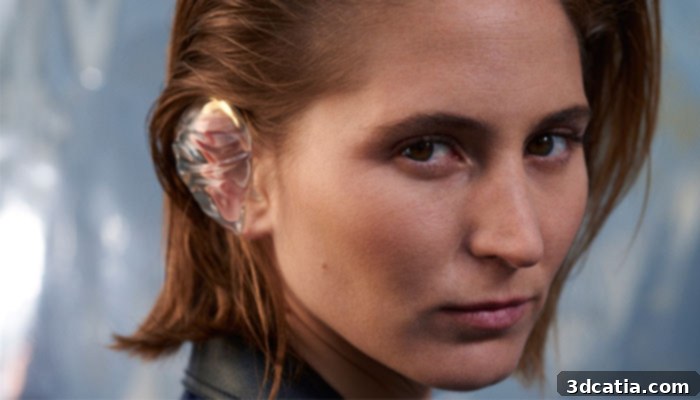
In a world increasingly shaped by innovation, 3D technologies offer revolutionary potential, especially when it comes to enhancing the daily lives of people with disabilities. These advanced manufacturing methods provide an unprecedented ability to create products meticulously adapted to individual needs, often transforming not just an object but the very experience of the person using it. This profound impact resonated deeply with Kate, a talented photographer who has navigated the world with hearing impairment for over two and a half decades, relying on hearing aids. Feeling that these essential devices lacked a personal touch and overtly signified a medical condition, Kate envisioned a change. She collaborated with two innovative designers, Flora and Julia, to conceptualize and bring to life a stunning collection of jewelry designed specifically to adorn and personalize hearing aids. This collaborative effort aimed to transcend the purely functional aspect of audioprostheses, infusing them with aesthetics that would not only erase the stigma of disability but celebrate individuality. The resulting collection, aptly named H(Earring), garnered significant recognition, winning the prestigious Swarovski accessory prize at the 33rd international festival of fashion, photography, and accessories in Hyères. We had the privilege of sitting down with Kate, Flora, and Julia to delve deeper into their inspiring shared project, exploring its origins, challenges, and the transformative power of design and technology.
Introducing the Visionaries Behind Project H(earring): Kate, Flora, and Julia
Kate: Hello, I’m Kate Fichard, a professional photographer. My journey with hearing impairment and hearing aids spans more than twenty-five years, shaping much of my perspective. This personal experience fueled my desire to redefine how hearing aids are perceived and worn. That’s why I approached Flora and Julia with the concept of creating a unique collection of jewelry specifically designed for hearing aids, a project truly close to my heart, aiming to transform a medical device into a statement of personal style and acceptance.
Flora & Julia (F & J): And we are Flora and Julia, the creative minds behind FandD studio, a Paris-based design duo. Our practice is inherently interdisciplinary, leading us to engage with a diverse range of projects spanning product design, accessories, and scenography. When Kate first presented us with the opportunity for this collaboration, we were immediately captivated by the immense social impact and potential of such a project. Kate’s infectious optimism and vision perfectly align with a broader global movement towards self-acceptance and the celebration of individuality that defines our generation. This venture also presented a unique and exciting opportunity to seamlessly integrate three distinct yet interconnected worlds: medicine, cutting-edge technology, and high fashion, forging a new path for assistive devices.
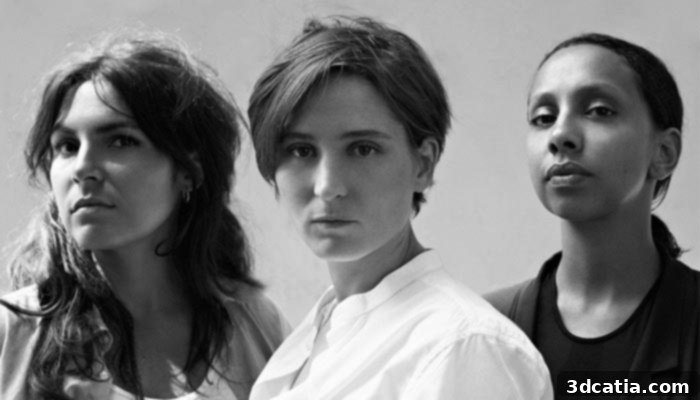
The visionary team behind Project H(earring): Kate, Flora, and Julia.
Designing this collection presented a formidable technical challenge, demanding an in-depth understanding of the miniature dimensions and intricate, complex curves inherent in hearing aid prostheses. To overcome these hurdles and achieve the required precision, we strategically employed 3D scanning technology. This advanced method allowed us to accurately capture the exact geometry of various hearing aids, providing us with a highly detailed digital blueprint. With this precise data, we were able to model the jewelry pieces with unparalleled accuracy, ensuring they would attach seamlessly and aesthetically to the devices. A particular focus was placed on developing secure and comfortable fastening systems, which were meticulously designed and varied across different jewelry pieces to accommodate their unique forms and placement.
Every jewelry model underwent an extensive prototyping phase involving multiple iterations of 3D prints. Each physical print served as a crucial validation step, allowing us to meticulously assess the jewel’s precise positioning on the hearing aid and its interaction with the ear’s anatomy. This iterative process was essential for fine-tuning the design, ensuring optimal aesthetics, and, most importantly, certifying that the jewelry would not introduce any discomfort or functional interference for the wearer. We rigorously tested for potential issues such as whistling sounds, imbalance, or any alteration of the hearing aid’s sound quality. Our intensive work focused on the ergonomics of each piece, guaranteeing not only comfort but also that the jewelry would in no way compromise the proper and effective functioning of the audioprosthesis. This commitment to both form and function was paramount throughout the design and development cycle.
The Genesis of Project H(earring): From Necessity to Fashion Statement
3DN: What was the primary motivation behind initiating Project H(Earring)?
Kate: My personal journey with hearing aids spans over a quarter-century, and throughout that time, I’ve observed a consistent aesthetic: their contours tend to closely resemble that of a medical prosthesis, subtly marking the wearer as someone with a disability. Manufacturers typically offer prostheses in a very limited palette of colors—blacks, grays, beiges—chosen primarily to blend with skin and hair, making them as discreet and unnoticeable as possible. While discretion has its place, I fundamentally disagree with the notion of hiding disability. Instead, I advocate for an approach that embraces and even showcases it, but with an aesthetic sensibility that is both beautiful and non-aggressive. Project H(Earring) was born from this desire to transform the perception of hearing aids, shifting them from something to be concealed into an accessory to be celebrated.
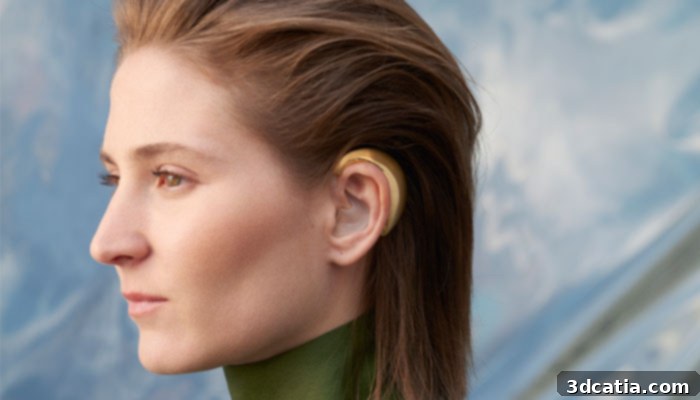
F & J: Our approach with Project H(Earring) was to develop a diverse range of “skins” or adornments for the hearing aids, varying significantly in their visibility and design complexity. These designs range from the most delicate and subtle to bold, eye-catching pieces, intended to be worn individually, in pairs, or even mismatched for a more avant-garde look. Our core focus was on the contour of the hearing aid itself, amplifying its inherent curves rather than concealing them. Through our designs, the prosthesis is not just underlined, but thoughtfully prolonged, thickened, or swollen, becoming a luminous and truly remarkable feature. The device is no longer hidden; instead, it is proudly assumed and openly displayed, transforming into a powerful act of self-affirmation and a unique style claim. This project offered us an extraordinary opportunity to create a jewelry collection characterized by an unusual formal vocabulary, where the design elegantly echoes not only the silhouette of the hearing aid but also the organic form of the human ear, creating a harmonious and personalized wearable art piece.
This project is profoundly characterized by a compelling duality: it places advanced technology squarely at the service of the sensitive and the human. Our design sketches vividly evoke this inherent tension, seamlessly juxtaposing geometric and regular silhouettes with more organic, fluid, and sometimes altered forms. This interplay of contrasting elements creates a dynamic visual language. Similarly, our thoughtful selection of materials, ranging from precious metals to other innovative substances, alongside various surface treatments, further reflects and emphasizes this underlying contrast. A significant source of inspiration for some pieces in the collection—the evocation of water and a noticeable fluid quality—emerged from a particularly poignant conversation with Kate during the initial project development process. She shared her perception that when she removes her hearing aids, her experience of sound transforms, becoming akin to our own muffled, serene auditory landscape when submerged underwater. This beautiful, poetic analogy deeply influenced our aesthetic choices, adding another layer of depth and meaning to the H(Earring) collection.
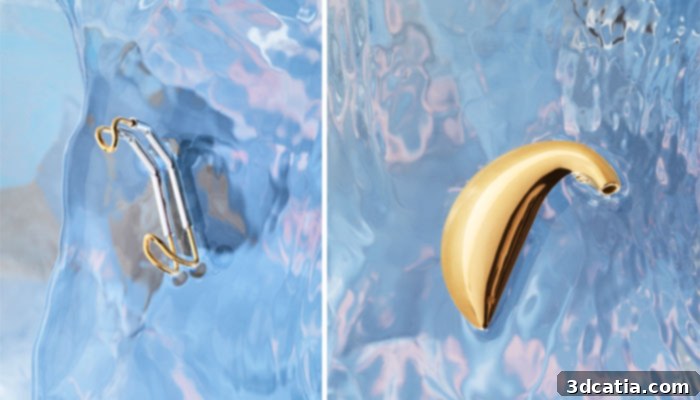
The Pivotal Role of 3D Printing in H(Earring)’s Creation
3DN: Why did you choose 3D printing for this project, and which technologies and materials were most crucial?
F & J: As a design duo, we extensively utilize 3D modeling in our practice. The unparalleled accuracy offered by this digital tool is particularly well-suited to the miniature scale and intricate details of a hearing aid prosthesis. Given this, it was a natural progression for us to integrate 3D printing into our workflow. This additive manufacturing technique proved invaluable, enabling us to rapidly iterate and adjust our models with exceptional efficiency. Working in such close collaboration with Kate, we were able to develop a product that was precisely adapted to her specific needs and exacting requirements. The speed of 3D printing meant that every modification made on a digital model could be quickly translated into a physical prototype, allowing Kate to provide immediate feedback and enabling rapid, informed design adjustments.
To facilitate this intensive prototyping phase, we undertook a residency at the “digital crossroads” within the City of Science and Industry, which boasts an impressive park of 3D printers. Access to these advanced machines was instrumental; it allowed us to swiftly test various volumes and forms, ensuring that each jewel would perfectly cling to the hearing aid. Our initial 3D prints were primarily conducted using PLA (Polylactic Acid) material on Ultimaker 2 and Ultimaker 3 models. We found that white PLA prints were particularly helpful for better visualizing the object’s silhouette when worn, offering a stark contrast that aided in design evaluation compared to black PLA. Given the exceptionally small, thin, and curvilinear nature of our objects, detaching supports from the Ultimaker 2 could be challenging and sometimes risked breaking delicate parts. This led us to predominantly use the Ultimaker 3 for the more complex geometries. Its principle of double extrusion was a game-changer, allowing us to print the support material with a water-soluble filament like PVA. This distinction made it perfectly clear where the support ended and the part began, facilitating easy removal. To expedite the dissolution process of the PVA support, we used warm water, carefully ensuring the temperature did not exceed 30°C to 35°C to prevent any deformation of the delicate PLA prints. A gentle stream of water from the tap helped to dislodge any stubborn residues. Typically, printing times for our prototypes ranged from a mere 20 minutes for simpler pieces to a few hours for more intricate designs, significantly accelerating our development cycle.

For the next stage of prototyping, particularly for pieces intended to be in metal, we employed the ancient technique of lost wax casting, directly utilizing our 3D models. This involved 3D printing the model directly in wax, which was then used to create a ceramic mold. Once the mold was prepared, molten metal was poured in, replacing the wax and solidifying into the final metal component. This crucial second step was essential for rigorously validating the behavior of the metal parts, assessing their comfort against the skin, and confirming the ease of their placement and removal on the hearing aid. For resin components, our moulder could work directly from high-resolution 3D SLS (Selective Laser Sintering) prints. The precision and surface quality of SLS prints meant that the extensive post-impression finishing work often required for FDM (filament-based) prints was largely avoided, streamlining the production of resin prototypes.
The ultimate realization of the H(Earring) collection involved skilled craftsmanship. The final pieces were meticulously produced by a dedicated artisan and a master jeweller, both based in Paris. Every component was carefully assembled, polished to a brilliant finish, and then expertly plated in exquisite gold and rhodium, ensuring both durability and a luxurious aesthetic that truly elevates the hearing aid into a piece of fine jewelry.
The Future of 3D Printing in the Hearing Aid Industry and Beyond
3DN: What do you foresee as the future of 3D printing within the hearing aid industry, and in the broader prosthetic sector?
F & J: We firmly believe that 3D printing holds immense promise for the prosthetic sector as a whole. Its core strength lies in its ability to produce highly personalized objects, allowing for designs to be precisely adjusted to each user’s unique morphology and preferences. The H(Earring) project, while focused on a jewelry collection that attaches to hearing aids, demonstrates this potential. In this specific context, neither the fundamental design nor the technology of the hearing aid itself was modified. Nevertheless, from our perspective as product designers, 3D printing is an incredibly powerful and indispensable tool. It empowers us to materialize our creative visions and detailed drawings almost instantaneously and with extraordinary accuracy. This rapid prototyping capability allows for agile development, enabling us to refine designs based on immediate feedback. In essence, 3D printing transforms us into “craftsmen of 3D,” bridging the gap between digital design and tangible creation, unlocking new frontiers for personalized assistive devices and fashion.
A Final Word: Empowering Individuality Through Design
3DN: Do you have a final message for our readers?
Kate, Flora & Julia: Our H(Earring) jewelry collection is, first and foremost, a thoughtful response to the interests and fundamental needs of users with hearing aids. However, it also serves a deeper, more profound purpose as a political tool. We are determined to harness the incredible power and influence that fashion exerts on public consciousness to fundamentally shift the perception of hearing aids. Our aim is to sublimate these devices, transforming them from something associated with medical necessity into objects of beauty, style, and personal expression, thereby unraveling the stigma and empowering individuals to wear them with pride and confidence.
What are your thoughts on Project H(Earring) and its innovative approach to personalized assistive technology? We invite you to share your perspectives in a comment below or engage with us on our Facebook and Twitter pages! Don’t forget to sign up for our free weekly Newsletter to receive all the latest news and innovations in 3D printing directly in your inbox!