
Revolutionizing Virtual Reality: UC San Diego’s 3D Printed Soft Robotic Haptic Glove Enhances Immersion
Innovation continues to surge from the University of California San Diego, a hub renowned for its pioneering advancements in robotics and additive manufacturing. Just recently, we marveled at their researchers’ ingenious creation: a 3D printed robot capable of navigating diverse terrains with impressive agility. Now, the Jacobs School of Engineering at UC San Diego is once again making headlines, this time by pushing the boundaries of virtual reality (VR) with a groundbreaking soft robotics project. This exciting development centers around a lightweight, 3D printed glove designed to integrate seamlessly with VR, offering an unparalleled level of tactile immersion previously unattainable.
The Immersion Gap: Why Traditional VR Falls Short
For all its visual splendor and auditory depth, the traditional virtual reality experience has long grappled with a significant limitation: the absence of realistic haptic feedback. Most current VR systems rely on “remote-like devices” – handheld controllers that, while functional, often break the illusion of being truly present in a virtual world. Imagine attempting to interact with a digital object, press a button, or grasp an item without any sensation of touch or resistance. This disconnect is precisely what hinders the full potential of VR, making interactions feel artificial and detached.
Jurgen Schulze, a prominent researcher at the Qualcomm Institute at UC San Diego, articulates this challenge perfectly: “You can’t touch anything, or feel resistance when you’re pushing a button. By contrast, we are trying to make the user feel like they’re in the actual environment from a tactical point of view.” This statement underscores the core problem: current VR often neglects the crucial sense of touch, which is fundamental to how humans perceive and interact with their environment. Without haptic feedback, the brain struggles to suspend disbelief, leaving users acutely aware that they are merely holding a controller, not truly inhabiting a virtual space. Bridging this immersion gap is the driving force behind UC San Diego’s latest endeavor.
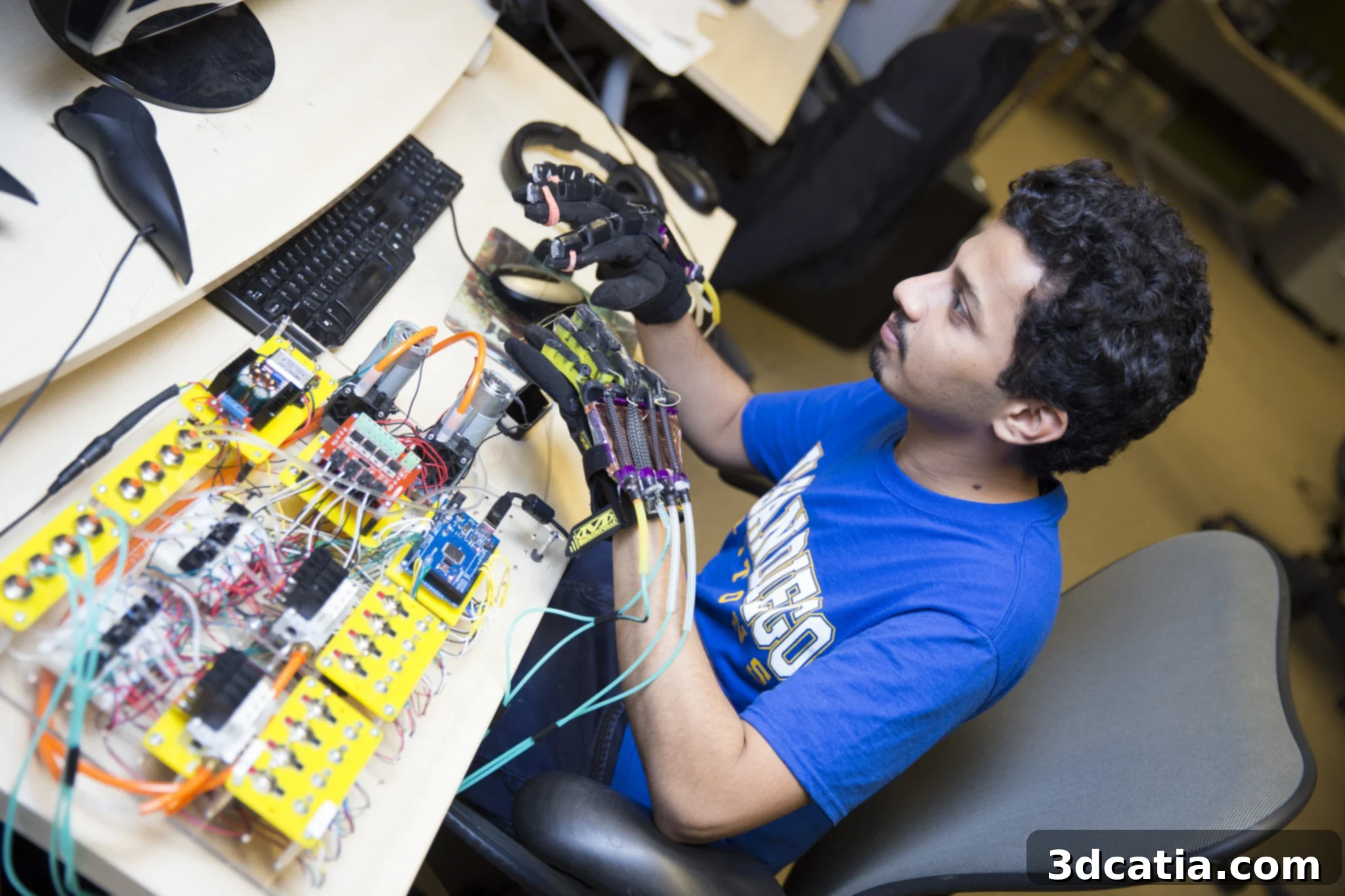
A demonstration of the VR robotic glove at UC San Diego, showcasing its potential for enhanced virtual interaction. Photo// jsoe on Flickr
The Breakthrough: A New Paradigm in VR Interaction with 3D Printing and Soft Robotics
Thanks to the dedication of these pioneering researchers, a new era of VR interaction is on the horizon. They have engineered a novel VR experience that leverages a specialized controller: a glove meticulously crafted using a “McKibben muscle” system. This innovative muscle is composed of “braided fibers” that possess a unique property: they contract and expand, responding much like a spring when force or pressure is applied to them. When inflated with air, these artificial muscles shorten and thicken, providing a precise and adaptable form of haptic feedback directly to the user’s hand and fingers. This mechanical action allows the glove to simulate the feeling of touching virtual objects, providing resistance, and conveying textural information, bringing a new dimension of realism to virtual environments.
The implementation of 3D printing technology was absolutely pivotal in the development of this prototype. To create the glove’s soft exoskeleton – the flexible outer structure that houses the McKibben muscles – the researchers first 3D printed a complex mold. This mold was then used to cast the compliant exoskeleton, enabling the creation of intricate geometries and custom-fit designs that would be difficult, if not impossible, to achieve with traditional manufacturing methods. Integrated seamlessly into this exoskeleton are Velcro straps at the joints, ensuring a secure and comfortable fit for the user while allowing the soft robotic elements to function unimpeded. The beauty of this 3D printed exoskeleton lies not only in its functionality but also in its potential for scalability. This manufacturing approach makes the device significantly easier to create, dramatically reducing production time and costs, and paving the way for eventual mass production and widespread adoption.
Vision and Transformative Applications
The potential applications of this soft robotic VR glove extend far beyond mere entertainment, promising to revolutionize various sectors. As Tolley, a distinguished faculty member in the Contextual Robotics Institute at UC San Diego, eloquently states, “Our final goal is to create a device that provides a richer experience in VR. But you could imagine it being used for surgery and video games, among other applications.” This vision highlights the versatility and profound impact such a device could have. In the realm of gaming, players could finally feel the texture of a virtual object, the impact of a punch, or the resistance of pulling a bowstring, elevating immersion to unprecedented levels.
Beyond leisure, the medical field stands to gain immensely. Imagine surgeons performing delicate remote operations with haptic feedback, feeling the nuances of tissue resistance as if they were physically present. This could significantly improve precision and safety in telesurgery. Rehabilitation could also be transformed, allowing patients to engage in interactive, gamified exercises that provide real-time tactile sensations, accelerating recovery and making therapy more engaging. Furthermore, in training and simulation, from operating complex industrial machinery to practicing emergency procedures in hazardous environments, the glove offers a safe and realistic platform for skill development. Design and engineering professionals could interact with 3D models with tangible feedback, improving prototyping and design validation processes. The possibilities truly are boundless, underscoring the revolutionary nature of this innovation.
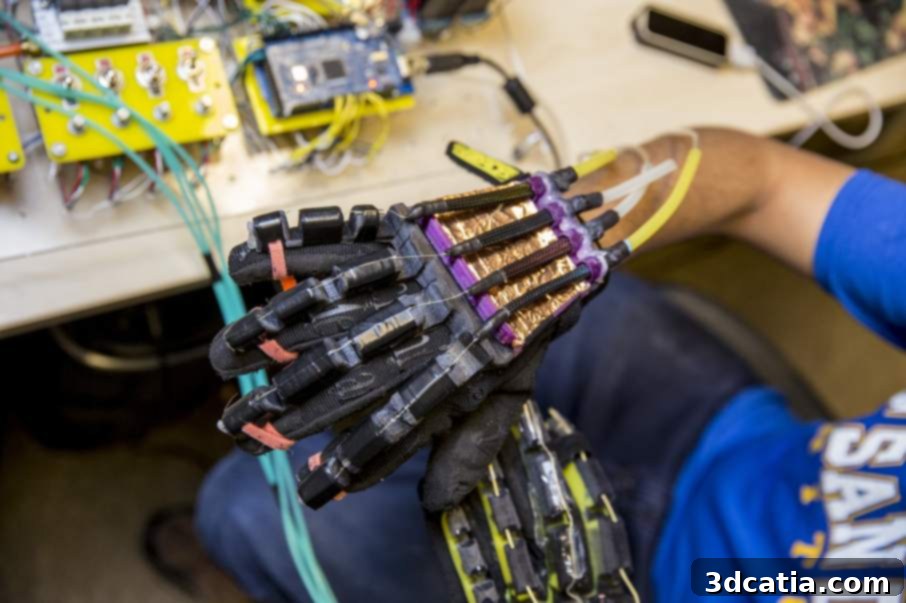
The flexible exoskeleton of the VR glove, critical for its functionality, was meticulously created using advanced 3D printing techniques.
The Engineering Marvel: Soft Robotics Meets Additive Manufacturing
The synergy between soft robotics and additive manufacturing is at the heart of this groundbreaking VR glove. Soft robotics, a subfield of robotics focused on creating robots from highly compliant materials, allows for safer, more adaptable, and more natural interactions with humans and unstructured environments. Unlike rigid, traditional robots, soft robots can deform, bend, and twist, making them ideal for tasks requiring delicate manipulation or close human interaction. The McKibben muscle, a prime example of a soft actuator, epitomizes this approach. Its ability to contract under pneumatic pressure provides a bio-inspired mechanism for generating precise force and motion, mimicking biological muscles.
The role of 3D printing in this context cannot be overstated. Additive manufacturing excels at producing complex, customized geometries with varying material properties within a single component. This capability is perfectly suited for soft robotics, where intricate internal channels for air pressure, variable stiffness sections, and organic shapes are often required. By 3D printing the molds for the soft exoskeleton, the UC San Diego team was able to rapidly iterate on designs, optimize the fit for human anatomy, and create a structure that is both lightweight and durable. This rapid prototyping capability significantly accelerates the research and development cycle, allowing for quicker experimentation and refinement. While still in its prototype phase, this innovation represents a significant leap forward in merging the digital and physical worlds, promising a future where virtual experiences are indistinguishable from reality, thanks to the power of tactile feedback and intelligent design.
The Future of Immersive Technology
The development of this 3D printed soft robotic VR glove at UC San Diego marks a pivotal moment for both virtual reality and human-computer interaction. It demonstrates the immense potential when cutting-edge disciplines like additive manufacturing, soft robotics, and advanced haptics converge. The vision of truly immersive virtual environments is no longer a distant dream but an approaching reality, driven by innovations that make our digital interactions feel as natural and intuitive as our physical ones. This advancement paves the way for a future where the lines between the physical and virtual blur, opening up new possibilities across every facet of life, from how we work and learn to how we play and heal. We eagerly anticipate what other groundbreaking innovations will emerge from UC San Diego as they continue to lead the charge in these transformative fields.
Witness the revolutionary VR glove in action:
For more in-depth information about this incredible robotic VR glove and its technical specifications, you can read further here.
What are your thoughts on this transformative VR glove and its potential impact on immersive technologies? We invite you to share your insights in the comments section below or join the conversation on our Facebook and Twitter pages. And don’t forget to subscribe to our free weekly newsletter, ensuring you receive all the latest news and innovations in the world of 3D printing delivered directly to your inbox!