
Exploring the Future: Top 5 Must-Watch 3D Printing Videos Revolutionizing Industries
The world of additive manufacturing is constantly evolving, pushing the boundaries of what’s possible across a myriad of sectors. From groundbreaking medical applications to advanced solutions in the automotive industry, 3D printing is not just a technology; it’s a transformative force reshaping design, production, and innovation. This week, we’ve meticulously curated a selection of the top five videos that vividly illustrate the profound impact of 3D printing on our society. These compelling visual stories offer a glimpse into the diverse ways this technology is being utilized, demonstrating its versatility and immense potential. Whether you’re a seasoned expert or new to the field, these insights will keep you abreast of the latest developments and inspire you with what’s on the horizon.
Our handpicked videos span a wide array of fascinating topics. We’ll delve into how a highly detailed 3D printed model is revolutionizing security planning for a major event like the Super Bowl, explore the efficiency gains of adopting additive manufacturing for serial production, and understand the critical role of simulation software in optimizing complex 3D prints. Furthermore, we’ll challenge conventional thinking with a look at the future of 3D printed foods in our kitchens and witness a compelling test of HP’s innovative Multi Jet Fusion technology. These captivating explorations highlight not just the capabilities of 3D printing but also its practical benefits, driving efficiency, reducing costs, and enabling unprecedented design freedom. The technology has infiltrated many sectors, from medical to automotive, proving its adaptability and vital contribution to modern progress. For even more immersive content and to stay connected with the cutting-edge innovations in additive manufacturing, be sure to visit and subscribe to our YouTube channel. We hope you enjoy this insightful journey into the future of manufacturing!
Spotlight: Revolutionizing Industries with 3D Printing Videos
1. Enhanced Security Planning: A 3D Printed Model of the Super Bowl
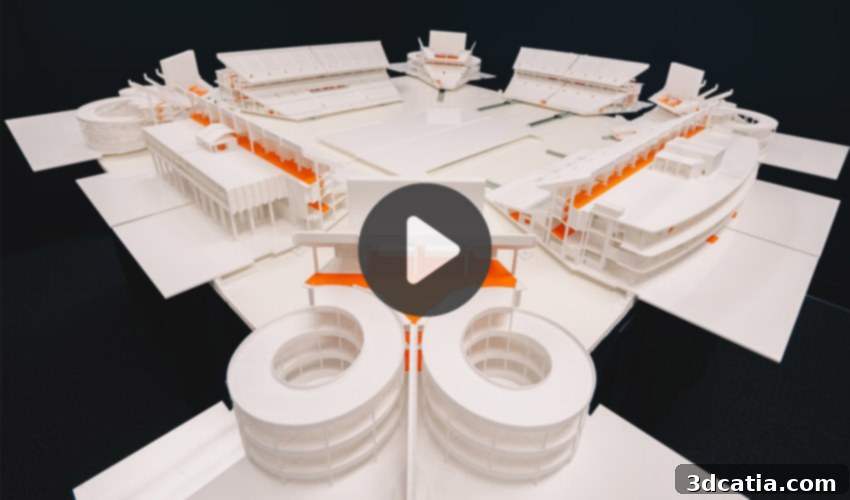
In an extraordinary demonstration of 3D printing’s practical utility, law enforcement agencies are leveraging additive manufacturing to enhance security and logistical planning for large-scale public events. This first video showcases how the Miami-Dade police department, in a remarkable collaboration with Florida International University (FIU), utilized a meticulously crafted 3D printed model of the Super Bowl stadium. This isn’t just a decorative piece; it’s a vital tactical tool that allows officers to visualize and strategize security deployments, emergency response routes, and crowd management with unparalleled precision.
The creation of this highly detailed, large-scale model underscores the power of 3D printing for architectural and topographical representation. Measuring an impressive 4 by 5 feet, the model required approximately 3,500 hours of continuous printing to achieve its intricate detail and scale accuracy. This extensive printing time is a testament to the complexity and sheer volume of data incorporated into the model, ensuring every ramp, entrance, seating section, and surrounding area was accurately replicated. Such a physical, tangible model provides a superior planning aid compared to purely digital maps or blueprints, allowing teams to conduct walk-throughs, identify potential vulnerabilities, and coordinate efforts more effectively in a shared, tactile environment. This innovative application exemplifies how 3D printing is moving beyond mere prototyping, becoming an indispensable tool for critical operational planning and public safety.
2. Unlocking Efficiency: 3D Printing for Serial Production at Carl Zeiss
The transition from traditional manufacturing methods to 3D printing is rapidly transforming how companies approach serial production, particularly for specialized components. Our second featured video highlights Carl Zeiss Optical Components, a globally renowned manufacturer of high-precision instruments including microscopes, multi-sensoric machines, and optical sensors critical for industrial measurement and quality assurance. This segment provides compelling insights into how Zeiss has embraced additive manufacturing to achieve significant gains in operational efficiency and cost reduction.
Traditionally, the production of complex, low-volume parts often involves expensive tooling, long lead times, and significant material waste. Carl Zeiss discovered that by integrating 3D printing into their workflow, they could bypass many of these hurdles. The video illustrates how this strategic shift directly translated into vastly improved lead times and dramatically lowered production costs for specific parts. For instance, a clear example provided is that of alignment tools – essential components that would typically cost around 300€ when produced using conventional methods. With the adoption of 3D printing, the cost for these very same tools plummeted to an astonishing 20€. This remarkable 93% reduction in cost is not just a testament to material efficiency but also to the ability of 3D printing to create complex geometries in a single, streamlined process, eliminating the need for multiple manufacturing steps and specialized jigs. This case study from Carl Zeiss serves as a powerful testament to the transformative potential of additive manufacturing for industrial serial production, enabling companies to be more agile, cost-effective, and innovative in their manufacturing processes.
3. The Imperative of Simulation Software in Additive Manufacturing
While 3D printing offers unparalleled design freedom, successfully translating a digital model into a physical, high-performance part requires meticulous planning and a deep understanding of material behavior during the additive process. Our third video emphasizes the critical role of advanced simulation software in optimizing additive manufacturing workflows, thereby maximizing benefits and minimizing costly errors. The segment features Knust-Godwin, a company that strategically utilizes Dassault Systèmes’ 3DEXPERIENCE platform and the powerful SIMULIA application.
Unlike traditional manufacturing where material properties and processes are often well-established, additive manufacturing introduces complexities such as residual stress, heat-induced warping, and anisotropic material properties that can lead to part deformation or failure if not properly managed. Knust-Godwin’s experience, as shared in the video, illustrates this perfectly. By thoroughly studying a part within the simulation software *before* sending it to the 3D printer, engineers can accurately predict how the material will react during the printing process. This predictive capability allows them to anticipate potential deformations, stresses, and other structural weaknesses. Crucially, they can then implement necessary design modifications or print parameter adjustments *in the digital realm* to counteract these predicted issues, effectively “reversing” or preventing undesirable deformations before any physical material is consumed. This proactive approach not only saves significant time and expensive materials by reducing trial-and-error iterations but also ensures that the final 3D printed part meets stringent performance and quality requirements. Simulation software is thus not just a tool for analysis; it’s an indispensable component for robust design, comprehensive testing, and ultimately, the successful realization of complex additive manufacturing projects.
4. The Culinary Revolution: Could 3D Printed Foods Become the Norm?
When considering the applications of 3D printing, food often emerges as one of the most surprising and, for some, even peculiar concepts. However, our fourth video challenges this perception, presenting a compelling vision for the future of food preparation. Lynette Kucsma from Natural Machines, a pioneer in the field of 3D food printing, eloquently explains the myriad benefits and potential of this innovative technology. While many might initially view 3D food printing as a novelty or an impractical concept, Kucsma strongly disagrees, advocating for its integration into our everyday lives as just another versatile appliance in the modern kitchen.
So, what exactly do food 3D printers offer that traditional cooking methods cannot? The advantages are remarkably diverse. Firstly, they enable unprecedented levels of customization. Imagine preparing meals tailored precisely to individual dietary needs, preferences, or even medical requirements – from precise calorie counts to specific nutrient ratios, or allergen-free options. This is particularly beneficial for hospitals, elderly care homes, or for individuals managing chronic health conditions. Secondly, 3D food printers unlock new avenues for culinary creativity and artistic expression. Chefs can design intricate shapes, complex textures, and personalized aesthetics that would be impossible to achieve by hand, elevating dining to an art form. Beyond aesthetics, the technology also holds promise for sustainability and reducing food waste by utilizing unconventional ingredients or transforming less appealing but nutritious food sources into attractive, palatable dishes. Furthermore, for those living in remote areas or extreme environments, such as astronauts on long space missions, 3D food printing could provide fresh, personalized meals from shelf-stable ingredients. As the technology evolves, its integration into smart homes could simplify meal preparation, making healthy and delicious food more accessible and personalized than ever before. It’s a vision that extends far beyond mere novelty, promising a future where our kitchens are equipped with tools that truly empower our culinary choices.
5. Pushing Boundaries: Testing HP’s Multi Jet Fusion Technology
Our final captivating video puts one of the leading industrial 3D printing technologies, HP’s Multi Jet Fusion (MJF), to a rigorous and visually striking test. The premise is simple yet profound: what happens when a heavy ball is forcefully smashed into wall tiles that have been innovatively structured with different lattice designs, all printed using HP’s Multi Jet Fusion technology? This dynamic demonstration provides an exceptional insight into the strength, resilience, and unique properties achievable through advanced additive manufacturing.
HP Multi Jet Fusion technology operates by fusing powdered material layer-by-layer, utilizing fusing and detailing agents along with an infrared energy source to produce functional, durable parts at speed. One of its standout capabilities, highlighted in this video, is the ability to fabricate intricate lattice structures. Lattice structures are essentially cellular materials or open-celled foams – repeating, three-dimensional patterns designed to optimize a part’s performance. They are notoriously challenging, if not impossible, to achieve with traditional manufacturing methods due to their complex internal geometries and the need for precise material deposition. However, additive manufacturing, and specifically MJF, excels at creating these structures with ease.
The power of lattice structures lies in their ability to impart a surprising number of enhanced properties to a component, directly influenced by their specific design. Depending on how they are engineered, lattices can significantly reduce weight while maintaining or even increasing strength, improve energy absorption (as seen in impact tests like this one), enhance thermal management, or customize stiffness and flexibility. In the context of the video’s impact test, the different lattice designs within the wall tiles demonstrate varying degrees of resistance and energy dissipation when struck by the heavy ball. This visually compelling experiment showcases how MJF technology, combined with intelligent lattice design, can engineer materials with tailor-made mechanical properties, opening up vast possibilities for lightweight components in automotive and aerospace, protective gear, advanced consumer products, and architectural elements where impact resistance and structural integrity are paramount. It’s a powerful testament to how 3D printing is not just fabricating objects, but engineering material performance from the inside out.
We trust you found this week’s exploration of the TOP 5 3D printing videos both insightful and inspiring! The rapid advancements in additive manufacturing continue to reshape industries and everyday life in exciting new ways. We’d love to hear your thoughts on these innovations – perhaps you have a favorite, or a particular application that resonated with you. Please feel free to drop a comment below and share your insights with our community. Don’t forget to connect with us on our social media channels; you can find us on Facebook and Twitter for daily updates and engaging discussions. To ensure you never miss out on the latest breakthroughs, trends, and news from the dynamic world of 3D printing, remember to sign up for our free weekly Newsletter. Get all the essential updates delivered straight to your inbox, keeping you at the forefront of additive manufacturing innovation!