
SEAT’s Additive Manufacturing Journey: Driving Automotive Innovation with 3D Printing
The synergistic integration of 3D printing, also known as additive manufacturing, with automotive production has undeniably proven to be a transformative force. Across the globe, a growing number of automotive companies are not merely experimenting with but actively embracing additive manufacturing as an indispensable component of their advanced production processes. Esteemed industry leaders such as BMW and General Motors have made substantial commitments, establishing dedicated centers focused on leveraging 3D printing for the creation of various vehicle components. While this trend has seen significant traction in the USA, its momentum is increasingly palpable across Europe as well. SEAT, a renowned Spanish car manufacturer celebrated for its innovative spirit and engineering prowess, recently announced the inauguration of its own dedicated 3D printing center. This strategic move aims to significantly enhance its production capabilities, streamline its development cycles, and integrate cutting-edge additive technologies more deeply into its operations. To gain a deeper understanding of how this prominent European automaker is harnessing the potential of additive manufacturing, we had the distinct opportunity to conduct an exclusive interview with a key member of their expert team, delving into their current applications, future visions, and the unique challenges and advantages they encounter.
3DN: Could you please introduce yourself briefly and share insights into your journey into the world of 3D printing?

My name is Marc Travesset, and I am a chemical engineer proudly based in the vibrant city of Barcelona. My introduction to the captivating realm of 3D printing dates back to my university days in 2007. During a particularly enlightening visit to Ascamm, an institution now recognized as Eurecat, I encountered a truly fascinating piece of machinery. This device utilized lasers to precisely fuse plastic powder, layer by layer, into complex three-dimensional objects. At that moment, it struck me as nothing short of a “magic machine.” Although my initial career path led me to explore other intriguing fields, specifically membrane technologies and the production of epoxy resins, the profound impression left by that additive technology never truly faded. The memory lingered, a latent interest waiting for the right moment to re-emerge. Years later, that moment arrived when I encountered the very same technology at SEAT, where I was working as the person responsible for the rapid development and production of prototype parts. It was at this juncture that my deep passion for 3D printing truly ignited. Since 2018, I have been incredibly fortunate to actively engage with these transformative technologies on a daily basis, allowing me to deepen my understanding and expertise in the subject. My perspective on 3D printing is perhaps a bit unique; I may not fit the conventional profile of a hobbyist “Maker.” Instead, my professional focus has always been firmly directed towards exploring and maximizing the immense industrial possibilities that additive manufacturing offers, particularly within the demanding environment of automotive production. My goal is to integrate these tools seamlessly into our workflows, driving efficiency and innovation.
3DN: When did SEAT make the strategic decision to integrate 3D printing into its core processes, and how has that journey evolved?
At SEAT, our commitment to leveraging the power of 3D printing spans over two decades. For more than 20 years, we have been strategically incorporating additive manufacturing into various facets of our operations, particularly within the critical domain of product development. In the highly complex and iterative world of automotive product design and engineering, flexibility is not merely an advantage; it is an absolute necessity. The ability to rapidly iterate, test, and refine designs is paramount to staying competitive and delivering high-quality vehicles to market. We are incredibly fortunate that, at SEAT, we possess the in-house capability to swiftly validate new concepts and achieve significant milestones in our development journey with unparalleled speed and unwavering confidence. This agility, largely facilitated by our extensive use of 3D printing, allows us to reduce lead times, minimize costly errors, and bring innovative ideas from concept to tangible reality much faster than traditional manufacturing methods would allow. Over these two decades, we’ve seen the technology evolve dramatically, from primarily being used for simple visual prototypes to its current applications in functional testing, advanced tooling, and even certain end-use components, continually expanding its impact on our efficiency and innovation.
3DN: What specific 3D printing projects and applications are you currently focused on at SEAT?
Our current portfolio of 3D printing projects at SEAT is diverse and continually expanding, touching upon several strategic areas that drive innovation, efficiency, and sustainability. As highlighted in a compelling presentation by Felip Fenollosa, Director of CIM at the Technical University of Barcelona and an esteemed Industrial Engineer, the multifaceted benefits of additive manufacturing—particularly its inherent flexibility, adaptability, and contributions to sustainability—are central to our approach. Flexibility, in particular, has consistently proven to be an extraordinary advantage, allowing us to achieve significant milestones in both product development and vehicle launch phases, building upon our extensive experience in rapid prototyping. This agility is crucial for navigating the fast-paced automotive market. To further maximize this critical capability, we initiated a comprehensive study in close collaboration with EURECAT and RMS, under the umbrella of CIAC (Competence Center for Automotive Industry of Catalonia). This collaborative effort specifically explored the innovative use of 3D printed components as a proactive measure to mitigate and prevent future supply chain bottlenecks, a lesson sharply learned from recent global disruptions. By identifying critical parts that could be produced on-demand using additive manufacturing, we aim to enhance our resilience and reduce dependency on lengthy or vulnerable supply chains.
In terms of customization, one of our most successful and ongoing applications has been the design and creation of numerous bespoke assembly and test fixtures. These custom tools are vital for ensuring precision and quality throughout our manufacturing processes. Unlike traditionally manufactured fixtures, 3D printed versions can be rapidly designed, iterated, and produced to perfectly match specific, often complex, component geometries or assembly requirements. This not only enhances ergonomic considerations for our workforce but also significantly improves the accuracy and repeatability of critical operations, ultimately boosting overall production quality and efficiency. Moving forward, our ambitious aim is to delve even deeper into this realm of highly customized industrial tooling, exploring new materials and advanced designs to take the next significant leap forward in optimizing our assembly lines and testing procedures.
Furthermore, in the critical context of sustainability, additive manufacturing presents a unique and powerful opportunity. By harnessing the virtually limitless design possibilities offered by 3D printing, we are actively working to create lighter vehicle components. Generative design algorithms, when paired with additive processes, allow engineers to optimize part geometries for minimal material usage while maintaining or even enhancing structural integrity. This direct approach to lightweighting directly translates into reduced vehicle weight, which in turn leads to improved fuel efficiency and lower emissions – tangible environmental benefits that align with SEAT’s broader sustainability goals. Currently, we are actively conducting rigorous trials in this area, rigorously testing new materials and designs to validate their performance and durability. Our objective is to successfully integrate these innovative, lightweight 3D printed components into future vehicle models, further enhancing our comprehensive sustainability efforts and contributing to a greener automotive industry. This holistic approach ensures that 3D printing serves not just as a tool for efficiency, but also as a powerful enabler for environmental responsibility.
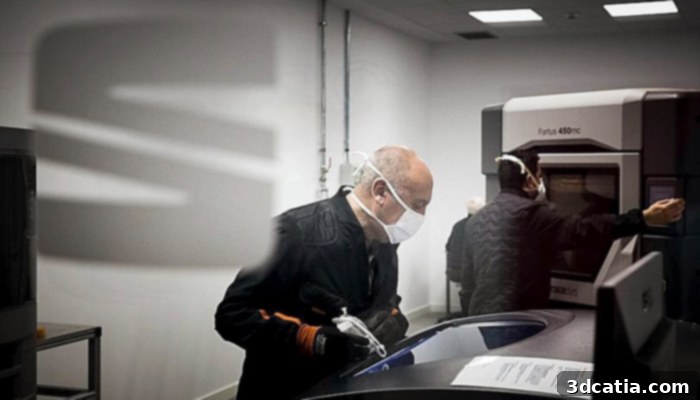
Photo credits: SEAT
3DN: What are the primary advantages and existing limitations of additive manufacturing in the automotive sector?
The automotive industry, characterized by its demand for constant innovation and rapid development cycles, derives immense benefits from the inherent flexibility and agility offered by 3D printing technologies. One of the most significant advantages is the unprecedented speed of iteration. The ability to obtain an assemblable and fully testable part within a single week brings substantial value to our product development and validation processes. This rapid turnaround significantly compresses timelines, allowing engineers to quickly validate designs, identify potential issues, and implement necessary modifications with remarkable efficiency. Furthermore, when additive manufacturing is skillfully combined with other conventional technologies, such as precision machining, we gain the capability to acquire a diverse range of high-quality tooling solutions suitable for nearly any application on the production line, from jigs and fixtures to specialized prototypes.
However, it is equally important to acknowledge the current limitations that still temper the widespread adoption of these technologies, especially in high-volume production scenarios. A key challenge is the relatively high cost associated with additive manufacturing materials. Specialized polymers, metals, and composites used in 3D printing often come at a premium compared to their counterparts in traditional injection molding or stamping processes. This cost factor can significantly impact the overall unit economics, making it less favorable for mass-produced components. Additionally, the productivity of additive manufacturing, measured by throughput and build speed, generally remains lower when compared to conventional manufacturing methods designed for economies of scale. While advancements are being made continuously, the cycle times for producing a significant volume of parts via 3D printing are often considerably longer than those of traditional techniques. Consequently, as of now, it remains largely unlikely that these technologies will be extensively employed for the direct mass production of millions of identical parts for consumer vehicles. Their true strength lies in prototyping, custom tooling, small-batch production, and parts with highly complex geometries where traditional methods are cost-prohibitive or impossible.
3DN: How do you envision the future of 3D printing within the dynamic automotive industry?
Looking ahead, the future of 3D printing in the automotive industry is incredibly promising, poised for substantial growth and deeper integration. First and foremost, it is absolutely crucial that all stakeholders and players across the entire automotive sector gain a comprehensive understanding of the immense potential that additive manufacturing offers us. The automotive industry is a colossal global enterprise, and within such a vast ecosystem, any improvement, regardless of how minor it may initially appear, has the capacity to create a profoundly significant impact on efficiency, cost, and sustainability. With 3D printing, we are afforded the unprecedented flexibility to implement small design changes or functional improvements almost immediately. This rapid iteration capability reduces development cycles, mitigates risks, and allows for agile responses to market demands or unforeseen challenges. As additive materials become increasingly sophisticated and robust, and as printing processes grow more powerful, precise, and repeatable, we will unlock even greater value from these technologies throughout the entire product lifecycle of a vehicle. This includes everything from early-stage conceptualization and prototyping to the production of specialized spare parts and highly customized components. We anticipate a future where 3D printing enables further lightweighting, highly personalized interior and exterior components, and localized, on-demand manufacturing that dramatically streamlines supply chains and reduces environmental footprints. The continuous advancements in multi-material printing, large-format systems, and artificial intelligence-driven design optimization will only accelerate this transformation, making 3D printing an even more indispensable tool for automotive innovation.
3DN: Do you have any final words or a message you’d like to share with our readers?
As an automotive company deeply committed to innovation and efficiency, we frequently leverage 3D printing for a myriad of our internal processes, from design validation to the creation of advanced manufacturing aids. I often recall Steve Jobs’ profound observation that the best technology is often invisible; it simply works seamlessly in the background, making our lives better without drawing attention to itself. In a similar vein, many of the contributions of 3D printing to modern automotive production occur behind the scenes, yet their impact is undeniably transformative. Therefore, I would strongly encourage all of your readers, whether they are engineers, designers, enthusiasts, or just curious minds, to continuously look for and think critically about novel ways to improve our collective lives, our products, and our industries with these truly “magic machines” that are reshaping the boundaries of what is possible. Their potential is far from fully realized, and the next great application could come from anyone with an inquisitive mind.
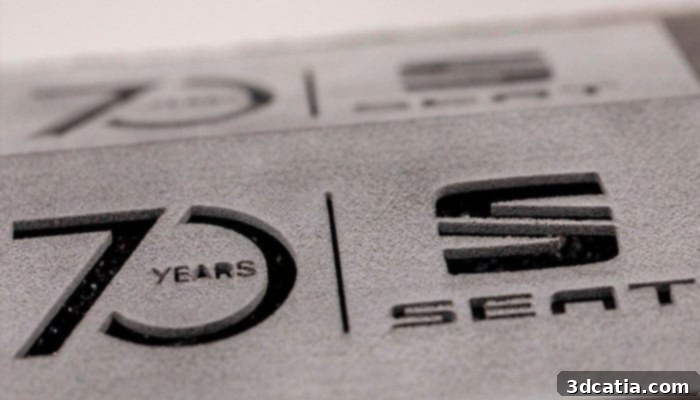
Photo credit: SEAT
What are your thoughts on SEAT’s innovative approach to integrating 3D printing into their automotive manufacturing processes? We’d love to hear your perspectives! Please feel free to let us know your opinions and insights in a comment below or join the discussion on ourLinkedIn,Facebook, andTwitter pages! Don’t forget to sign up for our free weeklyNewsletter here to receive the very latest 3D printing news, delivered straight to your inbox! You can also find all our compelling videos and expert interviews on ourYouTube channel, offering a visual dive into the world of additive manufacturing.
*All Photo credits: SEAT