
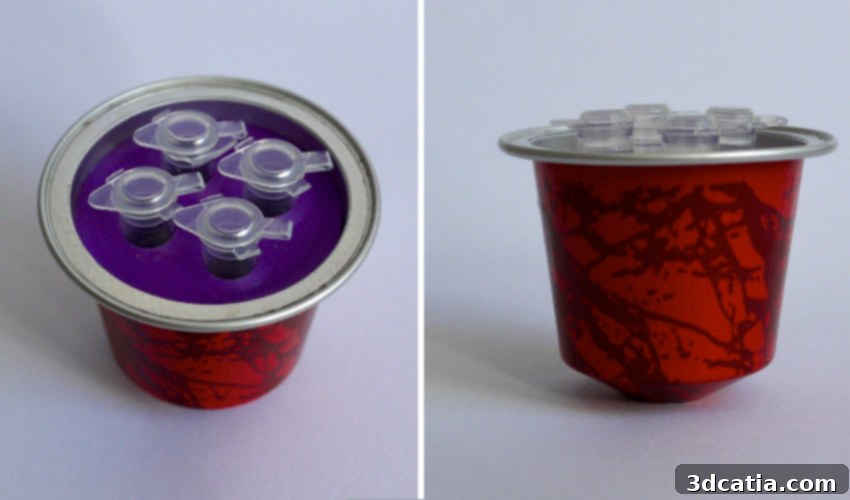
CoroNaspresso: Revolutionizing Affordable COVID-19 Testing with 3D Printing and Coffee Capsules
Imagine performing a reliable COVID-19 test using something as ubiquitous as an empty coffee capsule and a simple pan. This ingenious concept, born from the mind of a visionary scientist at Wageningen University in the Netherlands, aimed to drastically cut the prohibitive costs associated with conventional COVID-19 detection methods available on the market. By repurposing an aluminum coffee capsule, this researcher transformed an everyday household item into a compact chemical reactor, paving the way for a truly accessible diagnostic solution. What makes this innovation particularly compelling for us is the integral role of 3D printing: a custom-designed plastic holder, capable of securing four test tubes, was manufactured using additive manufacturing technology. Dubbed “CoroNaspresso,” this novel screening approach holds immense promise for scaling up daily testing capacities while simultaneously simplifying the entire diagnostic process. With an estimated cost of merely 24¢ (0.20€) per test, it represents a remarkable leap towards widespread, decentralized pandemic response.
Dr. Vittorio Saggiomo, an Italian chemist affiliated with the Bionanotechnology group at Wageningen University, initiated this project last March amidst the global health crisis. His primary motivation stemmed from the inherent challenges of centralized PCR testing. He articulated a crucial need for screening methods to evolve, becoming both easier to perform and significantly more affordable, thereby enabling mass production and broader accessibility. To achieve this, Saggiomo turned to loop-mediated isothermal amplification (LAMP), a well-established yet underutilized low-cost technique renowned for detecting various diseases. The beauty of LAMP lies in its simplicity: it operates effectively at a constant temperature of 65°C (149°F), eliminating the need for complex and expensive laboratory equipment. The mechanism is elegantly straightforward: a saliva sample is heated, and specific pH indicators cause a noticeable color change if the Sars-CoV-2 virus is present. Dr. Saggiomo vividly illustrates the outcome, explaining, “The color change is very striking: negative samples are pink and positive ones are yellow.” However, the critical hurdle remained: how to maintain this precise constant temperature outside a sophisticated lab environment while keeping the entire system inexpensive and user-friendly? This question was at the heart of the CoroNaspresso design.
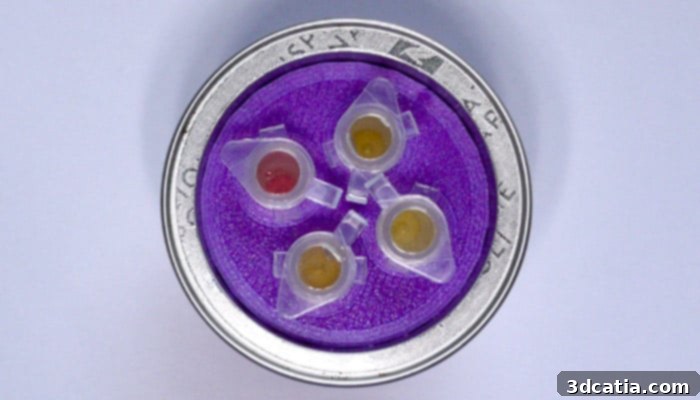
Positive test results are clearly indicated by a distinct yellow color (photo credits: Vittorio Saggiomo)
CoroNaspresso: Merging Everyday Objects with Cutting-Edge Innovation
The Ingenious Role of the Coffee Capsule and Phase Change Material
This is precisely where the humble coffee capsule enters the narrative as a pivotal component. Reimagined from its original purpose, an empty aluminum coffee capsule serves as the miniature reactor, perfectly sized to be immersed into a pot of boiling water. The brilliance of this design lies in what the capsule contains: a specific phase change material (PCM), identified as RT64HC. This specialized wax possesses a unique property – it melts precisely within a narrow temperature range of 63 to 65°C (145.4-149°F). The selection of RT64HC was not arbitrary; it is an incredibly cost-effective material, retailing at approximately €13 or $15 per kilogram. Its melting and subsequent solidification process, which is key to maintaining the constant temperature required for the LAMP reaction, takes roughly 25 minutes when using 5 grams of the wax in 1 liter of water. This mechanism ensures that the internal temperature for the samples remains stable at the optimal 65°C, providing the ideal conditions for accurate viral detection without the need for complex electronics or precise temperature controls typically found in laboratory settings. This innovative application of a PCM within a repurposed coffee capsule is a testament to Saggiomo’s resourcefulness and commitment to creating truly decentralized diagnostic tools.
3D Printing: Enabling Decentralization and Mass Production
Complementing the coffee capsule’s role, a custom-designed, 3D-printed holder secures the four tubes, each containing 200µl of saliva samples, within the capsule’s temperature-regulated environment. While specific intricate details regarding the 3D printing process are minimal, it has been confirmed that Polylactic Acid (PLA) was the material of choice. PLA is a biodegradable thermoplastic commonly used in desktop FDM (Fused Deposition Modeling) 3D printers, making the production of this component highly accessible. The simplicity of the part’s design means that virtually anyone with a home FDM 3D printer could fabricate it, further emphasizing the project’s commitment to decentralization and ease of adoption. The decision to leverage additive manufacturing was multi-faceted. Firstly, it perfectly aligns with the project’s core philosophy of ease of use and execution, allowing for rapid prototyping and iteration of the design. Secondly, for potential mass production, 3D printing offers unparalleled advantages. Given the holder’s compact size and straightforward geometry, dozens of these essential components could be printed in a single batch, facilitating widespread distribution and utilization should the CoroNaspresso system be scaled up. This synergy between a common household item, an inexpensive phase change material, and accessible 3D printing technology embodies the spirit of innovative, low-cost medical solutions.
Emphasizing Sustainability and Future Impact
Dr. Saggiomo has also placed a strong emphasis on the environmental sustainability of his CoroNaspresso test. He highlights that the system generates remarkably little waste, a stark contrast to the often-disposable nature of many medical diagnostics. He asserts, “The same capsule can be used several times, without generating unwanted waste. At the end of its life cycle, the aluminum can be recycled, the kerosene burned and the 3D printed plastic biodegraded.” This reusability significantly reduces the ecological footprint of repeated testing. However, it is crucial to note that while PLA is biodegradable, it requires specific industrial composting conditions to fully break down. It should not be simply discarded into nature, as this would not lead to proper biodegradation. Despite this nuance, the overall design significantly minimizes waste compared to single-use alternatives, contributing to a more environmentally conscious approach to public health. The ability to recycle the aluminum capsule and the potential for proper disposal of the PLA holder underscores a holistic view of the product’s life cycle, moving towards circular economy principles even in medical diagnostics.
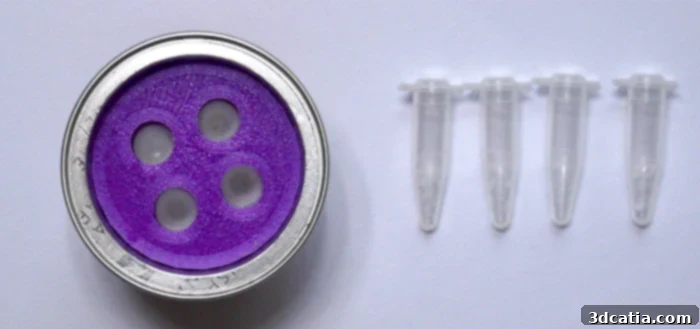
The CoroNaspresso test is designed to generate minimal waste, promoting sustainability (photo credits: Vittorio Saggiomo)
Ultimately, Vittorio Saggiomo harbors strong hopes that his CoroNaspresso project will advance beyond the conceptual and prototype stages to full-scale production. He is deeply convinced that this innovative approach could fundamentally transform COVID-19 screening by enabling truly decentralized testing, bringing diagnostic capabilities closer to individuals and communities. This would alleviate pressure on central laboratories, reduce turnaround times, and make testing more accessible to populations in remote areas or those with limited resources. The potential for a widely available, low-cost home test has profound implications for pandemic management, allowing for earlier detection, more effective contact tracing, and a greater sense of personal control over health. To further this cause and invite broader adoption and development, the chemist has transparently published the detailed manufacturing steps of his groundbreaking reactor, making the blueprints available to the global scientific and maker communities HERE. This open-source philosophy underscores the collaborative spirit essential for addressing global health challenges, fostering innovation and rapid deployment of life-saving technologies.
The CoroNaspresso test embodies a powerful fusion of resourcefulness, scientific innovation, and accessible technology, demonstrating how simple, everyday objects can be reimagined to solve complex global problems. By offering an affordable, easy-to-use, and sustainable solution for COVID-19 detection, Dr. Saggiomo’s work at Wageningen University not only addresses an immediate public health need but also sets a precedent for future decentralized diagnostics. This approach could be replicated for various other infectious diseases, empowering individuals and communities with rapid, accurate, and localized testing capabilities, fundamentally altering the landscape of public health responses. This truly represents the democratization of diagnostics, making critical health information more readily available to everyone, everywhere. Would you be willing to adopt and utilize this innovative CoroNaspresso COVID-19 test? We invite you to share your thoughts and perspectives in a comment below, or engage with us on our Facebook, Twitter, andLinkedIn pages! For the latest advancements and news in the world of 3D printing and additive manufacturing, sign up for our free weeklyNewsletter here, delivered straight to your inbox.