
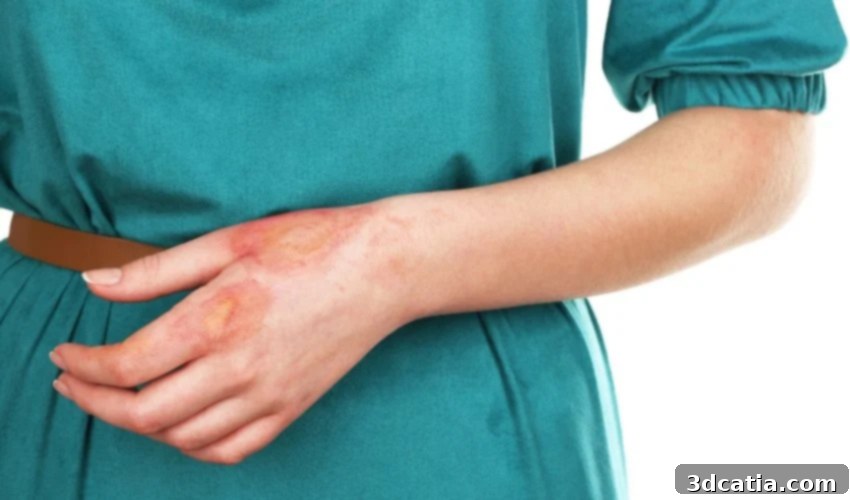
Revolutionizing Burn Treatment: 3D Bioprinting and Stem Cells from Burned Skin Offer New Hope
Burns continue to pose a devastating global health crisis, responsible for approximately 180,000 deaths annually, as reported by the World Health Organization (WHO). For the hundreds of thousands who survive, severe burns, particularly those affecting extensive areas of the body, represent one of modern medicine’s most profound and persistent challenges. Current standard treatments predominantly involve skin grafting, a procedure where healthy tissue is surgically harvested from a donor site on the patient’s own body to cover the wounds. However, this approach faces severe limitations, especially in cases of massive burns where finding enough healthy donor skin becomes practically impossible. Survivors often grapple with a myriad of debilitating long-term consequences, including disfiguring scarring, chronic pain, restricted mobility, increased susceptibility to infections, and significant psychological trauma, all of which severely impact their quality of life. In this critical context, a groundbreaking and innovative technique, powered by the synergy of 3D bioprinting and advanced stem cell culture, is emerging as a beacon of hope, poised to revolutionize the treatment of extensive burn injuries.
A significant milestone in this new era of burn care is set for early 2025, when the distinguished Centre for Burn Research at the Hamilton Health Sciences (HHS) hospital network in Canada will embark on a pioneering Phase 1 clinical trial. This trial is designed to meticulously evaluate the safety and initial effectiveness of a truly novel therapeutic strategy: utilizing stem cells specifically extracted from the patients’ own burned skin. This groundbreaking method promises to regenerate damaged tissue without the traditional and often restrictive reliance on healthy donor skin, a development that researchers believe will fundamentally transform the treatment paradigm for extensive burns worldwide. These powerful stem cells, once thought to be compromised or non-viable within burned tissue, will be carefully isolated, expanded, and then formulated into a specialized biological ink. This bio-ink will then be used in conjunction with a 3D bioprinter to construct and deliver new, functional skin directly onto the wound site, promoting unprecedented healing and regeneration.
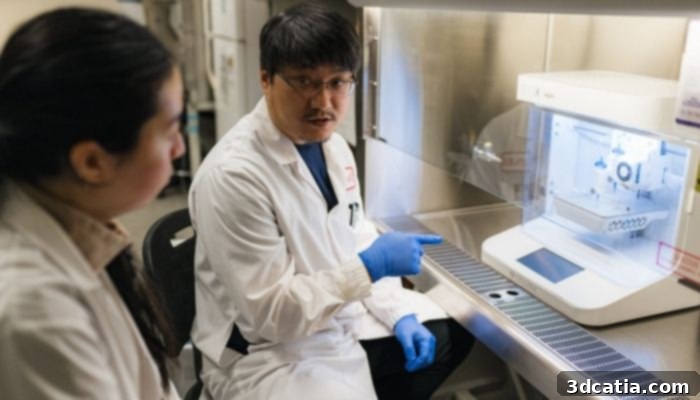
The pioneering study at Hamilton Health Sciences will utilize advanced bio-inks, meticulously composed of stem cells derived from burned tissue, to bioprint and regenerate new, functional skin. (Photo credits: Hamilton Health Sciences)
A Serendipitous Discovery: Unlocking Regenerative Potential in Burned Tissue
The genesis of this revolutionary approach began in a most unexpected fashion, rooted in an accidental yet pivotal discovery that shifted long-standing medical assumptions. Several years ago, during a routine surgical procedure at a Toronto hospital, a laboratory technician inadvertently mistook samples of severely burned skin for healthy tissue. Proceeding with the standard protocol, the technician attempted to extract viable stem cells from these mistaken samples. To the astonishment of everyone involved, the extraction was successful, yielding functional stem cells. This unforeseen error unequivocally demonstrated a profound truth: contrary to deeply entrenched medical dogma, even tissue profoundly damaged by burns retained viable stem cells with regenerative capabilities.
This serendipitous finding served as a powerful catalyst, igniting a dedicated and focused research program spearheaded by the esteemed Dr. Marc Jeschke. The groundbreaking results of this research were subsequently published in 2018, marking a significant scientific milestone. Dr. Jeschke’s team rigorously proved that these stem cells, derived directly from the patients’ own burned tissue, were not only viable but also remarkably effective in promoting and accelerating wound healing in preclinical animal models, including mice and pigs. This discovery shattered previously held paradigms, as burned tissue had historically been regarded as biologically inert and “disposable” material, devoid of regenerative potential. The realization that this abundant, readily available source of potent regenerative cells could be harvested directly from the site of injury opened up entirely new and unprecedented avenues for therapeutic development in burn medicine.
The Science Behind the Breakthrough: How 3D Bioprinting and Bio-Inks Work
At the heart of this innovative treatment lies the sophisticated integration of 3D bioprinting technology with specially engineered bio-inks. 3D bioprinting represents an advanced form of additive manufacturing, specifically tailored to work with biological materials, such as living cells, growth factors, and biocompatible gels, to fabricate functional tissues and, potentially, even organs. Unlike conventional 3D printing which uses inert materials like plastics or metals, bioprinters meticulously deposit layers of biological material, precisely following a digital blueprint to construct complex, multi-layered biological structures. For the purpose of skin regeneration, this cutting-edge technology allows for the precise recreation of the intricate architecture of natural skin, encompassing both the epidermis and dermis, with unparalleled accuracy and patient-specific customization.
The process begins with a small biopsy of the patient’s burned skin, from which these newly identified viable stem cells are carefully isolated and expanded in a controlled laboratory environment. Once a sufficient quantity of these pluripotent cells has been cultured, they are combined with a specialized, biocompatible hydrogel. This hydrogel serves a dual purpose: it acts as a supportive scaffolding for the cells, providing the necessary microenvironment for their viability, and it also functions as the carrier medium for their precise delivery. This cellular suspension forms the “bio-ink.” The 3D bioprinter then precisely extrudes and deposits this bio-ink, layer by layer, directly onto the patient’s wound bed. Essentially, it “prints” new, living skin in situ, directly where it’s needed. This revolutionary method offers numerous advantages over traditional skin grafting techniques: it enables the creation of customized skin constructs that perfectly conform to the unique contours of the patient’s wound, drastically minimizes or even eliminates the need for healthy donor sites, and critically, holds the potential to significantly reduce complications such as infection, scarring, and contractures by promoting a more natural and accelerated healing process.
The Clinical Trial: Paving the Way for Global Burn Care Transformation
Emphasizing the profound significance of this impending research, Dr. Marc Jeschke, Ph.D., who holds the distinguished positions of Vice President of Research and Chief Scientific Officer at HHS, shared his immense anticipation: “With the launch of the Phase 1 clinical trial, our lab will be the first in the world to treat patients using stem cells taken from their burned skin to help them heal.” This powerful statement underscores the pioneering nature and the truly global impact potential of the Hamilton Health Sciences’ initiative. The initial Phase 1 trial has been meticulously designed to enroll 20 carefully selected patients, all of whom have burns covering less than 20% of their total body surface area. This conservative patient selection is a standard and critical approach for early-stage clinical trials, prioritizing the thorough assessment of the safety and tolerability of the novel stem cell-based treatment before wider application.
The primary objectives of this crucial trial are multifaceted and ambitious. Researchers aim to thoroughly evaluate how stem cells derived from a patient’s own burned tissue can significantly accelerate the wound healing process, leading to faster closure of burn sites. Perhaps even more importantly, the trial will focus on effectively reducing the incidence and severity of scarring, including hypertrophic scars and contractures, which are pervasive and often debilitating complications of severe burn injuries. Beyond mere cosmetic improvement, a reduction in scarring promises enhanced functional outcomes, increased mobility, and a profound improvement in the overall quality of life for burn survivors. If these initial results prove positive, demonstrating both the safety and efficacy of the treatment, this revolutionary technique holds the potential to be incrementally expanded in subsequent trial phases to treat patients suffering from even more extensive and life-threatening burns, truly redefining the future of burn care on a global scale.
The broader implications of this groundbreaking research extend far beyond the immediate treatment of burns. Success in regenerating functional skin using a patient’s own previously “discarded” tissue could herald a new era in personalized regenerative medicine, influencing approaches to chronic wound healing, complex reconstructive surgeries, and potentially even the development of more accurate in vitro models for drug testing. It embodies the pinnacle of personalized medicine, where treatments are precisely tailored to the individual patient, minimizing risks of immune rejection, accelerating recovery, and maximizing regenerative potential with an abundant, self-sourced material. For those keenly interested in following this pivotal research and staying informed about the trial’s progress and results, comprehensive information is available on the official Hamilton Health Sciences website. You can explore more details and keep a close eye on these transformative developments by visiting their official page HERE.
Join the Conversation: Your Thoughts on the Future of Burn Treatment
What are your thoughts on this monumental study, which promises to profoundly change existing burn treatment paradigms through the innovative application of 3D bioprinting and autologous stem cell therapy from burned tissue? We eagerly encourage you to share your insights, questions, and predictions regarding these incredible advancements in the comments section below. Your unique perspective is invaluable as we collectively witness the unfolding of these exciting developments in medical science and regenerative medicine. Stay connected with the very latest in 3D printing and medical innovation by joining our vibrant community online. You can find us and actively engage in discussions on our LinkedIn, Facebook, and Twitter pages! Don’t miss out on any essential updates – make sure to sign up for our free weekly Newsletter here to receive the freshest and most impactful 3D printing news delivered directly to your inbox. Additionally, immerse yourself further in our comprehensive video content by visiting our dedicated YouTube channel, where you can explore a wealth of information on additive manufacturing and its transformative applications across various industries, including healthcare.