
Mastering Resin 3D Printing: A Comprehensive Guide to Choosing the Right Resin
Congratulations! If you’re reading this, you’ve likely joined the exciting world of resin 3D printing by acquiring your first machine. While the printer itself is a marvel of technology, another element is equally, if not more, crucial to the success and quality of your prints: the 3D printing resin you choose. The right resin isn’t just a consumable; it’s the very foundation of your creation, dictating everything from print resolution and surface finish to mechanical strength and final application suitability. This guide will walk you through the essential factors for selecting the perfect photopolymer resin for your projects, ensuring you achieve the best possible results every time.
So, what exactly is a 3D printing resin? Unlike FDM (Fused Deposition Modeling) filaments, which come in solid spools, resins are liquid photopolymers. They are typically stored in opaque bottles or cartridges to prevent premature curing. These specialized liquids are the core material used in vat photopolymerization processes, which include popular technologies like SLA (Stereolithography), DLP (Digital Light Processing), and MSLA/LCD (Masked Stereolithography / Liquid Crystal Display). In these methods, a UV light source precisely cures layers of the liquid resin, transforming it into a solid 3D object, layer by painstaking layer. The chemical composition of each resin determines its unique properties, making the selection process pivotal.
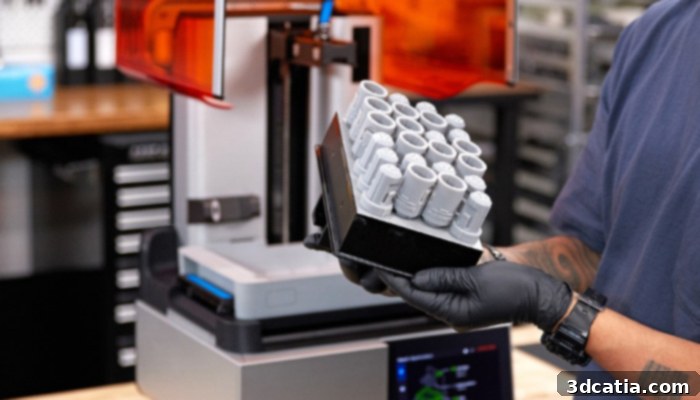
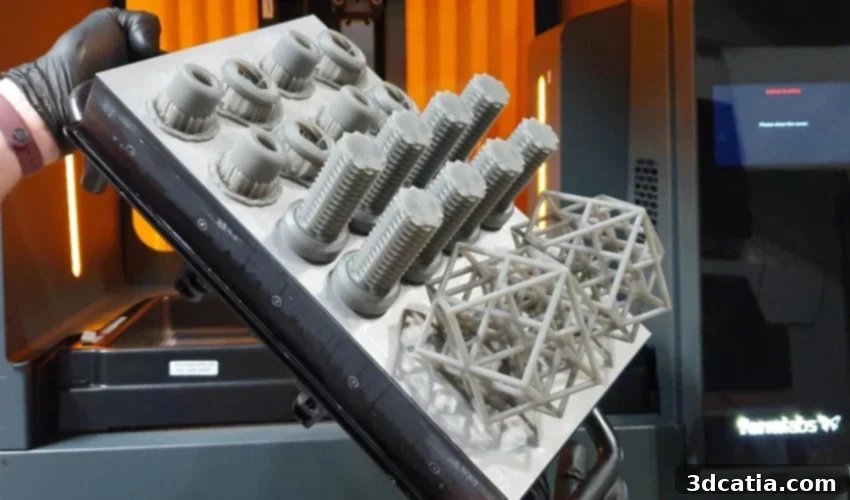
Resin 3D printing (also known as vat photopolymerization) enables the creation of highly detailed parts (photo credits: Formlabs)
Understanding the Diverse Landscape of 3D Printing Resins
Before diving into specific project requirements, it’s essential to grasp the vast array of resin options available on the market. Each resin type possesses a distinct set of physical and mechanical properties, making it uniquely suited for particular applications. Familiarizing yourself with these categories will empower you to make an informed decision for your next resin print. Here are some of the most common and important types of photopolymer resins:
- Standard Resins: These are the most common and often the most affordable resins, serving as an excellent entry point for beginners. They offer a good balance of print quality, ease of use, and cost-effectiveness. Standard resins typically yield prints with smooth surfaces and fine details, making them ideal for general prototyping, artistic models, figurines, and non-functional parts where extreme mechanical properties aren’t critical. While versatile, they generally have lower tensile strength, impact resistance, and heat deflection compared to specialized resins.
- High-Performance Resins: Also known as engineering resins, these are formulated to deliver superior mechanical properties for more demanding applications. They boast enhanced tensile strength, flexural modulus, impact resistance, and sometimes improved temperature resistance. High-performance resins are perfect for creating functional prototypes, end-use parts, jigs, fixtures, and other components that require durability, rigidity, or the ability to withstand specific stresses. Examples include tough resins, rigid resins, and durable resins, each tuned for specific mechanical characteristics.
- Technical Resins: This broad category encompasses resins designed with highly specialized characteristics to meet specific industry or application requirements.
- Biocompatible Resins: Certified for medical and dental applications, these resins are non-toxic and safe for contact with skin or mucous membranes. They are used for surgical guides, dental models, prosthetics, and custom medical devices.
- Heat-Resistant Resins: Engineered to maintain their structural integrity at elevated temperatures, these are crucial for applications like injection molding tools, thermal cycling fixtures, electronic casings, and parts exposed to high operating temperatures.
- Flexible and Elastic Resins: Offering varying degrees of flexibility, from semi-flexible to rubber-like, these resins are ideal for gaskets, seals, grips, wearable prototypes, and parts that require shock absorption or elasticity.
- Castable Resins: Specifically designed to burn out cleanly without ash residue during the investment casting process. These are indispensable for jewelry making, dental crowns, and other lost-wax casting applications where intricate metal parts are desired.
- ESD Safe Resins (Electrostatic Discharge Safe): These resins prevent the build-up of static electricity, making them critical for printing parts that handle sensitive electronic components, ensuring protection against electrostatic discharge.
- Flame Retardant Resins: Formulated to resist ignition and self-extinguish, these resins are vital for applications in aerospace, automotive, and consumer electronics where fire safety standards are paramount.
- Ceramic-Filled Resins: These resins contain ceramic particles, resulting in prints with high stiffness, abrasion resistance, and excellent surface hardness, often used for intricate technical components or molds.
- Art & Aesthetic Resins: While standard resins can be used for artistic pieces, dedicated art resins often focus on exceptional detail, smooth surface finish, vibrant color reproduction, or unique aesthetic effects (e.g., transparent, translucent, or specialty pigments). They are perfect for sculptures, miniatures, character models, decorative objects, and visual prototypes where aesthetics are prioritized.
Choosing the Optimal Resin for Your 3D Printing Project
The process of selecting the right resin can feel overwhelming given the multitude of options. However, by systematically evaluating your project’s needs against the properties of available resins, you can confidently narrow down your choices. Here’s a detailed look at the factors to consider when choosing the right resin:
- Consider the End Application: This is arguably the most critical factor. What will your printed object be used for?
- Is it a decorative piece or a functional part?
- Will it endure stress, heat, or chemicals?
- Does it need to be flexible, rigid, or extremely tough?
- If it’s a functional part, will it interact with other components, or serve as a jig or fixture?
- For example, a high-performance, impact-resistant resin would be necessary for a drone component, whereas an art resin would be perfect for a detailed miniature figurine.
- Required Physical and Mechanical Properties: Delve deeper into the specific properties your application demands.
- Tensile Strength: How much pulling force can the part withstand before breaking?
- Flexural Strength: How much bending force can it endure?
- Impact Strength: How well does it resist sudden shocks or drops?
- Heat Deflection Temperature (HDT): At what temperature will the material start to deform under load?
- Biocompatibility: Is the part safe for skin contact or medical use? Look for ISO 10993 or USP Class VI certifications.
- Chemical Resistance: Will the part be exposed to solvents, acids, or other chemicals?
- Transparency/Color: Does the aesthetic appearance matter? Do you need specific colors or optical clarity?
- Understanding these metrics will guide you towards resins specifically engineered to meet these challenges.
- Your Experience Level:
- If you are new to resin 3D printing, starting with a standard, easy-to-print resin is highly recommended. These resins are more forgiving with print settings and post-processing.
- Technical resins often require more precise calibration of exposure times, lift speeds, and other printer parameters. While many manufacturers provide detailed print profiles, beginners might find them more challenging to master. Gradually experiment with more advanced resins as your expertise grows.
- Budget Considerations:
- Resin prices vary significantly, from affordable standard resins to premium specialized technical resins. Define your budget early in the selection process.
- Remember that the “cheapest” resin isn’t always the most cost-effective if it leads to failed prints or parts that don’t meet your functional requirements.
- Consider the total cost of ownership, including the resin itself, post-processing consumables (IPA for washing, UV curing station), and the value of successful prints versus wasted material from incompatible choices.
- 3D Printer Compatibility: This is a non-negotiable factor. Always verify that your chosen resin is compatible with your specific resin 3D printer.
- Wavelength: Most modern resin printers use UV light at a 405nm wavelength. However, some professional or older machines may use 385nm, requiring specially formulated resins. Using the wrong wavelength resin can lead to print failures, incomplete curing, or even damage to your printer.
- Proprietary Systems: Some high-end industrial resin printers utilize proprietary resin cartridges that only work with their specific machines. Always check your printer’s manual and manufacturer recommendations.
- Using an incompatible resin, even if the wavelength is correct, can result in poor print quality, print failures, excessive wear on your FEP film, or even damage to the LCD screen.
- Post-Processing Requirements: Consider the effort and equipment needed after printing.
- Some resins clean easily with isopropyl alcohol (IPA), while others might require specialized cleaners or longer washing times.
- Curing requirements also vary; some resins need longer or more intense UV light exposure to achieve their final mechanical properties.
- Factor in the need for washing and curing stations, which are essential for proper post-processing and ensuring part integrity and safety.
- Safety and Ventilation: Resins are chemicals and require careful handling.
- Always work in a well-ventilated area to minimize exposure to fumes.
- Wear appropriate Personal Protective Equipment (PPE), including nitrile gloves and eye protection, when handling liquid resin or uncured prints. A respirator is also recommended for extended exposure.
- Some resins have stronger odors than others. If odor is a concern, look for low-odor formulations or ensure excellent ventilation.
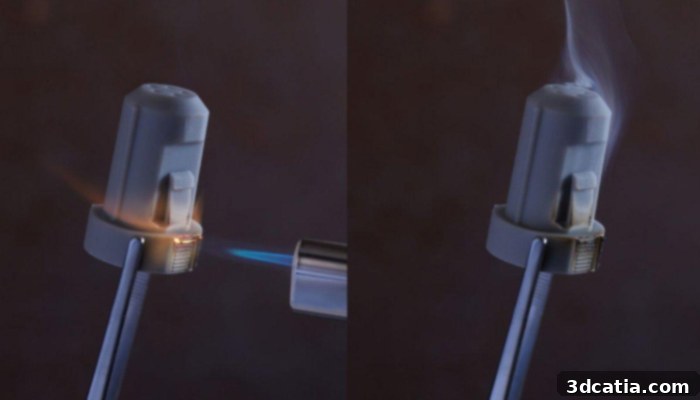
Using a flame-retardant resin to protect parts from flames (photo credits: Formlabs)
Reputable Brands and Supplier Recommendations
The 3D printing market is home to numerous manufacturers offering a wide array of high-quality 3D printing resins. Sticking with reputable brands often ensures consistent quality, reliable performance, and access to technical support and well-developed print profiles. Some of the industry leaders widely recognized for their diverse and high-quality resin portfolios include:
- Formlabs: Known for their professional-grade SLA printers and an extensive range of engineering and specialty resins, including biocompatible and high-temperature options.
- Peopoly: Popular for their powerful desktop DLP/MSLA printers and a good selection of resins, often favored by hobbyists and professionals alike for their detailed prints.
- Elegoo & Anycubic: These brands are dominant in the hobbyist and prosumer markets, offering a variety of affordable yet high-performing standard, ABS-like, and flexible resins that are widely compatible with most 405nm LCD/MSLA printers.
- Liqcreate: A European manufacturer offering a wide range of professional resins, including general-purpose, engineering, and medical-grade materials, known for their consistency and performance.
- Phrozen: Another popular brand in the desktop resin printer space, offering a broad spectrum of resins tailored for their machines and generally compatible with other 405nm systems.
- Siraya Tech: Highly regarded for their robust and versatile engineering resins like “Tenacious” (flexible/tough) and “Blu” (strong/rigid), often favored for demanding functional prints.
These brands and many others provide comprehensive product datasheets on their websites, detailing mechanical properties, print settings, and safety information. Don’t hesitate to explore their offerings, read user reviews, and check community forums to find the resin that best aligns with your specific needs and printer model. Many resin manufacturers also provide recommended print settings for various popular 3D printers, which can be an invaluable resource for both beginners and experienced users.
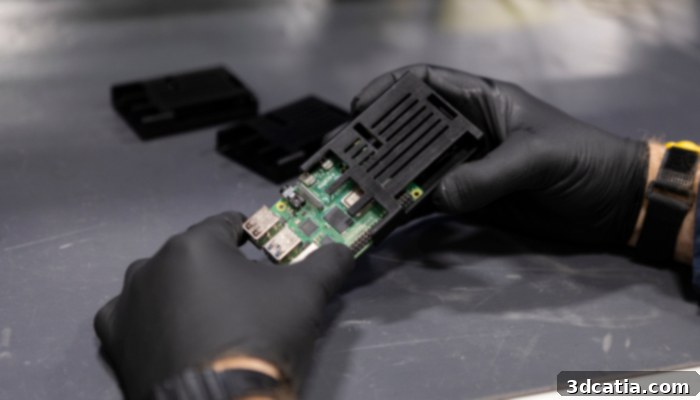
“ESD safe” materials protect electronic components from electrostatic discharges (photo credits: Nexa 3D)
Choosing the right resin for your 3D printing projects might initially seem like a complex endeavor, but by carefully considering the factors discussed above—your print’s final application, the required physical properties, your experience level, budget, and crucially, your printer’s compatibility—you can confidently select the perfect material. Always consult your printer’s specifications and the resin manufacturer’s guidelines, and don’t shy away from running test prints to dial in settings and ensure optimal compatibility. The world of resin 3D printing is rich with possibilities, and experimentation with different resins will undoubtedly lead you to discover new capabilities and achieve truly remarkable results that perfectly suit your creative and functional demands.
What is your favorite 3D printing resin, and why? Let us know in a comment below or on our LinkedIn, Facebook, and Twitter pages! Don’t forget to sign up for our free weekly newsletter here for the latest 3D printing news straight to your inbox! You can also find all our videos on our YouTube channel.