
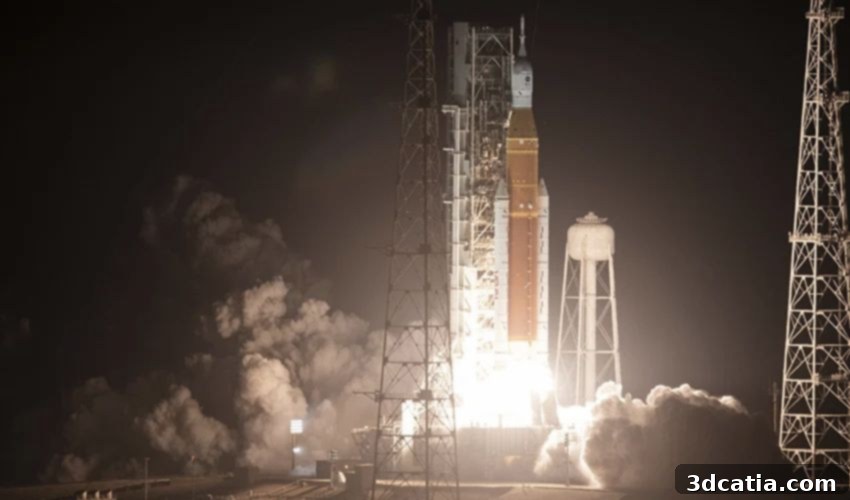
NASA’s Artemis 1 Mission: Pioneering Moon Exploration with Advanced 3D Printing and Engineering Innovations
A monumental stride for humanity unfolded on November 16, 2022, as NASA’s Artemis 1 mission successfully launched its most powerful rocket, the Space Launch System (SLS), from Kennedy Space Center in Florida. After overcoming several technical delays and challenging weather conditions, the uncrewed Orion spacecraft began its historic journey towards our natural satellite, marking the ambitious genesis of NASA’s Artemis program. This program is not merely a return to the Moon; it’s a strategic stepping stone for sustained lunar presence and eventual human missions to Mars. The primary objective of the Artemis 1 mission was to rigorously test the Orion spacecraft’s capabilities, ensuring it can safely transport astronauts through deep space, endure the harsh lunar environment, and execute a high-speed, fiery re-entry into Earth’s atmosphere.
The Artemis Program: Charting Humanity’s Next Chapter in Space
The Artemis program represents a bold new chapter in human space exploration, aiming to establish a long-term presence on the Moon, utilizing its resources, and preparing for future expeditions to Mars. Unlike the Apollo missions, which were primarily focused on demonstrating capabilities and planting flags, Artemis seeks to create a sustainable framework for lunar exploration. This includes developing the Gateway lunar orbital outpost, designing advanced lunar landers, and preparing for extended stays on the lunar surface. The insights gained from operating in the extreme environment of the Moon will be invaluable for tackling the even greater challenges of a Mars mission. Artemis 1 was the critical first step, an uncrewed shakedown cruise designed to push the boundaries of technology and validate the integrated systems of the SLS rocket and Orion spacecraft.
Artemis 1: A Crucial Test Flight for Humanity’s Return to the Moon
The Artemis 1 mission, an approximately 25-day journey, saw the Orion spacecraft orbit the Moon, venturing further into space than any human-rated spacecraft has before. This uncrewed test flight was crucial for gathering vast amounts of data on the spacecraft’s performance, radiation levels inside the cabin, and the efficacy of its thermal protection system during re-entry. The mission provided invaluable insights into the resilience of the Orion capsule, its service module, and the critical systems that would ultimately support a human crew. The successful splashdown of Orion in the Pacific Ocean confirmed its structural integrity and operational readiness, paving the way for future crewed missions and reaffirming NASA’s commitment to safety and innovation in space travel.
Powering the Journey: The RS-25 Engines and the Rise of Additive Manufacturing
At the heart of the powerful Space Launch System rocket are four RS-25 liquid-fueled engines, provided by Aerojet Rocketdyne, an American aerospace and defense manufacturer renowned for its propulsion systems. These engines, with a rich heritage tracing back to the Space Shuttle program, are not just incredibly powerful; they are engineering marvels designed to operate under the most extreme conditions. Each RS-25 engine generates an astonishing 512,000 pounds of thrust, collectively providing the immense power needed to lift the towering SLS rocket and its payload into orbit and beyond. A distinctive feature of these latest generation RS-25 engines is the significant incorporation of 3D printed parts, a testament to the transformative potential of additive manufacturing in the aerospace sector. This approach not only optimizes performance but also introduces efficiencies previously unattainable with traditional manufacturing methods.
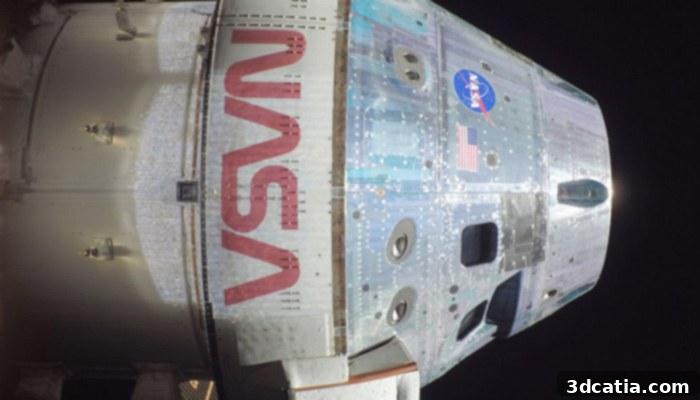
Photo of Orion, NASA’s spacecraft. (Photo credits: NASA)
3D Metal Printing: Revolutionizing Rocket Engine Production for Artemis
For the development of the SLS rocket and its propulsion systems, Aerojet Rocketdyne supplied a total of 39 crucial propulsion elements, including 38 liquid engines and one robust solid engine. Additionally, the company manufactured 14 high-pressure tanks, essential for holding propellants. A significant portion of these components, particularly within the RS-25 engines, leveraged advanced 3D metal printing techniques. Specifically, the laser powder bed fusion (LPBF) process was extensively employed. This cutting-edge additive manufacturing technology allows for the creation of complex geometries directly from powdered metal, layer by layer, using a high-powered laser. According to the manufacturer, the strategic adoption of 3D printing has resulted in a remarkable 35 percent reduction in the overall production costs of these sophisticated engines. After years of substantial delays and billions in budget overruns for various space projects, additive manufacturing is unequivocally proving its immense value in managing expenses, accelerating production timelines, and enabling designs that were once considered impossible. This technological shift is paramount for the sustainability and affordability of ambitious programs like Artemis.
Beyond Engines: Additive Manufacturing’s Broad Impact on Artemis Components
The application of additive manufacturing within the Artemis program extends beyond the core RS-25 engines. Northrop Grumman, another leading U.S. aerospace and defense contractor, played a vital role in manufacturing the massive solid rocket boosters (SRBs) designed for the Space Launch System. These boosters provide the initial, explosive thrust during the first two minutes of liftoff, accounting for a significant portion of the rocket’s power. While specific details on the 3D printing processes used for these particular boosters were not publicly disclosed, Northrop Grumman has been a pioneer in integrating additive manufacturing into various components for its aerospace and defense portfolio. The adoption of such advanced technologies across different prime contractors underscores a broader industry trend towards leveraging additive manufacturing for enhanced performance, reduced weight, and simplified supply chains for critical space hardware. This widespread integration is a clear indicator that 3D printing is no longer a niche technology but a fundamental pillar in the future of aerospace engineering and space exploration.
“This successful launch means that NASA and our partners are on the right track to explore farther than ever before in space for the benefit of humanity,” said Jim Free, NASA’s deputy associate administrator for Exploration Systems Development Mission Directorate.
Charting the Path Forward: Artemis II, Artemis III, and Sustainable Lunar Presence
With the resounding success of Artemis 1, NASA is now steadfastly paving the way for a sustained human presence on the Moon and beyond. The next critical mission, Artemis II, is projected to take place as early as 2024. This mission will mark a momentous occasion as it carries four astronauts on a lunar flyby, demonstrating the Orion spacecraft’s life support systems and validating critical crew operations in deep space. Following this, Artemis III aims to achieve the ultimate objective: landing humans on the Moon, including the first woman and first person of color, on the lunar south pole. This mission will be a historical milestone, utilizing advanced landers and potentially establishing the first elements of a long-term lunar habitat. These incremental steps are crucial, not just for reaching the Moon, but for developing the capabilities and infrastructure required for establishing a permanent human outpost on the lunar surface, a vital precursor to humanity’s eventual journey to Mars.
Building on the Moon: The Promise of In-Situ Resource Utilization (ISRU) and Lunar Regolith 3D Printing
Beyond the immediate goals of landing astronauts, the Artemis program is deeply invested in the concept of sustainability and reducing reliance on Earth-supplied resources. This vision heavily relies on In-Situ Resource Utilization (ISRU), which involves using local materials found on the Moon to support missions. A groundbreaking area of research in this regard is 3D printing with lunar regolith – the fine, dusty soil that covers the Moon’s surface. Pioneering work, such as that conducted by the University of Central Florida, has successfully demonstrated the feasibility of 3D printing bricks directly from simulated lunar regolith. This technology holds immense promise for constructing habitats, landing pads, and other vital infrastructure on the Moon using readily available local materials. Such capabilities would drastically reduce the cost and logistical complexity of building lunar bases, making long-duration missions and ultimately, lunar colonization, a much more attainable reality. Developing these autonomous construction methods is a cornerstone for enabling a truly self-sufficient human outpost in space.
The Broader Implications of Artemis: Innovation, Inspiration, and Future Frontiers
The Artemis program, propelled by cutting-edge innovations like advanced 3D printing, transcends the immediate goals of lunar exploration. It serves as a powerful catalyst for technological advancement across numerous sectors, pushing the boundaries of material science, robotics, artificial intelligence, and life support systems. The challenges inherent in deep space exploration demand solutions that often have unforeseen terrestrial applications, leading to spin-off technologies that benefit humanity in countless ways. Moreover, Artemis embodies a profound sense of global inspiration, reigniting the collective human spirit of exploration and discovery. By pushing the frontiers of what is possible, NASA and its international partners are not only setting the stage for human expansion into the solar system but also inspiring a new generation of scientists, engineers, and dreamers to pursue STEM fields and contribute to humanity’s greatest endeavors. The Moon is not merely a destination; it’s a proving ground, a classroom, and a launching pad for humanity’s ultimate journey to Mars and beyond, ensuring that the legacy of exploration continues for centuries to come.
What are your thoughts on NASA’s ambitious Artemis project and the innovative role of 3D printing in space exploration? We invite you to share your insights in a comment below or join the conversation on our LinkedIn, Facebook, and Twitter pages! Don’t miss out on the latest advancements in additive manufacturing – be sure to sign up for our free weekly Newsletter here, delivering the most recent 3D printing news directly to your inbox! You can also find all our captivating videos on our YouTube channel.
*Cover photo credits: NASA