
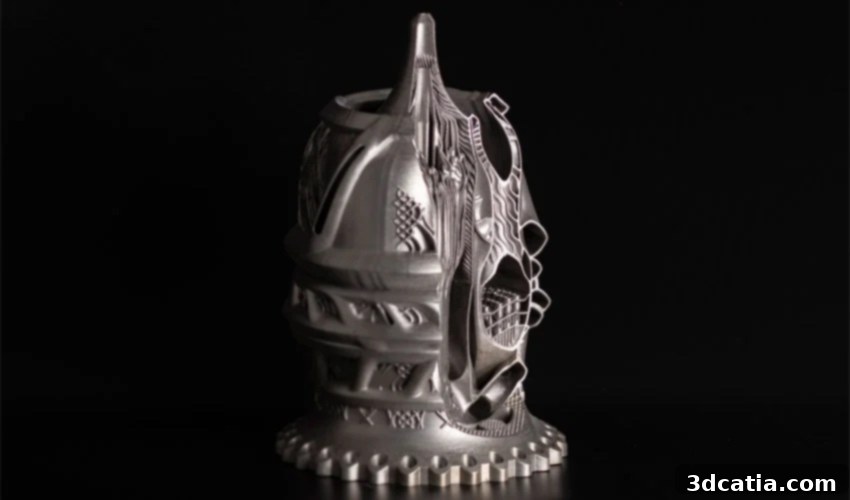
EOS and Hyperganic Forge Strategic Partnership: Revolutionizing 3D Printed Rocket Engines with Algorithmic Engineering
In a landmark collaboration set to redefine the landscape of advanced manufacturing, the esteemed German additive manufacturing pioneer, EOS, has officially announced a strategic partnership with Hyperganic, a trailblazing Munich-based company specializing in algorithmic engineering software powered by cutting-edge artificial intelligence. This groundbreaking alliance is specifically designed to seamlessly integrate Hyperganic’s innovative core platform with EOS’s robust 3D printing solutions, thereby unlocking unprecedented possibilities for the design and production of highly complex, performance-optimized parts tailor-made for advanced additive manufacturing processes.
One of the most compelling and immediate achievements stemming from this strategic partnership is the successful development and 3D printing of an aerospike rocket engine. This particular engine, renowned for its inherently intricate design and demanding performance requirements, serves as a powerful testament to the combined capabilities of both companies. Initially fabricated from a high-performance nickel alloy, the project quickly evolved, leading to the subsequent production of a larger volume aerospike engine using copper, showcasing the adaptability and material versatility enabled by this collaborative approach.
Hyperganic’s Vision: Pioneering Algorithmic Engineering with AI
Established in 2015, Hyperganic has rapidly ascended to a prominent position within the additive manufacturing design industry. The company distinguished itself by developing sophisticated software capable of generating intricate, nature-inspired geometries and automating virtually every stage of the design process to an exceptional degree. At the heart of this transformative solution lies the sophisticated interplay of advanced algorithms and artificial intelligence, which are leveraged to meticulously optimize the performance characteristics of the final 3D printed component. Hyperganic’s approach moves beyond traditional CAD methods by allowing engineers to define rules and objectives, letting the AI explore vast design spaces to find optimal solutions that might be impossible for human designers to conceive.
During a previous engagement with the company in 2019, Hyperganic articulated a clear strategic objective: to broaden its ecosystem through diversified partnerships and foster closer ties with leading 3D printer manufacturers. This vision has now been realized with resounding success through the recent pivotal agreement with EOS, marking a significant milestone in Hyperganic’s growth trajectory and solidifying its position at the forefront of digital design. Lin Kayser, the visionary CEO of Hyperganic, expressed his profound enthusiasm for the collaboration, stating, “We are very excited to partner with EOS in this industry-first collaboration. Algorithmic Engineering translates ideas into designs in minutes, with the engineer setting the rules and the computer generating the results. Specifically, the field of space propulsion, which still uses very conservative designs, will benefit greatly from Algorithmic Engineering.” This statement underscores the transformative potential of algorithmic design in sectors traditionally constrained by conventional manufacturing paradigms.
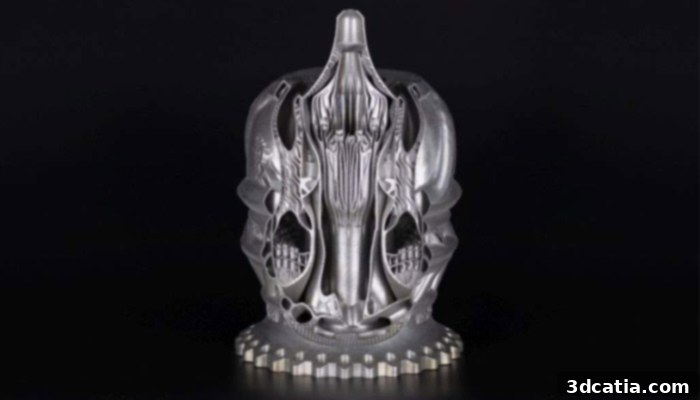
Photo Credits: EOS / Hyperganic
EOS and Hyperganic: Advancing the Frontier of Space Propulsion
With the collaborative spirit and cutting-edge technology as their driving force, the two industry leaders embarked on the ambitious project of creating a 3D printed aerospike rocket engine. Hyperganic’s expert teams leveraged their sophisticated algorithmic models to conceptualize and generate an exceptionally innovative design for the engine. This process involved the rapid generation of several hundred design iterations, allowing for extensive exploration and optimization within the digital realm. Ultimately, one of these highly optimized iterations was selected for physical realization and 3D printed on an advanced EOS M 400-4 machine.
Understanding the Aerospike Engine and Additive Manufacturing Advantages
A significant aspect of this achievement is the ability to print such a complex structure, specifically an aerospike engine, without the need for additional support structures, utilizing NickelAlloy IN718. This represents a monumental challenge in additive manufacturing, as the inherent design of an aerospike nozzle necessitates a fundamental deconstruction of conventional engine design principles, leading to an extremely complex and intricate redesign. The unique geometry of aerospike nozzles is engineered to optimize propulsion efficiency across a remarkably wide range of altitudes, offering a significant performance advantage over traditional bell-shaped nozzles that are optimized for a single, specific altitude. The geometric freedom afforded by 3D printing is crucial here, as it allows for the creation of internal channels and cooling passages that would be impossible or prohibitively expensive to produce with conventional subtractive manufacturing techniques.
Scaling Production: From Nickel Alloy to Copper
Following the successful printing of this initial part, the entire engine design underwent further refinement and was subsequently reworked to accommodate manufacturing on a significantly larger system: the AMCM M 4K machine. This state-of-the-art device, developed by AMCM – an eponymous company and integral part of the EOS Group – boasts an impressive production volume of approximately 18 inches by 18 inches by 40 inches (around 457 x 457 x 1016 mm) and integrates up to four powerful lasers, enabling high-throughput and large-scale manufacturing. Notably, industry innovators such as Launcher have already invested in this particular machine, underscoring its capability and potential in the burgeoning space sector.
The partnership’s commitment to innovation didn’t stop there. Building on the success of the initial nickel alloy print, an even larger iteration of the aerospike engine has now been successfully 3D printed, this time utilizing pure copper. Copper is a material of particular interest for rocket engine applications due to its exceptional thermal conductivity, which is critical for managing the extreme temperatures encountered during engine operation. The ability to print such large and complex components in copper further demonstrates the incredible versatility and advanced material processing capabilities achieved through the EOS-Hyperganic collaboration. This dual-material approach not only proves the robustness of the algorithmic design combined with additive manufacturing but also opens doors for optimizing engine performance based on specific material properties required for different sections of the engine, such as combustion chambers and nozzles.
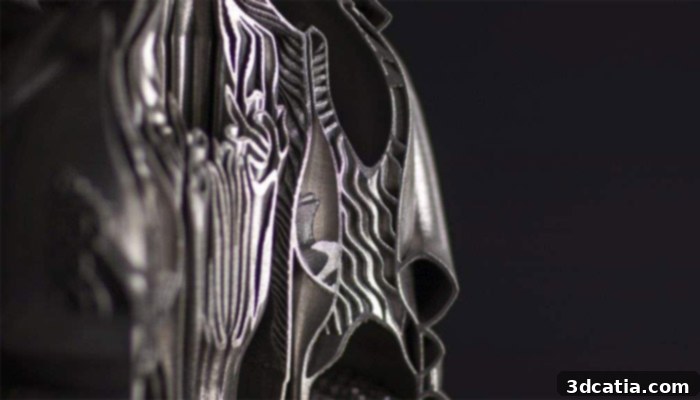
Hyperganic’s software allows the creation of complex shapes (photo credits: EOS/Hyperganic)
A Paradigm Shift: Revolutionizing Design for Additive Manufacturing
Dr. Hans J. Langer, the visionary founder of EOS, eloquently summarized the profound implications of this partnership, stating, “As a constant and pioneering innovator, we are now partnering with Hyperganic to introduce another paradigm shift in AM. It is a design shift that expands solution spaces as well as performance levels. At the same time, it will revolutionize the design process for AM, making AM a truly digital workflow from software-generated Algorithmic Engineering to digital manufacturing.” This statement encapsulates the core philosophy driving the collaboration: to move beyond incremental improvements and fundamentally transform how parts are conceived, designed, and manufactured.
The integration of Hyperganic’s algorithmic engineering with EOS’s advanced 3D printing technology promises to create a seamless, end-to-end digital workflow. This means that design engineers can specify functional requirements and constraints, allowing the AI-powered software to explore countless design iterations and generate optimal geometries that are inherently suited for additive manufacturing. This approach not only dramatically accelerates the design cycle but also enables the creation of parts with unparalleled performance, reduced weight, and integrated functionalities – capabilities that are often unattainable with traditional design and manufacturing methods. This digital thread from conception to production ensures maximum efficiency, traceability, and optimization, pushing the boundaries of what is currently possible in engineering and product development across various industries, including aerospace, automotive, medical, and consumer goods.
The collaboration between EOS and Hyperganic is more than just a partnership; it represents a convergence of hardware excellence and software intelligence that is poised to unlock the full potential of additive manufacturing. By making the design process more accessible, intuitive, and powerfully optimized through algorithmic engineering, this alliance is paving the way for a future where complex, high-performance components can be developed and produced with unprecedented speed and efficiency. The aerospike rocket engine project stands as a compelling proof-of-concept, demonstrating how this revolutionary approach can tackle some of the most challenging engineering problems and deliver innovative solutions that push humanity’s technological frontiers.
What are your thoughts on this transformative partnership between EOS and Hyperganic, and the implications for the future of 3D printing and space propulsion? We encourage you to share your insights in a comment below or join the conversation on our LinkedIn, Facebook, and Twitter pages! Don’t forget to sign up for our free weekly Newsletter here to receive the latest 3D printing news straight to your inbox! You can also find all our compelling videos on our YouTube channel for more in-depth content.
*Cover Photo Credits: EOS/Hyperganic