
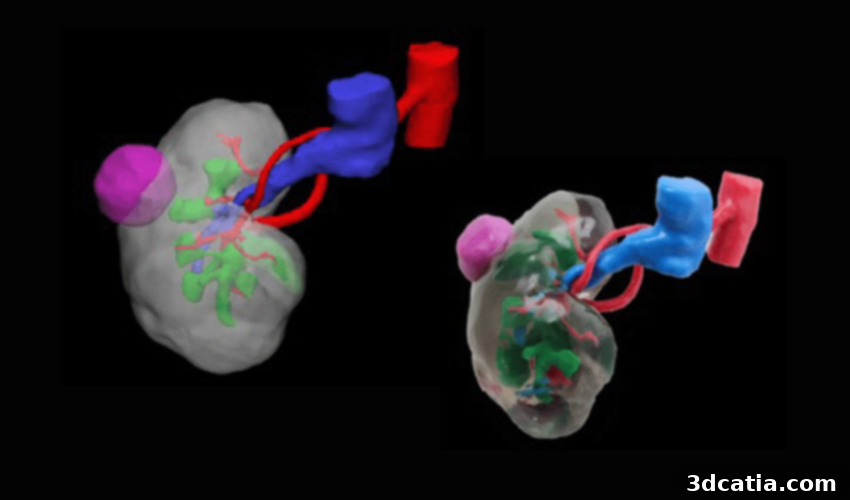
3D Bioprinting Revolutionizes Kidney Cancer Treatment with Patient-Specific Tumor Models from Tsinghua University
Researchers at Tsinghua University have unveiled a groundbreaking application for 3D bioprinting that promises to fundamentally transform the study and treatment of kidney cancer. This pioneering team has successfully developed a method to bioprint kidney tumors directly from a patient’s own cells, creating sophisticated, hyperrealistic models that meticulously replicate the intricate biological environment of tumors within the human body. This significant advancement addresses a critical need in oncology, providing an unprecedented tool for understanding cancer progression and evaluating therapeutic efficacy.
Their innovative work, recently published in the esteemed journal ‘Biofabrication,’ details a sophisticated process where bioprinting technology is leveraged to combine primary tumor cells with crucial supportive cell types. Furthermore, the bioprinting technique enables the creation of structures that closely mimic blood vessels, a vital component of a tumor’s microenvironment. These meticulously printed tumors, often referred to as organoids, precisely mirror the genetic, structural, and functional characteristics of an individual patient’s cancer. This represents a monumental leap forward, offering a far more accurate and reliable platform for both fundamental research and personalized treatment testing compared to the limitations of conventional laboratory models.
Kidney cancer, particularly renal cell carcinoma (RCC), represents a significant global health challenge, with its incidence steadily rising across populations. Treating RCC remains notoriously difficult, primarily due to the diverse and often unpredictable ways individual patients respond to standard chemotherapy regimens and targeted drugs. A major hurdle is the inherent ability of tumors to mutate and evolve over time, frequently leading to the development of drug resistance and a heightened risk of cancer recurrence. These factors underscore the urgent need for more effective and personalized treatment strategies.
Traditional laboratory models, such as two-dimensional cell cultures or even basic animal models, frequently fall short in accurately representing the complex dynamics of tumor growth and their intricate interactions within the human physiological environment. These models often fail to capture the crucial aspects of the tumor microenvironment, including cellular heterogeneity, stromal cell interactions, and vascularization, which are known to profoundly influence tumor behavior and drug response. Consequently, relying on these conventional models can make it exceedingly difficult to precisely identify and validate truly effective therapies for kidney cancer patients, often leading to trial-and-error approaches in clinical settings. The inability of these models to fully replicate the in vivo conditions has long been a bottleneck in the development of breakthrough cancer treatments.

There are around 400,000 new cases of Kidney Cancer annually worldwide. (Image Credit: American Cancer Society)
The Tsinghua University research team is directly confronting these critical shortcomings through the development of their targeted bioprinting approach. The bioprinted tumor organoids they have created are engineered to precisely maintain the complex genetic and structural traits of the original patient tumor. This fidelity allows scientists to meticulously test a multitude of potential therapies within a highly controlled and biologically relevant environment. Unlike traditional methods that rely on simplified cell lines, these organoids offer a comprehensive platform to observe how an individual patient’s cancer cells might react to various drugs, mimicking the in-body response much more closely.
This innovative method also significantly reduces the reliance on laborious and time-consuming manual techniques that often characterize traditional drug screening processes. By automating the creation of these complex 3D models, researchers can produce them at a much faster rate, thereby accelerating the evaluation of diverse treatment strategies. This capability is pivotal for advancing personalized medicine, as it empowers clinicians and researchers to swiftly identify the most promising therapeutic avenues for individual patients. The speed and accuracy offered by these bioprinted organoids could dramatically cut down the time it takes to move from diagnosis to an effective, tailored treatment plan, ultimately improving patient outcomes and quality of life. The ability to create multiple identical organoids from a single patient allows for parallel testing of various drugs and dosages, leading to highly optimized therapeutic regimens.
Dr. Yuan Pang, a distinguished co-author of this seminal study, underscored the profound implications of their findings, stating, “This new method could greatly improve how we study kidney cancer and develop personalized treatments for patients. The rapid production of organoids will make it much faster to find the right treatment for individual patients.” Her insights highlight the potential for a paradigm shift in oncology, where diagnostic and therapeutic decisions are increasingly guided by precise, patient-specific data.
Indeed, the promise of quicker results coupled with the unparalleled reliability of these 3D printed tumor models positions them as a critical tool in the ongoing fight against kidney cancer. By enabling more accurate drug screening and a deeper understanding of tumor biology, these models are poised to significantly improve survival rates for patients suffering from this challenging disease. Furthermore, they are expected to accelerate the discovery and development of entirely new generations of therapies, offering hope for patients who currently have limited treatment options.
This pioneering research serves as a powerful testament to how additive manufacturing technologies, particularly advanced bioprinting, are steadily moving beyond their conventional industrial applications and making a direct, transformative impact on the healthcare sector. The ability to create functional biological tissues and structures is ushering in an era of precision medicine. As bioprinting technologies continue their rapid advancement, the creation of patient-specific organoids from a patient’s own cells is not merely a research curiosity; it is increasingly likely to become a standard, indispensable step in the comprehensive diagnosis, prognosis, and treatment planning for kidney cancer and potentially many other complex diseases. This integration into clinical practice could usher in an era where therapeutic decisions are consistently optimized for each individual, moving away from a one-size-fits-all approach.
Looking ahead, the potential applications of Tsinghua’s bioprinting technology extend far beyond kidney cancer. The methodologies developed could pave the way for creating patient-specific tumor models for a wide array of other cancers, offering a universal platform for advancing precision oncology. This approach holds the promise of dramatically reducing the time and cost associated with drug development, as it allows for early identification of effective compounds and the elimination of ineffective ones, long before expensive and lengthy human clinical trials. Moreover, these models could also be invaluable for studying metastatic processes, understanding drug resistance mechanisms at a cellular level, and even exploring novel therapeutic approaches like immunotherapy in a highly controlled, patient-relevant environment.
While the current achievements are remarkable, ongoing research will focus on further enhancing the complexity and functionality of these bioprinted organoids, such as refining vascular networks and incorporating immune cells to better mimic the full tumor microenvironment. This continuous innovation aims to make these models even more predictive of clinical outcomes. The integration of artificial intelligence and machine learning with bioprinting could further accelerate drug screening and optimize treatment protocols, solidifying bioprinting’s role as a cornerstone of future personalized healthcare. By offering an unparalleled window into the individualized nature of cancer, bioprinting is not just a technology; it is a vital tool for unlocking the next generation of precision oncology.
What are your thoughts on these recent developments in medical and dental 3D printing? Let us know in a comment below or on our LinkedIn or Facebook pages! Plus, don’t forget to sign up for our free weekly Newsletter to get the latest 3D printing news straight to your inbox. You can also find all our videos on our YouTube channel.
*Cover Photo Credit: Tsinghua University